
Last letters from the living dead man
David Patterson (Spirit) Hatch
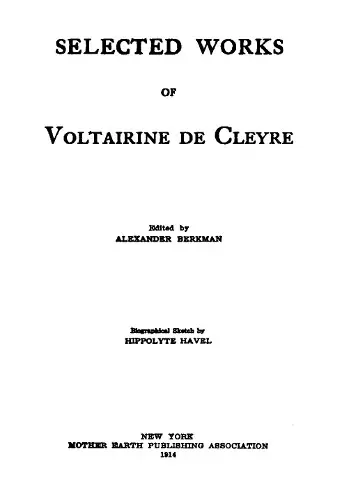
THE CLASSIC COLLECTION · 1914
"Selected Works of Voltairine de Cleyre" by Voltairine De Cleyre is a collection of poetic and prose writings, likely composed during the late 19th century. The works encompass a range of themes including personal reflection, social justice, feminism, and anarchist principles, reflecting the author's deep commitment to individual liberty and critique of societal norms. As one of the notable figures within the anarchist movement, de Cleyre's writings serve as a poignant exploration of human freedom and the struggles faced by marginalized groups. The opening portion introduces Voltairine de Cleyre as a revolutionary thinker and passionate advocate for freedom, setting the tone for the collection. It features a biographical sketch that narrates de Cleyre's tumultuous early life, her awakening to free thought, and her eventual embrace of anarchism. The text reflects her literary journey and personal evolution, capturing her experiences with societal repression and her fight for the rights of the oppressed. Through a combination of autobiographical elements and reflections on broader social issues, de Cleyre’s voice emerges as both personal and political, inviting readers to rethink freedom and justice in their own lives.
Introduction adapted from the source catalogue; source summaries may be automatically generated.
Free to read · English · 136,747 words · No account needed
MAKE TIME FOR A GOOD BOOK
On by default. Untick to stop anonymous reading totals. Each page counts after 10 seconds in view. How this works.
Anonymous counting is on unless you have switched it off.
The light is pleasant, is it not, my friends? It is good to look into each other's faces, to see the hands that clasp our own, to read the eyes that search our thoughts, to know what manner of lips give utterance to our pleasant greetings. It is good to be able to wink defiance at the Night, the cold, unseeing Night. How weird, how gruesome, how chilly it would be if I stood here in blackness, a shadow addressing shadows, in a house of blindness! Yet each would know that he was not alone; yet might we stretch hands and touch each other, and feel the warmth of human presence near. Yet might a sympathetic voice ring thro' the darkness, quickening the dragging moments.--The lonely prisoners in the cells of Blackwell's Island have neither light nor sound! The short day hurries across the sky, the short day still more shortened in the gloomy walls. The long chill night creeps up so early, weaving its sombre curtain before the imprisoned eyes. And thro' the curtain comes no sympathizing voice, beyond the curtain lies the prison silence, beyond that the cheerless, uncommunicating land, and still beyond the icy, fretting river, black and menacing, ready to drown. A wall of night, a wall of stone, a wall of water! Thus has the great State of New York answered =Emma Goldman=; thus have the classes replied to the masses; thus do the rich respond to the poor; thus does the Institution of Property give its ultimatum to Hunger!
"Give us work," said =Emma Goldman=; "if you will not give us work, then give us bread; if you do not give us either work or bread, then we shall take bread." It wasn't a very wise remark to make to the State of New York, that is--Wealth and its watch-dogs, the Police. But I fear me much that the apostles of liberty, the fore-runners of revolt, have never been very wise. There is a record of a seditious person, who once upon a time went about with a few despised followers in Palestine, taking corn out of other people's corn-fields, (on the Sabbath day, too). That same person, when he wished to ride into Jerusalem told his disciples to go forward to where they would find a young colt tied, to unloose it and bring it to him, and if any one interfered or said anything to them, were to say: "My master hath need of it." That same person said: "Give to him that asketh of thee, and from him that taketh away thy goods ask them not back again." That same person once stood before the hungry multitudes of Galilee and taught them, saying: "The Scribes and the Pharisees sit in Moses' seat; therefore whatever they bid you observe, that observe and do. But do not ye after their works, for they say, and do not. For they bind heavy burdens, and grievous to be borne, and lay them on men's shoulders; but they themselves will not move them with one of their fingers. But all their works they do to be seen of men; they make broad their phylacteries, and enlarge the borders of their garments: and love the uppermost rooms at feasts, and the chief seats in the synagogues, and greeting in the markets, and to be called of men, 'Rabbi, Rabbi.'" And turning to the Scribes and the Pharisees, he continued: "Woe unto you, Scribes and Pharisees, hypocrites! for ye devour widows' houses, and for a pretense make long prayers: therefore shall ye receive the greater damnation. Woe unto you Scribes and Pharisees, hypocrites! for ye pay tithe of mint, and anise, and cummin, and have omitted the weightier matters of the law, judgement, and mercy, and faith: these ought ye to have done and not left the other undone. Ye blind guides, that strain at a gnat and swallow a camel! Woe unto you, Scribes and Pharisees, hypocrites! for ye make clean the outside of the cup and platter, but within they are full of extortion and excess. Woe unto you, Scribes and Pharisees, hypocrites! For ye are like unto whited sepulchres, which indeed appear beautiful outward, but within are full of dead men's bones and all uncleanness. Even so ye outwardly appear righteous unto men, but within ye are full of hypocrisy and iniquity. Woe unto you, Scribes and Pharisees, hypocrites! Because ye build the tombs of the prophets and garnish the sepulchres of the righteous; and say 'If we had been in the days of our fathers we would not have been partakers with them in the blood of the prophets'. Wherefore ye be witnesses unto yourselves that ye are the children of them which killed the prophets. Fill ye up then the measure of your fathers! Ye serpents! Ye generation of vipers! How can ye escape the damnation of hell!"
Your reading position is saved on this browser. Take it to another device with a library code. Reading pages adapt to text, rather than matching a printed edition.
BEHIND THE BOOK
This eBook is for the use of anyone anywhere in the United States and most other parts of the world at no cost and with almost no restrictions whatsoever. You may copy it, give it away or re-use it under the terms of the Project Gutenberg License included with this eBook or online at www.gutenberg.org. If you are not located in the United States, you will have to check the laws of the country where you are located before using this eBook. Read the source licence.
The original source file, including credits and licence, is retained by this library. Request an original-format copy at no charge. Please include the book title and Project Gutenberg identifier #43098.
KEEP YOUR CURIOSITY GOING
David Patterson (Spirit) Hatch

David Patterson (Spirit) Hatch

David Patterson (Spirit) Hatch
Coulson Kernahan

Ralph Waldo Emerson

Maurice Baring