THE CLASSIC COLLECTION✦Victorian Ode for Jubilee Day, 1897CLASSIC FREE BOOKS
Victorian Ode for Jubilee Day, 1897
Francis Thompson
THE CLASSIC COLLECTION · 1908
"Selected Poems of Francis Thompson" by Francis Thompson is a collection of poetry written in the late 19th century. The book features a range of themes including childhood, love, and spirituality, expressing the poet's rich emotional depth and intricate use of language. Thompson's work reflects his struggles and aspirations, often captivating readers with his vivid imagery and profound insights. The opening of the collection introduces readers to several of Thompson's poems centered around childhood and intimate emotions. Among these are poems dedicated to children, exploring themes such as innocence and fleeting beauty, as seen in "Daisy". Additionally, the beginning includes pieces like "The Making of Viola," which convey both spiritual and earthly wonders, showcasing his inclination to blend the mystical with everyday life. These early works set the stage for the poet's exploration of love and loss, inviting readers into Thompson's world through touching and evocative language.
Introduction adapted from the source catalogue; source summaries may be automatically generated.
Free to read · English · 29,755 words · No account needed
MAKE TIME FOR A GOOD BOOK
On by default. Untick to stop anonymous reading totals. Each page counts after 10 seconds in view. How this works.
Anonymous counting is on unless you have switched it off.
"I, the presence-hall where Angels
Do enwheel their placèd King--
Even my thoughts which, without change else,
Cyclic burn and cyclic sing.
To the hollow of Heaven transplanted,
I a breathing Eden spring,
Where with venom all outpanted
Lies the slimed Curse shrivelling.
For the brazen Serpent clear on
That old fangèd knowledge shone;
I to Wisdom rise, Ischyron,
Agion Athanaton!
"Then commanded and spake to me
He who framed all things that be;
And my Maker entered through me,
In my tent His rest took He.
Lo! He standeth, Spouse and Brother,
I to Him, and He to me,
Who upraised me where my mother
Fell, beneath the apple-tree.
Risen 'twixt Anteros and Eros,
Blood and Water, Moon and Sun,
He upbears me, He Ischyros,
I bear Him, the Athanaton!"
Where is laid the Lord arisen?
In the light we walk in gloom.
Though the sun has burst his prison,
We know not his biding-room.
Tell us where the Lord sojourneth,
For we find an empty tomb.
"Whence He sprung, there He returneth,
Mystic Sun,--the Virgin's Womb."
Hidden Sun, His beams so near us,
Cloud enpillared as He was
From of old, there He, Ischyros,
Waits our search, Athanatos!
Camp of Angels! Well we even
Of this thing may doubtful be,--
If thou art assumed to Heaven,
Or is Heaven assumed to thee!
Consummatum. Christ the promised,
Thy maiden realm is won, O Strong!
Since to such sweet Kingdom comest,
Remember me, poor Thief of Song!
Cadent fails the stars along:--
"Mortals, that behold a woman
Rising 'twixt the Moon and Sun;
Who am I the heavens assume? an
All am I, and I am one."
From "AN ANTHEM OF EARTH"
In nescientness, in nescientness,
Mother, we put these fleshly lendings on
Thou yield'st to thy poor children; took thy gift
Of life, which must, in all the after days
Be craved again with tears,--
With fresh and still petitionary tears.
Being once bound thine almsmen for that gift,
We are bound to beggary; nor our own can call
The journal dole of customary life,
But after suit obsequious for 't to thee.
Indeed this flesh, O Mother,
A beggar's gown, a client's badging,
We find, which from thy hands we simply took,
Naught dreaming of the after penury,
In nescientness.
In a little thought, in a little thought,
We stand and eye thee in a grave dismay,
With sad and doubtful questioning, when first
Thou speak'st to us as men: like sons who hear
Newly their mother's history, unthought
Before, and say--"She is not as we dreamed:
Ah me! we are beguiled!" What art thou, then,
That art not our conceiving? Art thou not
Too old for thy young children? Or perchance,
Keep'st thou a youth perpetual-burnishable
Beyond thy sons decrepit? It is long
Since Time was first a fledgling;
Yet thou may'st be but as a pendant bulla
Against his stripling bosom swung. Alack!
For that we seem indeed
To have slipped the world's great leaping-time, and come
Upon thy pinched and dozing days: these weeds,
These corporal leavings, thou not cast'st us new,
Fresh from thy craftship, like the lilies' coats,
But foist'st us off
With hasty tarnished piecings negligent,
Snippets and waste
From old ancestral wearings,
That have seen sorrier usage; remainder-flesh
After our father's surfeits; nay with chinks,
Some of us, that if speech may have free leave
Our souls go out at elbows. We are sad
With more than our sires' heaviness, and with
More than their weakness weak; we shall not be
Mighty with all their mightiness, nor shall not
Rejoice with all their joy. Ay, Mother! Mother!
What is this Man, thy darling kissed and cuffed,
Thou lustingly engender'st,
To sweat, and make his brag, and rot,
Crowned with all honour and all shamefulness?
From nightly towers
He dogs the secret footsteps of the heavens,
Sifts in his hands the stars, weighs them as gold-dust,
And yet is he successive unto nothing
But patrimony of a little mould,
And entail of four planks. Thou hast made his mouth
Avid of all dominion and all mightiness,
All sorrow, all delight, all topless grandeurs,
All beauty, and all starry majesties,
And dim transtellar things;--even that it may,
Filled in the ending with a puff of dust,
Confess--"It is enough." The world left empty
What that poor mouthful crams. His heart is builded
For pride, for potency, infinity,
All heights, all deeps, and all immensities,
Arrased with purple like the house of kings,
To stall the grey-rat, and the carrion-worm
Statelily lodge. Mother of mysteries!
Sayer of dark sayings in a thousand tongues,
Who bringest forth no saying yet so dark
As we ourselves, thy darkest! We the young,
In a little thought, in a little thought,
At last confront thee, and ourselves in thee,
And wake disgarmented of glory: as one
On a mount standing, and against him stands,
On the mount adverse, crowned with westering rays,
The golden sun, and they two brotherly
Gaze each on each;
He faring down
To the dull vale, his Godhead peels from him
Till he can scarcely spurn the pebble--
For nothingness of new-found mortality--
That mutinies against his gallèd foot.
Littly he sets him to the daily way,
With all around the valleys growing grave,
And known things changed and strange; but he holds on,
Though all the land of light be widowèd,
In a little thought.
Your reading position is saved on this browser. Take it to another device with a library code. Reading pages adapt to text, rather than matching a printed edition.
Francis Thompson
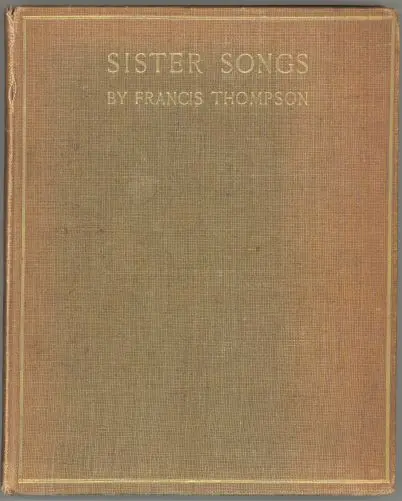
Francis Thompson
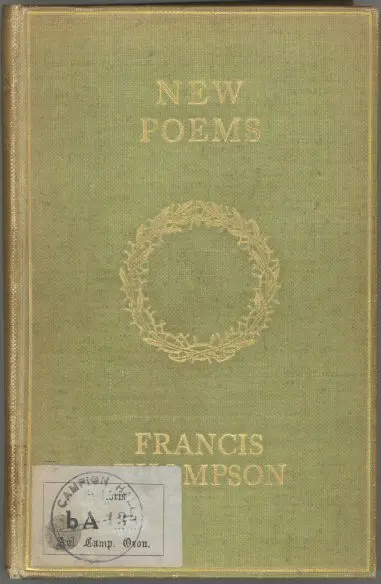
Francis Thompson
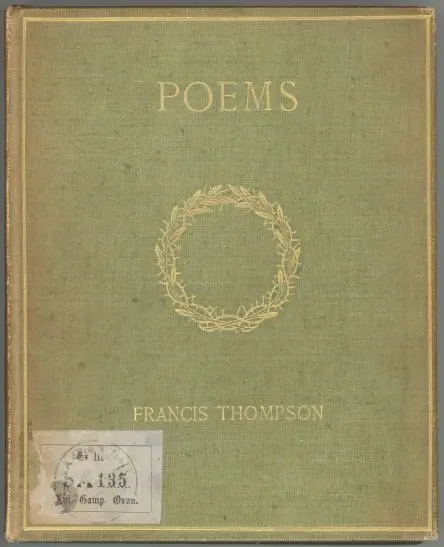
Francis Thompson
BEHIND THE BOOK
This eBook is for the use of anyone anywhere in the United States and most other parts of the world at no cost and with almost no restrictions whatsoever. You may copy it, give it away or re-use it under the terms of the Project Gutenberg License included with this eBook or online at www.gutenberg.org. If you are not located in the United States, you will have to check the laws of the country where you are located before using this eBook. Read the source licence.
The original source file, including credits and licence, is retained by this library. Request an original-format copy at no charge. Please include the book title and Project Gutenberg identifier #41215.
KEEP YOUR CURIOSITY GOING

Eric Mackay
Edmund Gosse
Sophia Margaretta Hensley
Gilbert Parker
George MacDonald

Elizabeth Bibesco