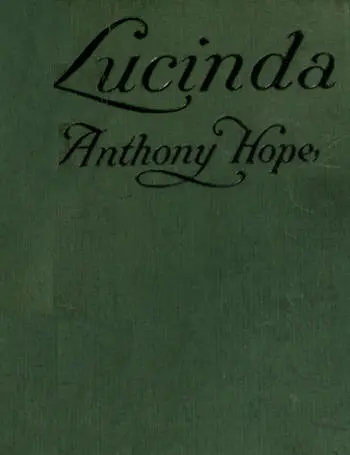
Lucinda
Anthony Hope
THE CLASSIC COLLECTION · 1910
"Second String" by Anthony Hope is a novel written in the early 20th century. The story begins in a quaint English town, Meriton, and focuses on the character Jack Rock, a butcher who is reintroducing himself into the local social scene while reflecting on his friendship with Andy Hayes, who returns from years abroad. The book seems to explore themes of homecoming, class dynamics, and the intrigue of personal relationships amid the backdrop of rural life. At the start of the narrative, the protagonist Andy Hayes arrives in Meriton after a long absence and reconnects with locals, including Jack Rock, whose sister he is related to by marriage. Andy reminisces about his family and friends, feeling both nostalgia and a sense of disconnection from his past. As he navigates the changes in the town and the social relationships within it, the complexities of class structure and his own ambitions come to the forefront. The initial interactions set up a world where characters grapple with their identities and aspirations, suggesting a mix of drama, romance, and social commentary as the plot unfolds.
Introduction adapted from the source catalogue; source summaries may be automatically generated.
Free to read · English · 120,293 words · No account needed
MAKE TIME FOR A GOOD BOOK
On by default. Untick to stop anonymous reading totals. Each page counts after 10 seconds in view. How this works.
Anonymous counting is on unless you have switched it off.
Their talk went only for an embellishment of their general state--so comfortable, so serene, so exceptionally fortunate. Were not they pearls? Andy had seen something of the swine, had perhaps even been one of them. A vague protest stirred in him; were they not too serene, too comfortable, too fortunate? Yet he loved it all; it was beautiful. How many uglies go to make one beautiful? It is a bit of social arithmetic. When you have got the result, the deduction may well seem difficult.
"It doesn't much matter whether they're real or not, if a really pretty woman hangs them round her neck," Harry laughed. "The neck carries the pearls!"
"But we'd all rather they were real," said Isobel Vintry suddenly, the first of the women to intervene. "Other women guess, you see."
"Does it hurt so much if they do?" Belfield asked.
"The only thing that really does hurt," Isobel assured him, smiling.
"Oh, my dear, how disproportionate!" sighed Mrs. Belfield.
"I'd never have anything false about me--pearls, or lace, or hair, or--or anything about me," exclaimed Vivien. "I should hate it!" Feeling carried her into sudden unexpected speech.
Very gradually, very tentatively, Andy was finding himself able to speak in this sort of company, to speak as an equal to equals, not socially only, but in an intellectual regard.
"Riches seem to me all wrong, but what they produce, leaving out the wasters, all right." He let it out, apprehensive of a censuring silence. Belfield relieved him in a minute.
"I'm with you. I always admire most the things to which I'm on principle opposed--a melancholy state of one's mental interior! Kings, lords, and bishops--crowns, coronets, and aprons--all very attractive and picturesque!"
"We all know that the governor's a crypto-Radical," said Harry.
"I thought Carlyle, among others, had taught that we were all Radicals when in our pyjamas--or less," said Belfield. "But that's not the point. The excellence of things that are wrong, the narrowness of the moral view!"
"My dear! Oh, well, my dear!" murmured Mrs. Belfield.
"I've got a touch of asthma--I must say what I like." Belfield humorously traded on his infirmity. "A dishonest fellow who won't pay his tradesmen, a flirtatious minx who will make mischief, a spoilt urchin who insists on doing what he shouldn't--all rather attractive, aren't they? If everybody behaved properly we should have no 'situations.' What would become of literature and the drama?"
"And if nobody had any spare cash, what would become of them, either?"
asked Harry.
"Well, we could do with a good deal less of them. I'll go so far as to admit that," said Wellgood.
Your reading position is saved on this browser. Take it to another device with a library code. Reading pages adapt to text, rather than matching a printed edition.
Anthony Hope
Anthony Hope
Anthony Hope
Anthony Hope
BEHIND THE BOOK
This eBook is for the use of anyone anywhere in the United States and most other parts of the world at no cost and with almost no restrictions whatsoever. You may copy it, give it away or re-use it under the terms of the Project Gutenberg License included with this eBook or online at www.gutenberg.org. If you are not located in the United States, you will have to check the laws of the country where you are located before using this eBook. Read the source licence.
The original source file, including credits and licence, is retained by this library. Request an original-format copy at no charge. Please include the book title and Project Gutenberg identifier #38796.
KEEP YOUR CURIOSITY GOING
Coulson Kernahan

Maurice Baring
Frances Wright
Cécile Tormay

Frederic Jesup Stimson

W. H. P. (William Henry Pope) Jarvis