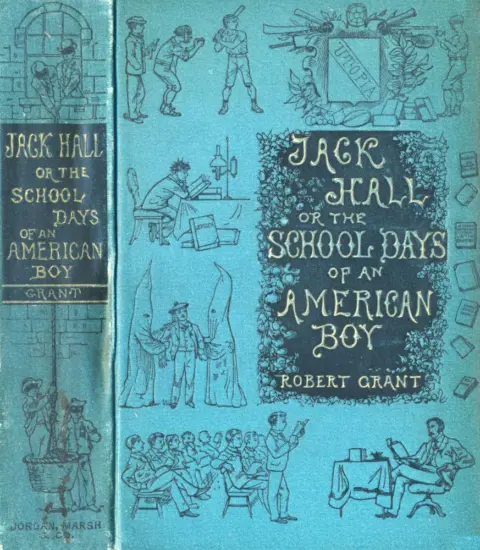
Jack Hall
Robert Grant
THE CLASSIC COLLECTION · 1899
"Search-Light Letters" by Robert Grant is a philosophical work written in the late 19th century. This book takes the form of letters that address various audiences, including young men and women seeking ideals, modern women with social ambitions, and political optimists. Through a series of essays, Grant delves into topics of morality, societal values, and the pursuit of personal and social excellence, urging readers to reflect on the nature of character and ethics amidst the dynamics of modern life. The opening of "Search-Light Letters" sets the tone for a reflective exploration of ethics and ideals. The author begins by assuming certain qualities in his readers, such as honesty, purity, and courage, as foundational for those seeking an uncommon life. The narrative presents thoughts on the nature of character in society, comparing those with refined manners and morals to those who lack depth and authenticity. Through the lens of a cheerful conversation between two characters, the Philosopher and a Refined Instructress, Grant examines everyday ethical dilemmas and societal expectations, using their interaction to illustrate broader moral questions. This opening effectively lays the groundwork for the exploration of the ideals the author wishes to engage with throughout the letters.
Introduction adapted from the source catalogue; source summaries may be automatically generated.
Free to read · English · 45,552 words · No account needed
MAKE TIME FOR A GOOD BOOK
On by default. Untick to stop anonymous reading totals. Each page counts after 10 seconds in view. How this works.
Anonymous counting is on unless you have switched it off.
No. 3. The Worshipper of False Gods.--It is a commonplace of foreign criticism that the free-born American is insatiate for money, and that everything else pales into insignificance before the diameter of the mighty dollar. That is the favorite taunt of those who do not admire our institutions and behavior, and the favorite note of warning of those who would fain think well of us. No one can deny that the influence and power of money in this country during the last thirty years have been enormous. One reason for this is obvious. The magnificent resources of a huge territory have been developed during that period. Men have grown rich in a night, and huge fortunes have been accumulated with a rapidity adapted not merely to dazzle and stir to envy other nations, but to turn the heads of our own people. We have become one of the wealthiest civilizations, and our multi-millionaires are among the money magnates of the world. Yet popular sentiment in public utterance affects to despise money, and inclines to abuse those who possess it. I write "affects," for here again the point of hypocrisy recurs to mind, and even you very likely would be prompt to remind me that, according to our vernacular, to make one's pile and make it quickly is a widespread touch-stone of ambition. True enough it is that there has been, and is, room for reproach in the aggressiveness of this tendency, and yet the seeming hypocrisy is once more unconscious in that the popular point of view intends to be sincere, but the situation has been too dazzling for sober brains and high resolves. For let it be said that keenness of vision and a capacity for escaping from the trammels of conventional and inveterate delusions are essentially American traits, and as a consequence no one more clearly than the American citizen appreciates the importance of material resources as a factor of happy living, and none so definitely as he refuses to be discouraged by the priestly creed that only a few can be comfortable and happy in this life and that the poor and miserable will be recompensed hereafter for their earthly travails. His doctrine is that he desires, if possible, to be one of that comfortable and happy few, and in the exuberance of his consciousness that human life is absorbing, he fortifies the capacity to make the most of it by the quaint, convincing statement that we shall be a long time dead. His quick-witted, intelligent repugnance to the old theory that the mass should be cajoled into dispensing with earthly comforts has helped to give a humorous, material twist to his words; and yet, I venture to assert, has left his finer instincts unperverted, except in the case of the individual. This combination of an extraordinary opportunity and a shrewd intelligence has, however, it must be admitted, produced a considerable and sorry crop of individuals guided by the principle that wealth is the highest good, and should be sought at the expense of every scruple. Their many successes in the accomplishment of this single purpose have served to create the impression that the whole nation is thus diseased, and have done the greater harm of dwarfing many an aspiring nature, spell-bound by the cloud-capped towers and gorgeous palaces which sheer money-making has established. As a result the best Americanism is menaced both by the example of accumulation without conscience, and the dangerous public atmosphere which this generates, in that the common eye is caught by the brilliance of the spectacle, and the common mind lured to meditate imitation at every sacrifice. So they say of us that the American hero is the man of material successes, "the smart man" who "gets there" by hook or crook, and that we are content to ask no embarrassing questions as to ways and means, provided the pecuniary evidences of attainment are indisputable. The patriotic American resents this as a libel, and maintains that this type of hero-worship is but a surface indication of the public soul, just as the horrors of the divorce court are but a surface indication of the general conditions of married life. Yet the patriot must admit that there is danger to the noble aspirations which we claim to cherish as Americans from the bright, keen, easy-going, metallic, practical, hard-headed, humorous citizen, male and female, whose aim is simply to push ahead, at any cost, and who in the process does not hesitate to part with his spiritual properties as being cumbersome, unremunerative and somewhat ridiculous. The materialist is no new figure in human civilization. "Eat, drink, and be merry, for to-morrow we die," is but the ancient synonyme for "we shall be a long time dead." A deep, abiding faith in the serious purposes of humanity has ever been obvious to us Americans as a national possession, however foreigners may deny it to us, but the American nature is at the same time, as I have suggested, essentially practical, level-headed, and inquiring, and is ever ready with a shrewd jest to dispute the sway of traditions founded on cant or outworn ideas. It behooves you then, if you would be a true American, to beware overstepping the limit which separates aspiring, intelligent, winsome common-sense from the philosophy of mere materialism. There lies one of the great perils of democracy; and unless the development of democracy be toward higher spiritual experiences, Americanism must prove a failure. Keen enjoyment of living is a noble thing, so too is the ambition to overcome material circumstances, and to command the fruits of the earth. A realization of the possibility of this, and an emancipation from dogmas which foreordained him to despair, has evolved the alert, independent, progressive American citizen, and side by side with him the individual whom the less enlightened portion of the community have enshrined in their hearts under the caption of a smart man. This popular hero, with his taking guise of easy-going good nature, assuring his admirers by way of flippant disposition of the claims of conscience and aspiration that "it will be all the same a hundred years hence" is the kind of American whom every patriot should seek to discredit and avoid imitating.
Your reading position is saved on this browser. Take it to another device with a library code. Reading pages adapt to text, rather than matching a printed edition.
Robert Grant
Robert Grant
Robert Grant
Robert Grant
BEHIND THE BOOK
This eBook is for the use of anyone anywhere in the United States and most other parts of the world at no cost and with almost no restrictions whatsoever. You may copy it, give it away or re-use it under the terms of the Project Gutenberg License included with this eBook or online at www.gutenberg.org. If you are not located in the United States, you will have to check the laws of the country where you are located before using this eBook. Read the source licence.
The original source file, including credits and licence, is retained by this library. Request an original-format copy at no charge. Please include the book title and Project Gutenberg identifier #37613.
KEEP YOUR CURIOSITY GOING

David Patterson (Spirit) Hatch

David Patterson (Spirit) Hatch

David Patterson (Spirit) Hatch
Coulson Kernahan

Ralph Waldo Emerson

Maurice Baring