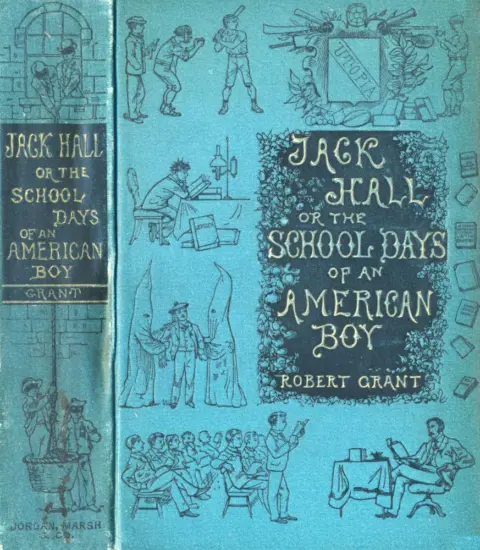
Jack Hall
Robert Grant
THE CLASSIC COLLECTION · 1899
"Search-Light Letters" by Robert Grant is a philosophical work written in the late 19th century. This book takes the form of letters that address various audiences, including young men and women seeking ideals, modern women with social ambitions, and political optimists. Through a series of essays, Grant delves into topics of morality, societal values, and the pursuit of personal and social excellence, urging readers to reflect on the nature of character and ethics amidst the dynamics of modern life. The opening of "Search-Light Letters" sets the tone for a reflective exploration of ethics and ideals. The author begins by assuming certain qualities in his readers, such as honesty, purity, and courage, as foundational for those seeking an uncommon life. The narrative presents thoughts on the nature of character in society, comparing those with refined manners and morals to those who lack depth and authenticity. Through the lens of a cheerful conversation between two characters, the Philosopher and a Refined Instructress, Grant examines everyday ethical dilemmas and societal expectations, using their interaction to illustrate broader moral questions. This opening effectively lays the groundwork for the exploration of the ideals the author wishes to engage with throughout the letters.
Introduction adapted from the source catalogue; source summaries may be automatically generated.
Free to read · English · 45,552 words · No account needed
MAKE TIME FOR A GOOD BOOK
On by default. Untick to stop anonymous reading totals. Each page counts after 10 seconds in view. How this works.
Anonymous counting is on unless you have switched it off.
To A Young Man wishing to be an American. I.
I wrote this once as a definition of Americanism: "It seems to me to be, first of all, a consciousness of unfettered individuality coupled with a determination to make the most of self." In short, a compound of independence and energy. To you, in the earnest temper of mind which your letter of inquiry suggests, this definition may seem a generality of not much practical value; declarative of essential truth, yet only vaguely helpful to the individual. Yet I offer it as a starting-point of doctrine, for to my thinking the people of the United States who have impressed themselves most notably on the world have possessed these two traits, independence and energy, in marked degree. And to you, whatever your condition in life, if you consider, it must be apparent that manly self-respect and enterprising force are essential to character and good citizenship, and that the prominence accorded to these qualities by those who have analyzed the component parts of our nationality is a distinction which should be perpetuated and reinforced by succeeding generations.
Nevertheless, the counsel seems to approximate a glittering generality for the reason that the opportunities for acting upon it no longer sprout on every bush as in the forties, fifties, sixties, and seventies of the present century when we were a budding nation and much of our territory was still virgin soil. I write "seems to approximate" advisedly, for the opportunities are just as plenty, merely less obvious. Yet here again I must make this qualification--one which recalls doubtless the favorite aphorism employed to meet the plea that the legal profession is overcrowded--that there is always an abundance of room on the top benches. Indisputably the day has passed when the ambitious and enterprising American youth could have fruit from the tree of material fortune almost by stretching out his hand. Now he has to climb far, and the process is likely to be slow and discouraging. The conditions peculiar to a sparse population in a new country rich in resources have almost ceased to exist, and, though a young nation still, we are face to face with the problems which concern a seething civilization where almost every calling seems full. Now and again some lucky seeker for fortune still finds it in a brief twelve-month, but for the mass of American young men the opportunities for speedy, dazzling prosperity have ceased to exist. Those who win the prizes of life among us nowadays owe their success, in all but sporadic cases, to unusual talents, tireless zeal and unremitting labor, almost as in England, and France, and Germany. So also, with the passing of the period when enterprise and ambition were whetted by the promise of sudden and vast rewards, have disappeared many of the traits, both external and psychological, which were characteristic of our early nationality. The buffalo is nearly extinct, and with him is vanishing much of the bluff, graceless assertiveness of demeanor which was once deemed essential by most citizens to the display of native independence. Our point of view has changed, broadened, evolved in so many ways that it were futile to do more than indicate by a general description what is so obvious. Partly by the engrafting and adoption of foreign ideas and customs, partly by the growth among us of new conditions beyond the simple ken of our forefathers, our national life has become both complex and cosmopolitan. If we, who were once prone to believe our knowledge, our manners, and our customs to be all-sufficient, have been borrowing from others, so we in our turn have been imitated by the older nations of Europe, and the result is an approximation in sympathies and a blurring of distinctions. Political differences and race superficialities of expression seem a larger barrier than they really are, for in its broader faiths and vision the civilized world is becoming homogeneous. The ocean cable and the facilities for travel have palsied insular prejudice and lifted the embargo on the free interchange of ideas. The educated American sees no resemblance to himself in the caricatures of twenty-five years ago, and rejoices in the consciousness that the best men the world over are essentially alike. This, perhaps, is only another way of reasserting that human nature is always human nature, but this old apothegm has a clearer significance to-day than ever before.
Your reading position is saved on this browser. Take it to another device with a library code. Reading pages adapt to text, rather than matching a printed edition.
Robert Grant

Robert Grant
Robert Grant
Robert Grant
BEHIND THE BOOK
This eBook is for the use of anyone anywhere in the United States and most other parts of the world at no cost and with almost no restrictions whatsoever. You may copy it, give it away or re-use it under the terms of the Project Gutenberg License included with this eBook or online at www.gutenberg.org. If you are not located in the United States, you will have to check the laws of the country where you are located before using this eBook. Read the source licence.
The original source file, including credits and licence, is retained by this library. Request an original-format copy at no charge. Please include the book title and Project Gutenberg identifier #37613.
KEEP YOUR CURIOSITY GOING

David Patterson (Spirit) Hatch

David Patterson (Spirit) Hatch

David Patterson (Spirit) Hatch
Coulson Kernahan

Ralph Waldo Emerson

Maurice Baring