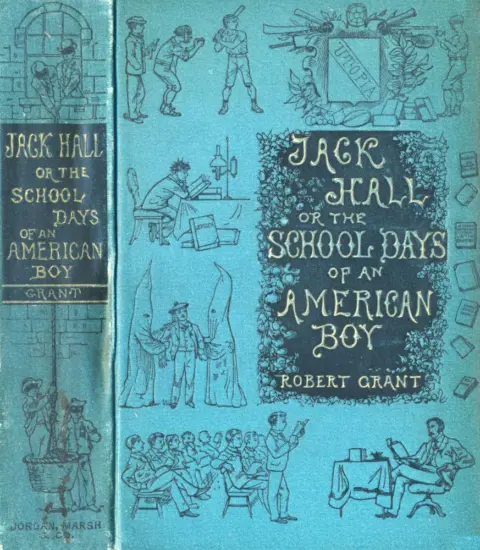
Jack Hall
Robert Grant
THE CLASSIC COLLECTION · 1899
"Search-Light Letters" by Robert Grant is a philosophical work written in the late 19th century. This book takes the form of letters that address various audiences, including young men and women seeking ideals, modern women with social ambitions, and political optimists. Through a series of essays, Grant delves into topics of morality, societal values, and the pursuit of personal and social excellence, urging readers to reflect on the nature of character and ethics amidst the dynamics of modern life. The opening of "Search-Light Letters" sets the tone for a reflective exploration of ethics and ideals. The author begins by assuming certain qualities in his readers, such as honesty, purity, and courage, as foundational for those seeking an uncommon life. The narrative presents thoughts on the nature of character in society, comparing those with refined manners and morals to those who lack depth and authenticity. Through the lens of a cheerful conversation between two characters, the Philosopher and a Refined Instructress, Grant examines everyday ethical dilemmas and societal expectations, using their interaction to illustrate broader moral questions. This opening effectively lays the groundwork for the exploration of the ideals the author wishes to engage with throughout the letters.
Introduction adapted from the source catalogue; source summaries may be automatically generated.
Free to read · English · 45,552 words · No account needed
MAKE TIME FOR A GOOD BOOK
On by default. Untick to stop anonymous reading totals. Each page counts after 10 seconds in view. How this works.
Anonymous counting is on unless you have switched it off.
Most significant among the changes which experience and time have brought to pass has been the development on the educational and social side. Always alive to the importance of general education, but unfortunately so proud of the maintenance of public schools that it was disposed to sneer at any learning not to be acquired at them, the American people--that portion of it which foreigners are so apt to overlook when they attempt to characterize us--is seeking to foster in a variety of ways the opportunities for higher learning, and wider intellectual intelligence. Within the last twenty-five years not merely an array of colleges and other educational institutions have sprung into existence, but with them an army of disciples whose clubs and classes and associations for the investigation and study of all the forms of learning from English literature to Sanscrit have given a new tone and stimulus to the social side of American life. An independent, but now generally respectful eagerness to learn has taken the place of an independent ignorance relying upon its own infallibility, which was often worn as a chip upon the shoulder. With it all has been manifest the same originality, independence, and energy of spirit which has been conspicuous from the first. This still serves to handicap as well as to promote progress, for it is apt to beget undue self-confidence and lead our new women and eager youth of both sexes to ignore the accumulated wisdom of older civilizations, and claim a special clearness of vision, the only basis for which is often half-digested superficial knowledge. But educational and professional life all over the country is being constantly enriched by more and more competent students and practitioners who stand not merely for what is best and most earnest in American life, but who typify the true American spirit. While the omniscient class in the population has become less assertive and more humble-minded, the class which was once politically proscribed in some sections of the country because it was cultivated and because it shrugged its shoulders in spite of its breeding, has undergone a transformation also. A large portion of it, always patriotic at heart so far as dying was concerned, has learned to recognize that it must live in sympathy with our republican institutions if it would not be regarded as an exotic, and that aloofness is akin to lack of patriotism. A fringe of vain and more and more extravagant and self-indulgent society exists in our large cities, especially in New York, which affects to claim social superiority to the rest of the population, and is indifferent to national progress and to the best public interests; but it is numerically small, and, except in the newspapers, a very unimportant factor of influence as compared with the already large and growing body of citizens over the country which is eager to live nobly and wisely. This right-minded and aspiring class represents the drawing together and amalgamation of the once seemingly hostile poles of opinion typified by the conservative, civilized, sedate, social aristocrats of the nation, and the independent, assertive, ignorant but truth-seeking sons and daughters of the soil. Each has recognized the justice of the other's criticisms, and as the outcome of a mutually amended point of view we have an earnest, intelligent, and interesting alliance, which insists on both fineness and strength of fibre as essential to progressive national character. The confines of this belt of good citizenship shade away into stiff or heartless conventionalism on the one side, and smart, obtuse, social perceptions on the other, but it is constantly widening and undergoing the refining process which results from the increasing intelligence of the contracting parties. By way of exemplification in matters feminine may be instanced the more and more frequent requirement by those in authority in women's colleges that applicants for the position of teacher should possess those evidences of gentle nurture which the world is accustomed to associate with the word "lady." Conversely one may point to the fact that originality, independence, and suggestiveness are no longer repulsed by the conservative, but welcomed as a leavening grace necessary to the development of a finer womanhood.
Your reading position is saved on this browser. Take it to another device with a library code. Reading pages adapt to text, rather than matching a printed edition.
Robert Grant

Robert Grant
Robert Grant
Robert Grant
BEHIND THE BOOK
This eBook is for the use of anyone anywhere in the United States and most other parts of the world at no cost and with almost no restrictions whatsoever. You may copy it, give it away or re-use it under the terms of the Project Gutenberg License included with this eBook or online at www.gutenberg.org. If you are not located in the United States, you will have to check the laws of the country where you are located before using this eBook. Read the source licence.
The original source file, including credits and licence, is retained by this library. Request an original-format copy at no charge. Please include the book title and Project Gutenberg identifier #37613.
KEEP YOUR CURIOSITY GOING

David Patterson (Spirit) Hatch

David Patterson (Spirit) Hatch

David Patterson (Spirit) Hatch
Coulson Kernahan

Ralph Waldo Emerson

Maurice Baring