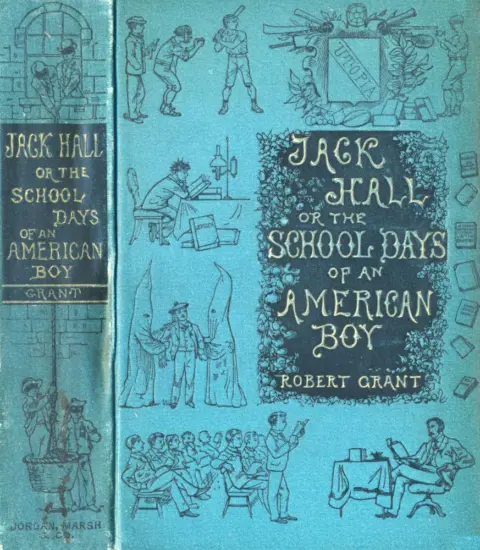
Jack Hall
Robert Grant
THE CLASSIC COLLECTION · 1899
"Search-Light Letters" by Robert Grant is a philosophical work written in the late 19th century. This book takes the form of letters that address various audiences, including young men and women seeking ideals, modern women with social ambitions, and political optimists. Through a series of essays, Grant delves into topics of morality, societal values, and the pursuit of personal and social excellence, urging readers to reflect on the nature of character and ethics amidst the dynamics of modern life. The opening of "Search-Light Letters" sets the tone for a reflective exploration of ethics and ideals. The author begins by assuming certain qualities in his readers, such as honesty, purity, and courage, as foundational for those seeking an uncommon life. The narrative presents thoughts on the nature of character in society, comparing those with refined manners and morals to those who lack depth and authenticity. Through the lens of a cheerful conversation between two characters, the Philosopher and a Refined Instructress, Grant examines everyday ethical dilemmas and societal expectations, using their interaction to illustrate broader moral questions. This opening effectively lays the groundwork for the exploration of the ideals the author wishes to engage with throughout the letters.
Introduction adapted from the source catalogue; source summaries may be automatically generated.
Free to read · English · 45,552 words · No account needed
MAKE TIME FOR A GOOD BOOK
On by default. Untick to stop anonymous reading totals. Each page counts after 10 seconds in view. How this works.
Anonymous counting is on unless you have switched it off.
"Just as you men--merchants, lawyers, or doctors--" pursued Josephine, reflectively, "deliberately or unconsciously contrast yourselves with your fellows in the same calling and become friendly rivals yet competitors for success and renown, it seems to be inevitable that the modern woman with social ambitions should keep her eye on other modern women with social ambitions and try to make sure that they do not get ahead of her. Your Mrs. Sherman, at the time the newspaper woman visited her, had reached the point where it would naturally occur to her to scan the horizon to observe how the other feminine celebrities of her environment were progressing, and her attention was especially called to the matter by the article on 'Progressive Women.' There she had the opportunity to behold them in their respective glories, and to be jealous of or indifferent to them, according to her judgment as to what each amounted to. It was an interesting list, and she experienced in perusing it, in conjunction with the portraits, some qualms of mild envy on account of several of the progressionists, but the only face and career which really discouraged her were the face and career of the woman I have referred to, Mrs. J. Webb Johnston, or, as every one calls her, Mrs. Webb Johnston.
"When she had finished she felt herself essentially on a par with the others; but in the case of Mrs. Webb Johnston she experienced a frog in her throat, and she looked into distance with a harassed air for more than five minutes. Mrs. Webb Johnston was not a stranger to her, but she was comparatively a novelty. That is, she had appeared on the social stage since Mrs. Sherman herself had become prominent, and had been making mushroom-like progress; such rapid progress in fact that it was only when she read the text of the article that she realized the extent of it. Then it came over her with a rush that she was in peril of being distanced on her own ground. For, to all intents and purposes, they were rivals. Their visiting lists were practically the same; they represented and appealed to the same constituency. In personal appearance she could not justly claim any superiority to Mrs. Webb, who was at least three years her junior in age, and who possessed a certain luscious, Juno-like beauty which was calculated, without question, to dazzle undiscriminating eyes, and which would not be regarded except by the very subtle as inferior in type to her own refined effectiveness. Yes, there was no doubt about Mrs. Webb's physical charms, or her great executive ability, or her enthusiastic devotion to the entire range of interests over which she herself was aiming to hold undisputed sway. Her own ambition was to be the guiding spirit, the modern, original social force above all other modern social forces in her constituency; yet here was another with an evidently similar ambition, and a war-cry or shibboleth which was disconcertingly fetching. I trust you have appreciated, philosopher, that our Mrs. Sherman (I am really sorry for her now, so I call her 'our'), from the very first, has been decorously conservative in her point of view, eschewing cheap and vagabond devices and adhering to elegant and appropriately conventional usages, such as seemed to befit a conscientious woman eager to lead public opinion. If dignified conservatism has been her ruling motive, you will readily appreciate that it would disturb her to find that a Bohemian looseness of social vision distinguished her rival, who had been working her way to the front by the specious cry of 'liberty,' and a seductively expressed intention of freeing the community from the manacles of old fogy conventions. I am sure you will agree, philosopher, that it is natural she should have been worried, or, at least, distracted from settling down to her 'Art in Humble Homes' by this discovery. And investigation and reflection only serve to agitate her still further; for, as the weeks go by, it becomes more and more obvious that the things indicated in the article are true--that Mrs. Webb Johnston is hand in glove with authors, actors, opera-singers, and other celebrities, and that the entertainments which she gives and the conversation heard there lack the dull, cut-and-dried, mechanical flavor observable at ordinary social gatherings. You see the situation, don't you, dear?"
Your reading position is saved on this browser. Take it to another device with a library code. Reading pages adapt to text, rather than matching a printed edition.
Robert Grant

Robert Grant
Robert Grant
Robert Grant
BEHIND THE BOOK
This eBook is for the use of anyone anywhere in the United States and most other parts of the world at no cost and with almost no restrictions whatsoever. You may copy it, give it away or re-use it under the terms of the Project Gutenberg License included with this eBook or online at www.gutenberg.org. If you are not located in the United States, you will have to check the laws of the country where you are located before using this eBook. Read the source licence.
The original source file, including credits and licence, is retained by this library. Request an original-format copy at no charge. Please include the book title and Project Gutenberg identifier #37613.
KEEP YOUR CURIOSITY GOING

David Patterson (Spirit) Hatch

David Patterson (Spirit) Hatch

David Patterson (Spirit) Hatch
Coulson Kernahan

Ralph Waldo Emerson

Maurice Baring