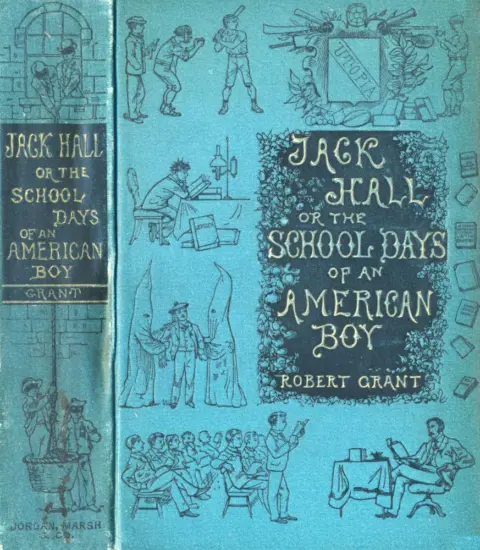
Jack Hall
Robert Grant
THE CLASSIC COLLECTION · 1899
"Search-Light Letters" by Robert Grant is a philosophical work written in the late 19th century. This book takes the form of letters that address various audiences, including young men and women seeking ideals, modern women with social ambitions, and political optimists. Through a series of essays, Grant delves into topics of morality, societal values, and the pursuit of personal and social excellence, urging readers to reflect on the nature of character and ethics amidst the dynamics of modern life. The opening of "Search-Light Letters" sets the tone for a reflective exploration of ethics and ideals. The author begins by assuming certain qualities in his readers, such as honesty, purity, and courage, as foundational for those seeking an uncommon life. The narrative presents thoughts on the nature of character in society, comparing those with refined manners and morals to those who lack depth and authenticity. Through the lens of a cheerful conversation between two characters, the Philosopher and a Refined Instructress, Grant examines everyday ethical dilemmas and societal expectations, using their interaction to illustrate broader moral questions. This opening effectively lays the groundwork for the exploration of the ideals the author wishes to engage with throughout the letters.
Introduction adapted from the source catalogue; source summaries may be automatically generated.
Free to read · English · 45,552 words · No account needed
MAKE TIME FOR A GOOD BOOK
On by default. Untick to stop anonymous reading totals. Each page counts after 10 seconds in view. How this works.
Anonymous counting is on unless you have switched it off.
This is the hour when the Wordsworthian spirit, refined, conscientious, aspiring, beauty and duty loving, sees through the splendor of the lucent, saffron sky, heaven open, and the angels of God ascending and descending. Not always is the vision so adorable. Often enough the gazer knows the bitterness of divine discontent, and finds the golden glory but a bar, shutting out God. In the favorable hour, though, comes the rapture, and the transfiguration; the exquisite, refined feelings seem to find communion with the infinite, and a voice from heaven to say:
Well done, good and faithful servant.
I have selected this experience of the cultivated English household rather than that of the purely religious life as an example, for the reason that in it the aesthetic side is represented in the soul-hunger, and that the existing conditions of earth are, to a certain extent, taken into account. In the purely religious life, the emotions of the exalted soul have, in the past at least, been prone to exclude the actual conditions of human life from consideration. The thought has been that the earthly existence is travail, and at best a discipline; that the joys of life are vanity, and the mundane problems of life unworthy of the interested attention of the heaven-seeking soul. Modern religious theories have modified this point of view, but certainly in some sects still the aesthetic value of existence is almost contemptuously discarded by religion. I have taken the beautiful lives of the Wordsworthians as an example, also because the religious element is so manifestly cherished and cultivated in them. It is intended in them that art and God should work together, or, more accurately, the precept is that the aesthetic side of humanity is one of the noblest manifestations of the infinite within us. It is significant in this connection that though art has often reached its apogee in periods of moral decay, the ruin of the nation, thus robbed of spiritual vitality, has soon followed, in spite of the glory of its sculpture and canvasses. But that is a mere interjection. The point I wish to suggest is this: The sane soul recognizes, when face to face with truth, that what we see in the glory of the sunset, when we think we walk with God, must be, in order to be of value, an inspiration based on the conditions of mundane life. Without this, prayer and adoration become a mere nervous exhalation, reaching out for something which has no more substance than an ignus fatuus. The old saints who lived and died in prayer, ignoring human relations, seem to us to-day to have been wofully deluded. They yearned to be translated from a world to which they had contributed nothing but the desire to be holy. This desire is of the essence of the matter; and so we consent to give their reverences the benison of our distinguished consideration. But aspiring souls, as evidenced by the aesthetic man and woman of culture, presently perceived the error. They recognized that aspiration, to be vital, must start with a conception of the world as it was, and seek a realization of the world as it might be, and that in this seeking lay service to God and preparation for heaven. Proceeding they fixed on unselfish human love and on beauty as the motive of their creed, and endeavored to live lives animated by these principles. This creed has been the real creed of aspiring humanity during the past century and a half, and it still seems sufficient to many. There have been diverse differences of application and administration in connection with it, according as the pendulum swung more or less near to one or the other of the two cardinal points of faith, unselfish love, or exquisite beauty. There have been some who, in their desire to make the relations of man toward those with whom he lived and whom he loved more ideal, have been disposed to ignore the claims of color and elegance; and there have been others so eager in their allegiance to the cause of beauty that they have exalted sense and emotion at the expense of unselfishness and purity. Essentially, however, the ideal life of the modern centuries has sought to develop the individual soul by stimulating its faculties to cherish self-sacrificing devotion to familiar friends, aesthetic appreciation of form, color and sound, and exquisite personal refinement. The Christian life, in its highest form, from this amalgamation of human traits, has constructed an ideal for the soul founded on something tangible and substantial in human consciousness. When the Christian said, "O God, make me pure and noble," it has been no longer necessary to rhapsodize on a heaven concerning which he knew nothing, and to disclaim all interest in this earth. On the contrary, he has appreciated that conceptions of the ideal must be based on human conditions or they cease to be intelligible, and that the soul which seeks God can reach him only through faithfulness to a method of life, the aim of which is to make the best use of earth and its possibilities.
Your reading position is saved on this browser. Take it to another device with a library code. Reading pages adapt to text, rather than matching a printed edition.
Robert Grant

Robert Grant
Robert Grant
Robert Grant
BEHIND THE BOOK
This eBook is for the use of anyone anywhere in the United States and most other parts of the world at no cost and with almost no restrictions whatsoever. You may copy it, give it away or re-use it under the terms of the Project Gutenberg License included with this eBook or online at www.gutenberg.org. If you are not located in the United States, you will have to check the laws of the country where you are located before using this eBook. Read the source licence.
The original source file, including credits and licence, is retained by this library. Request an original-format copy at no charge. Please include the book title and Project Gutenberg identifier #37613.
KEEP YOUR CURIOSITY GOING

David Patterson (Spirit) Hatch

David Patterson (Spirit) Hatch

David Patterson (Spirit) Hatch
Coulson Kernahan

Ralph Waldo Emerson

Maurice Baring