THE CLASSIC COLLECTION✦An outlaw’s diary: the CommuneCLASSIC FREE BOOKS
An outlaw’s diary: the Commune
Cécile Tormay
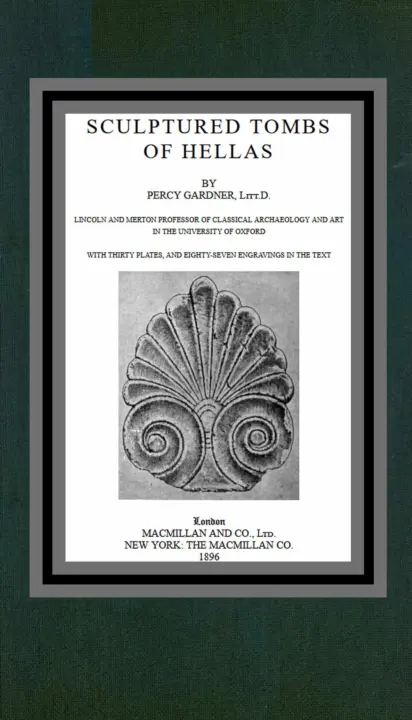
THE CLASSIC COLLECTION · 1896
"Sculptured Tombs of Hellas" by Percy Gardner is a scholarly exploration of ancient Greek burial customs, written in the late 19th century. This work delves into the significance of sepulchral monuments, examining their artistic and cultural implications within the ancient Greek psyche and societal practices concerning death. Gardner addresses not only the structures themselves but also the rituals surrounding mourning and the offerings made to the dead. The opening of the text introduces the profound connection between burial customs and the cultural consciousness of ancient Greece, emphasizing the importance of funerary practices in relation to general societal beliefs about life and death. Gardner articulates that the public expressions found in literature and art often reflect highbrow sentiments that differ from the common people's perspectives on mortality. He outlines the structure of the book, which will address Greek burial practices, beliefs about the afterlife, and a focused study of the tombs and monuments that characterize significant regions such as Athens and Asia Minor, providing a robust context for understanding these sculptural tombs.
Introduction adapted from the source catalogue; source summaries may be automatically generated.
Free to read · English · 69,265 words · No account needed
MAKE TIME FOR A GOOD BOOK
On by default. Untick to stop anonymous reading totals. Each page counts after 10 seconds in view. How this works.
Anonymous counting is on unless you have switched it off.
[12] Gräber der Hellenen, p. 42, pl. viii. Stackelberg found the coffin himself near the Acharnian Gate at Athens, and drew it immediately on discovery.
[13] Pottier et Reinach, La Nécropole de Myrina, p. 101.
[14] Herodotus, iv. 26. The word γευέσια may perhaps mean, as some have suggested, the anniversary of the death, if death be regarded as birth into a new life. The early Christians seem to have adopted this view.
[15] P. 519; Charon, 22.
[16] II. p. 926; De Luctu, 9.
[17] Plutarch, Solon, 21.
[18] Athen. Mittheil. i. 143.
[19] Plutarch, Aristides. 21.
[20] Athen. Mittheil. 1893, p. 53.
[21] See below, Chap. VI.
[22] Ephem. Archaiol. 1886, pl. iv.
[23] Benndorf, Griech. und Sicil. Vasenb. pl. xxi, 2: cf. xxi. 1,
xxii, xxv, &c.
[24] Dumont, Céram. de la Grèce, pl. xxv.
[25] Pottier, Lécythes blancs, pl. iv: cf. p. 74.
[26] No. 735 of the Athens Museum.
[27] Pl. lx.
[28] In a later Chapter (X) I show by instances how close is sometimes the resemblance in reliefs and on vases between the toilet scenes of daily life and scenes of offering to the dead.
[29] Catalogue of Vases, IV. pl. iv. I cannot accept the view of the author of the Catalogue, that all three figures are those of mourners.
[30] As to the pillar (κίων) and table (τράπέζα), see Chap. VIII.
[31] Psyche, Seelencult und Unsterblichkeitsglaube der Griechen, 1894.
[32] Odyssey, iv. 560.
[33] x. 28. Cf. Robert, Die Nekyia des Polygnot. Halle, 1892.
[34] Antike Denkmäler, published by the German Archaeological Institute, vol. i. pl. xxiii. 3.
[35] Nos. 1 and 2 on the plate already cited.
[36] Pottier, Lécythes blancs, pl. 3: cf. Benndorf, Griech. und
Sicil. Vasenb. pl. 27.
[38] See Wiener Vorlegeblätter, Series E, pl. i-iii: cf. Baumeister, Denkmäler, article ‘Unterwelt.’
[39] Cf. the relief published in Athen. Mittheil. iv. pl. ix.
[42] Agesilaus, xi. 8.
[43] See Chap. XI.
[44] II. p. 364 E (translation of Davies and Vaughan).
[45] Chap. XII.
[46] Plutarch, Pelopidas, 20-22.
[47] Odyssey, xi. 602.
[48] For this see, among other works, Schliemann, Mycenae and Tiryns; Schuchhardt, Excavations of Schliemann (Eng. trans.); Perrot et Chipiez, La Grèce Primitive; Gardner, New Chapters in Greek History.
[49] Schuchhardt, Schliemann’s Ausgrabungen, p. 176.
[50] Perrot et Chipiez, La Grèce Primitive, p. 638.
[51] Schliemann, Mycenae, pl. E.
[52] Perrot et Chipiez, pl. vi.
[53] Journal of Hellenic Studies, ii. p. 136, pl. xiii.
[54] Helbig, La Question mycénéenne. 1896.
[55] Schliemann, Mycenae, p. 81.
[56] Ibid. p. 86.
[57] Perrot et Chipiez, p. 770.
[58] The most recent account of these, by M. Joubin, will be found in the Bulletin de Corresp. hellén. 1895, p. 69.
[59] II. 22, 2 (Ταντάλου) ἰδὼν οἰδα ἐν Σιπύλῳ τάφον Θέας ἄξιον.
[60] Texier, Description, pl. cxxx.
[61] Weber, Le Sipyle, pl. i.
[62] Perrot et Chipiez, v. 83. Mr. Ramsay, while allowing the general excellence of this drawing, disputes its accuracy in some particulars. See Journ. Hell. Stud. 1889, p. 155.
[63] Perrot et Chipiez, v. p. 103.
[64] Perrot et Chipiez, v. p. 111. Another drawing in Journ. Hell. Stud. 1888, p. 368 (Ramsay).
[65] Journ. Hell. Stud. pl. xviii.
Your reading position is saved on this browser. Take it to another device with a library code. Reading pages adapt to text, rather than matching a printed edition.
BEHIND THE BOOK
This eBook is for the use of anyone anywhere in the United States and most other parts of the world at no cost and with almost no restrictions whatsoever. You may copy it, give it away or re-use it under the terms of the Project Gutenberg License included with this eBook or online at www.gutenberg.org. If you are not located in the United States, you will have to check the laws of the country where you are located before using this eBook. Read the source licence.
The original source file, including credits and licence, is retained by this library. Request an original-format copy at no charge. Please include the book title and Project Gutenberg identifier #69508.
KEEP YOUR CURIOSITY GOING
Cécile Tormay

Moritz Busch
John L. Ransom
Frances Wright
Cécile Tormay

Mabel Potter Daggett