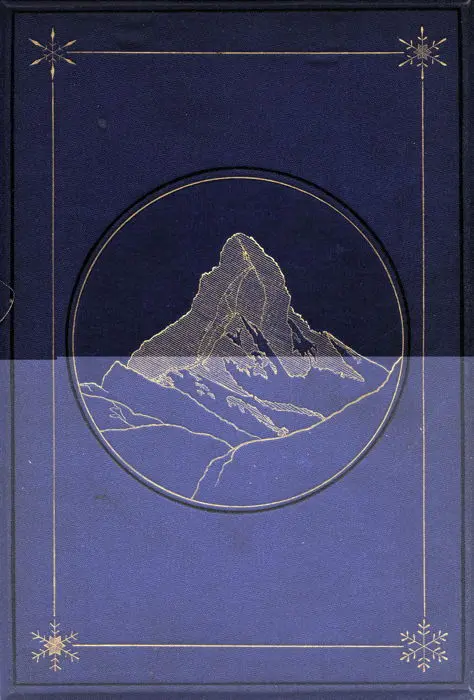
The Ascent of the Matterhorn
Edward Whymper
THE CLASSIC COLLECTION · 1871
"Scrambles Amongst the Alps in the Years 1860-69" by Edward Whymper is a historical account written in the late 19th century. This work chronicles Whymper's adventures and experiences as a mountaineer in the Alps, particularly focusing on his attempts to ascend various peaks, including the notorious Matterhorn. The narrative not only captures the thrill and challenges of mountaineering but also delves into the beauty and awe-inspiring nature of the Alpine landscape. The opening of the book sets the stage for Whymper's passionate exploration of the Alps, beginning with his initial forays into mountaineering, including a comedic yet perilous attempt to climb the chalk cliffs of Beachy Head as a schoolboy. He recounts these early experiences interspersed with vivid descriptions of the mountains he encounters, showcasing not only his growing fascination with climbing but also his learning curve in navigating the challenges of the alpine terrain. Additionally, the early chapters reveal the camaraderie and dynamics of his climbing companions, as well as the quirks of local guides, establishing a foundation for the more rigorous adventures that follow in his quest to conquer the peaks of the Alps.
Introduction adapted from the source catalogue; source summaries may be automatically generated.
Free to read · English · 96,746 words · No account needed
MAKE TIME FOR A GOOD BOOK
On by default. Untick to stop anonymous reading totals. Each page counts after 10 seconds in view. How this works.
Anonymous counting is on unless you have switched it off.
Had things gone as they ought, within six hours more we should have been at Chamounix. Upon the other side we knew that there was a couloir in correspondence with that up which we had just come. If it had been filled with snow, all would have been well: it turned out to be filled with ice. Croz, who led, passed over to the other side, and reported that we should get down somehow, but I knew from the sound of his axe how the somehow would be, and settled myself to sketch, well assured that I should not be wanted for an hour to come. What I saw is shown in the engraving—a sharp aiguille (nameless), perhaps the sharpest in the whole range, backed on the left by the Aiguille de Triolet; queer blocks of (probably) protogine sticking out awkwardly through the snow; and a huge cornice from which big icicles depended, that broke away occasionally and went skiddling down the slope up which we had come. Of the Argentiere side I could not see anything.
Croz was tied up with our good manila rope, and the whole two hundred feet were paid out gradually by Almer and Biener before he ceased working. After two hours’ incessant toil, he was able to anchor himself to the rock on his right. He then untied himself, the rope was drawn in, Biener was attached to the end and went down to join his comrade. There was then room enough for me to stand by the side of Almer, and I got my first view of the other side. For the first and only time in my life I looked down a slope of more than a thousand feet long, set at an angle of about fifty degrees, which was a sheet of ice from top to bottom. It was unbroken by rock or crag, and anything thrown down it sped away unarrested until the level of the Glacier d’Argentiere was reached. The entire basin of that noble glacier was spread out at our feet, and the ridge beyond, culminating in the Aiguille d’Argentiere, was seen to the greatest advantage. I confess, however, that I paid very little attention to the view, for there was no time to indulge in such luxuries. I descended the icy staircase and joined the others, and then we three drew in the rope tenderly as Almer came down. His was not an enviable position, but he descended with as much steadiness as if his whole life had been passed on ice-slopes of fifty degrees. The process was repeated, Croz again going to the front, and availing himself very skillfully of the rocks which projected from the cliff on our right. Our two hundred feet of rope again came to an end, and we again descended one by one. From this point we were able to clamber down by the rocks alone for about three hundred feet. They then became sheer cliff, and we stopped for dinner, about 2.30 P.M. at the last place upon which we could sit. Four hours’ incessant work had brought us rather more than halfway down the gully. We were now approaching, although we were still high above, the schrunds at its base, and the guides made out, in some way unknown to me, that Nature had perversely placed the only snow-bridge across the topmost one toward the centre of the gully. It was decided to cut diagonally across the gully to the point where the snow-bridge was supposed to be. Almer and Biener undertook the work, leaving Croz and myself firmly planted on the rocks to pay out rope to them as they advanced. It is generally admitted that veritable ice-slopes (understanding by ice something more than a crust of hard snow over soft snow) are only rarely met with in the Alps. They are frequently spoken of, but such as that to which I refer are very rarely seen, and still more seldom traversed. It is, however, always possible that they may be encountered, and on this account, if for no other, it is necessary for men who go mountaineering to be armed with ice-axes, and with good ones. The form is of more importance than might be supposed. Of course, if you intend to act as a simple amateur and let others do the work, and only follow in their steps, it is not of much importance what kind of ice-axe you carry, so long as its head does not fall off or otherwise behave itself improperly. There is no better weapon for cutting steps in ice than a common pick-axe, and the form of ice-axe which is now usually employed by the best guides is very like a miniature pick. My own axe is copied from Melchior Anderegg’s. It is of wrought iron, with point and edge steeled. Its weight, including spiked handle, is four pounds. For cutting steps in ice the pointed end of the head is almost exclusively employed: the adze-end is handy for polishing them up, but is principally used for cutting in hard snow. Apart from its value as a cutting weapon, it is invaluable as a grapnel. It is naturally a rather awkward implement when it is not being employed for its legitimate purpose, and is likely to give rise to much strong language in crushes at railway termini, unless its head is protected with a leathern cap or in some other way. Many attempts have been made, for the sake of convenience, to fashion an ice-axe with a movable head, but it seems difficult or impossible to produce one except at the expense of cutting qualities and by increasing the weight.
Your reading position is saved on this browser. Take it to another device with a library code. Reading pages adapt to text, rather than matching a printed edition.
Edward Whymper
BEHIND THE BOOK
This eBook is for the use of anyone anywhere in the United States and most other parts of the world at no cost and with almost no restrictions whatsoever. You may copy it, give it away or re-use it under the terms of the Project Gutenberg License included with this eBook or online at www.gutenberg.org. If you are not located in the United States, you will have to check the laws of the country where you are located before using this eBook. Read the source licence.
The original source file, including credits and licence, is retained by this library. Request an original-format copy at no charge. Please include the book title and Project Gutenberg identifier #41234.
KEEP YOUR CURIOSITY GOING
Wilfrid Scawen Blunt
Wilfrid Scawen Blunt

E. W. (Edgar Watson) Howe
Cécile Tormay

Moritz Busch
John L. Ransom