THE CLASSIC COLLECTION✦An outlaw’s diary: the CommuneCLASSIC FREE BOOKS
An outlaw’s diary: the Commune
Cécile Tormay
THE CLASSIC COLLECTION · 1903
Scottish chapbook literature by William Harvey is a literary history written in the early 20th century. It surveys the rise, character, and influence of Scotland’s cheap popular print—broadsides and chapbooks—and the chapmen who sold them, tracing their growth, peak, and decline. The study highlights major types (humorous, instructive, romantic, superstitious, and songs/ballads), key authors and printers, and includes illustrations, notes, a glossary, and indexes to guide readers.
The opening of the book states its aim to give a concise account of the chapman and his wares across roughly three centuries, with plentiful extracts, biographical and bibliographical notes, a list of titles, and reproductions of crude but revealing woodcuts. It defines “chapbook” by distribution rather than size, sketches the pedlar’s hard, news-bearing life, and outlines early Scottish printing (Chepman and Myllar), Reformation broadsides, censorship, and the rise from single sheets to song-sheets and small booklets, through Allan Ramsay, into the main chapbook era, which the author places from the late 17th to early 19th century. It marks Dougal Graham as the pivotal figure and explains the later decline as new cheap series displaced the old, noting poor paper, short type supplies, piracy, and comically misused woodcuts, as well as a few short-lived serials; English imports are acknowledged but set aside. The first main section, “Humorous,” centers on Graham—his Jacobite camp-following, and lively pieces like Jockey and Maggy’s Courtship, The Coalman’s Courtship, and The Haverel Wives—which vividly portray rustic wooing, riotous weddings, kirk discipline, and anti-Popish satire; it also touches his more anecdotal collections, the semi-autobiographical John Cheap the Chapman, Leper the Taylor, later figures such as William “Hawkie” Cameron, the respectable Mansie Wauch, and popular verse and jest-books. The text then turns to “Instructive” chapbooks—first, historical narratives (Bothwell Bridge and Drumclog by an eyewitness, and Graham’s metrical history of the ’45), and topical broadsides and “last speeches” sold at executions, illustrated with a peddler’s sharp-eyed account of hawking a bogus reprieve.
Introduction adapted from the source catalogue; source summaries may be automatically generated.
Free to read · English · 33,432 words · No account needed
MAKE TIME FOR A GOOD BOOK
On by default. Untick to stop anonymous reading totals. Each page counts after 10 seconds in view. How this works.
Anonymous counting is on unless you have switched it off.
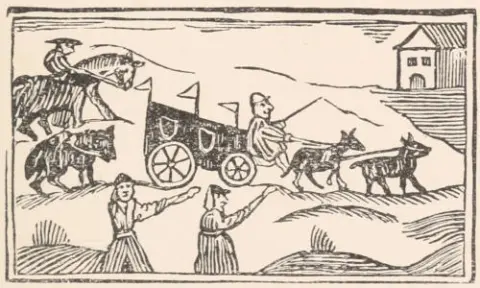
It has been said that the chapbook varied in size. Leaving out of consideration what are known as broadsides, it was a publication of any extent from eight pages to two hundred pages, and sold at prices ranging from a penny to a shilling. Sometimes, in the larger and more expensive productions, there was an attempt at artistic printing, but, as a general rule, chapbook literature did little credit to the followers of Caxton. The paper was invariably of the coarsest kind. The heavy duty on that article of manufacture kept it dear, and accounts for the rude appearance of many of these productions. A study of a number of chapbooks from any one press reveals some of the difficulties with which the printer had to contend. For one thing, his type not unfrequently gave out. An edition of Allan Ramsay’s Collection of Scotch Proverbs forms one of the chapbooks of G. Caldwell of Paisley. This book naturally entailed a heavy drain on “capitals,” and it is amusing to notice with what frequency the compositor had to fall back on “italics” or “lower-case” letters when his Roman capitals failed him. Sometimes the paper ran short. In these days, the proverbial editorial blue-pencil is called into use to effect a judicious condensation. The chapbook printer scorned such a method. His reader must have everything, and the last page or so was occasionally set in a smaller size of type, so that all the author’s work might appear. At other times, the story was too short to fill the desired number of pages, and trifles of any kind were introduced to fill up space. In this last-mentioned respect, the editor of the present day still follows the chapbook publisher. In the matter of illustrations, some amazing results were achieved. Anything in the way of ornament was called into service, and one picture had frequently to do duty in many chapbooks. So long as an illustration did not deal with a specific subject, the matter was of little moment; but when it came to the portrait of one man—and that man probably a creature of the artist’s imagination—doing duty for several authors, the result was as amusing as it was absurd. A few examples may be mentioned. A number of religious chapbooks, issued in Glasgow and “printed for the booksellers,” were adorned with an illustration on the title page. This was a clergyman of the conventional type, clad in gown and bands, and wearing a full-bottomed wig. There was apparently only one woodcut in the printer’s stock, and it did duty in turn for John Welch and Donald Cargill, William Secker and Ebenezer Erskine, Thomas Wilcocks and Isaac Watts. No less amusing was the combination effected on another occasion. A History of Wallace, the renowned Scottish Champion, was issued at Glasgow, without date, “printed for the booksellers.” At the first glance the illustration on the cover did not seem quite accurate. It was the portrait of a man wearing a crown. Now, not even the Scottish Rights Association or the “Britain v. England” patriots ever claimed a crown for Wallace, and there was evidently an error somewhere. A scrutiny of certain other chapbooks explained the matter. The portrait requisitioned to adorn the History of Wallace had done duty in another chapbook as an illustration of Henry the Second of England! For the humour of the thing, one could wish that it had been Edward Longshanks. Less glaringly absurd were some other combinations. A portrait of a man in Highland costume—with an unmistakable claymore and an abbreviated kilt—adorned a history of Prince Charlie. Accompanied by other text, it served to represent Rob Roy. A Highland piper, seated on a stool or “creepie,” and playing lustily on his pipes, embellished the front page of Odds and Ends, and a footnote, which referred to one of the anecdotes contained in the publication, set forth that he was “the Piper who was carried away for dead during the Plague in London, but revived before interment.” Without the explanatory footnote, he adorned The Scotch Haggis; somewhat appropriately he embellished the History of James Allan, the Celebrated Northumberland Piper, and he also played in The Long Pack, or the Robbers Discovered. So far as the artist was concerned, Dick Turpin and O’Donnel, the Irish assassin, wore a garb and features common to each other in the chapbook, and in real life alien to them both. These facts are not without consolation to those of us who have had to submit to the not very tender mercies of the newspaper artist. A comparison of a number of song-chapbooks, with the same imprint, shows that the early printer was alive to the possibilities of variation, and that he frequently “rung the changes” on certain pieces. When a song was put into type, it was seemingly kept “standing” for some time, and made to serve in several chapbooks ere the type was distributed. This afforded the printer an easy and cheap method of producing a number of publications, and meant that if any one wanted a collection of songs, he had to buy a greater quantity of books than would have been the case if the contents of each sheet had been entirely different.
Your reading position is saved on this browser. Take it to another device with a library code. Reading pages adapt to text, rather than matching a printed edition.
BEHIND THE BOOK
This eBook is for the use of anyone anywhere in the United States and most other parts of the world at no cost and with almost no restrictions whatsoever. You may copy it, give it away or re-use it under the terms of the Project Gutenberg License included with this eBook or online at www.gutenberg.org. If you are not located in the United States, you will have to check the laws of the country where you are located before using this eBook. Read the source licence.
The original source file, including credits and licence, is retained by this library. Request an original-format copy at no charge. Please include the book title and Project Gutenberg identifier #77447.
KEEP YOUR CURIOSITY GOING
Cécile Tormay

Moritz Busch
John L. Ransom
Frances Wright
Cécile Tormay

Mabel Potter Daggett