THE CLASSIC COLLECTION✦An outlaw’s diary: the CommuneCLASSIC FREE BOOKS
An outlaw’s diary: the Commune
Cécile Tormay
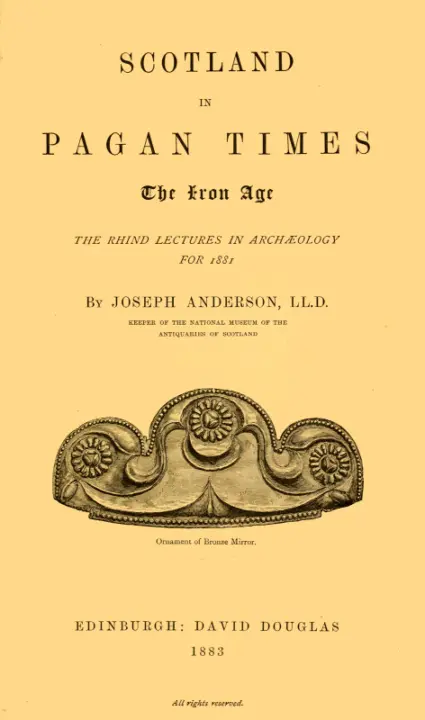
THE CLASSIC COLLECTION · 1883
"Scotland in Pagan Times; The Iron Age" by Joseph Anderson is a historical account written in the late 19th century. This work comprises a series of lectures focusing on the archaeological investigations of the Pagan period in Scotland, especially during the Iron Age. It aims to explore burial customs and artifacts from this era, providing insights into the culture and civilization of the time. The opening of the text sets the stage for a detailed examination of burial practices, distinctively separating Christian and Pagan customs, with Anderson emphasizing the archaeological importance of grave goods and cremation in Pagan burials. He discusses the transition from Pagan to Christian burial practices in Scotland, illustrated by the survival of certain elements in Christian ceremonies that have their roots in Pagan traditions. The section introduces foundational concepts, highlighting the significance of burial customs in understanding human culture, and suggests a methodical approach to analyzing archaeological evidence from this period.
Introduction adapted from the source catalogue; source summaries may be automatically generated.
Free to read · English · 90,489 words · No account needed
MAKE TIME FOR A GOOD BOOK
On by default. Untick to stop anonymous reading totals. Each page counts after 10 seconds in view. How this works.
Anonymous counting is on unless you have switched it off.
From these descriptions it appears that there are two distinct varieties of one strongly-marked typical form of massive bronze armlet, decorated in a style of art which is remarkable for the special Celticism of its characteristics. It is a form which is found over a wide area in Scotland, and has only been once found out of Scotland. The single example which carries the area of the form beyond the bounds of this country was found near Newry, in County Down, Ireland (Fig. 135). It is 5 inches in its greatest diameter, and 3½ inches in height, and belongs to the transitional variety, which links this typical form with the zoomorphic type, which I next proceed to describe.
Some time before 1827 a man shooting over that wide waste of sand known as the Culbin Sands, near the mouth of the Findhorn, accidentally lost his gun-flint. He knew, however, that in a special locality among these sand hills there is, on the site of an ancient settlement of the hunters of prehistoric times, a spot which is thickly strewn with fragments of flint, which these early hunters, who also used this material, had accumulated in the manufacture of their arrow-heads and other implements. Accordingly, he proceeded to this ancient flint factory to furnish himself with a new gun-flint, and when looking about for a suitable flake for his purpose he found a large and finely-made armlet of bronze (Fig. 136), which he carried with him and sold to a shopkeeper in Forres for half-a-crown. It subsequently passed into the possession of Lady Cumming of Altyre, by whom it is now exhibited in the Museum. It was described by Sir Thomas Dick Lauder, and engraved in the Transactions of the Society so long ago as 1827. At that time it stood alone, and was regarded more as a curiosity than as a work of art. Now it stands as the representative of a peculiar class of art-products, which, so far as we know, are confined to Scotland alone. Its form is that of an armlet, formed of a coiled, double-headed serpent. It measures 3½ inches in diameter, and the same in depth externally. Its internal diameter is 2½ inches, and its weight 2 lbs. 9½ oz. It is a single casting in bronze, convex externally, concave internally, throughout the length of the coils, which, though closely contiguous, are completely separate, so that a sheet of paper can pass between them. There are three complete coils, and the middle coil (as seen in Fig. 137) is symmetrically ornamented with lozenge-shaped spaces, bounded by curves, and of considerable prominence. Each end terminates in a snake-like head, the eyes of which are set with blue glass. In front of the eyes is a round disc, sunk in the metal, which has probably been filled with enamel. The upper part of the head and neck is ornamented with raised trumpet-shaped scrolls, and about three inches behind the terminal head there is a simulation of a second head, the eyes of which are also set with blue glass. Speaking of it as a work of art, Sir Henry Ellis unhesitatingly calls it Roman work of the very best period, while Sir Thomas Dick Lauder observes that its workmanship is most beautiful. The taste which it displays, he says, is exquisite, and the detail executed with the greatest delicacy. And he further remarks that the natural form of the serpent has not been servilely and awkwardly copied, “as one might expect that a workman in an infant state of society would have done.” But there is nothing in the character of the work, or in the nature of the art, to suggest that the workman belonged to an infant state of society. The technical skill displayed in modelling and casting such a difficult piece of work is undoubtedly of a very high order, and he would be considered a good workman to-day who could turn out an equally well finished casting of the kind. As to the design of the decoration there can be but one opinion. It possesses the merits of originality of conception, boldness of treatment, purity of style, and freedom of execution. It is decoration, also, of that complex kind which unites the effects of colour with those of form, and deals harmoniously with the results of such diverse processes as modelling in relief, chasing and engraving, the setting of jewels, and the fixing of enamels. The qualities of brain and hand that conceived and executed this piece of metal-work are not to be estimated solely by the results they have obtained in this single example. The man who did this was capable of much higher work if higher work had come in his way, and this solitary specimen of the work of an unknown artist is at least as interesting for the potentiality which it reveals as for the actual ability which it so clearly displays.
Your reading position is saved on this browser. Take it to another device with a library code. Reading pages adapt to text, rather than matching a printed edition.
BEHIND THE BOOK
This eBook is for the use of anyone anywhere in the United States and most other parts of the world at no cost and with almost no restrictions whatsoever. You may copy it, give it away or re-use it under the terms of the Project Gutenberg License included with this eBook or online at www.gutenberg.org. If you are not located in the United States, you will have to check the laws of the country where you are located before using this eBook. Read the source licence.
The original source file, including credits and licence, is retained by this library. Request an original-format copy at no charge. Please include the book title and Project Gutenberg identifier #57812.
KEEP YOUR CURIOSITY GOING
Cécile Tormay

Moritz Busch
John L. Ransom
Frances Wright
Cécile Tormay

Mabel Potter Daggett