THE CLASSIC COLLECTION✦An outlaw’s diary: the CommuneCLASSIC FREE BOOKS
An outlaw’s diary: the Commune
Cécile Tormay
THE CLASSIC COLLECTION · 1883
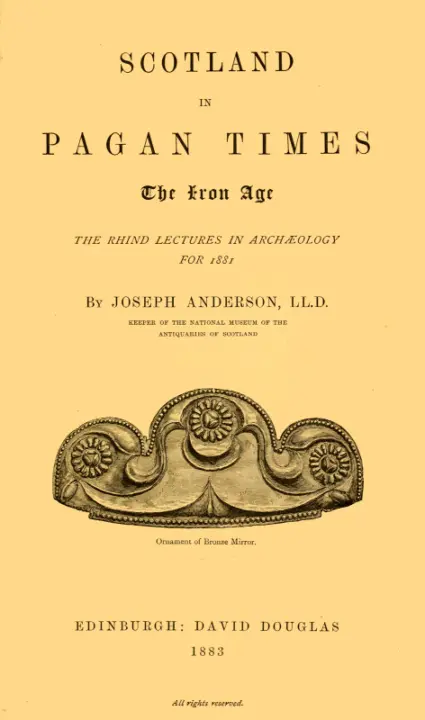
"Scotland in Pagan Times; The Iron Age" by Joseph Anderson is a historical account written in the late 19th century. This work comprises a series of lectures focusing on the archaeological investigations of the Pagan period in Scotland, especially during the Iron Age. It aims to explore burial customs and artifacts from this era, providing insights into the culture and civilization of the time. The opening of the text sets the stage for a detailed examination of burial practices, distinctively separating Christian and Pagan customs, with Anderson emphasizing the archaeological importance of grave goods and cremation in Pagan burials. He discusses the transition from Pagan to Christian burial practices in Scotland, illustrated by the survival of certain elements in Christian ceremonies that have their roots in Pagan traditions. The section introduces foundational concepts, highlighting the significance of burial customs in understanding human culture, and suggests a methodical approach to analyzing archaeological evidence from this period.
Introduction adapted from the source catalogue; source summaries may be automatically generated.
Free to read · English · 90,489 words · No account needed
MAKE TIME FOR A GOOD BOOK
On by default. Untick to stop anonymous reading totals. Each page counts after 10 seconds in view. How this works.
Anonymous counting is on unless you have switched it off.
“The first Christians,” says Aringhi, “did not follow the heathen custom of placing deposits of gold, silver, and other precious articles in their sepulchres.” But it is plain from his further statement that they followed it partly, or, in other words, that the older custom was continued in a modified form;[1] for he goes on to say that “they permitted gold, interwoven with the cloth used in the preparation of the body for burial, and such things as gold rings on the fingers; with young girls, too, they often buried their ornaments and such things as they most delighted in.”
Footnote 1:
The body was swathed in linen, sometimes with the insignia of office, or with ornaments of gold, or gems placed in the coffin or sarcophagus.—Euseb. Vit. Const. iv. 66; Ambros. Orat. in obit. Theodos; August. Conf. ix. 12, cited in Smith’s Dict. of Christ. Antiq., sub voce “Burial of the Dead.” The insignia of office, if the deceased had held any such position—gold and silver ornaments in the case of private persons—were often flung into the open grave, and the waste and ostentation to which this led had to be checked by an imperial edict.—Cod. Theodos. xi. tit. 7, 1, 14. Ibid. So common was the burial of weapons and ornaments in Early Christian times among the Franks, that enactments against the violation of graves in search of treasure form a special feature in the Salic Laws. Gregory of Tours tells of the robbery of the grave of the wife of Gonthram, who was buried in the Church of Metz, “cum auro multo rebusque preciosis;” and Montfaucon adds that from this we see that it was not the kings only, but the great of the land also, who were at that time buried with things of price.
Although the Pagan form of burial in which the dead were placed in their tombs, apparelled in their richest robes, and with their arms, ornaments, and insignia, is clearly opposed to the doctrine taught in all ages of the church, that the dead are for ever done with the things of this life,[2] we find it strangely surviving as a Christian ceremonial in the burial of kings and clergy. Childeric, the last of the Pagan kings of France, was buried seated on a throne, in his kingly robes, and with the arms, ornaments, and insignia of royalty. Charlemagne, the establisher of Christianity (who meted out the punishment of death to the Saxons who dared to burn their dead after the old manner),[3] was also buried seated on a throne, with his royal robes, his arms and ornaments, and the book of the Gospels on his knee. The Scandinavian Viking was buried with his arms because his Valhalla was a fighting place; but the Christian kings of Denmark continued to be buried with their arms although there was no Valhalla prepared for them.[4] Giraldus Cambrensis, describing the miserable death of Henry II. of England, laments that when the body was being prepared for burial “scarcely was a decent ring to be found for his finger or a sceptre for his hand, or a crown for his head, except such a thing as was made from an old head-dress.” When the custom was disused for kings, it was retained for the clergy.[5] Archbishops and bishops have always been buried with their insignia and robes of office.[6] Their graves, containing the crosier or staff, the chalice and paten, the robes and ring, although necessarily of Christian time and Christian character, are directly related in the line of archæological succession to those of the earlier Paganism. The custom also survives in the pompous accessories of a military funeral. When we see the sword laid over the coffin, and the horse led in procession to the grave, we witness the survival of one of the oldest ceremonies ever performed among men—the difference being, that of old the weapon was laid in the grave beside the hand that had wielded it, and the horse was slaughtered to accompany his master to the unseen world.[7] Some forms of this survival gradually passed into distinctively Christian usages[8] with a definitely Christian significance, and others became actually incorporated in the ritual of the Church. One of the most striking of the sepulchral customs of the Pagan Northmen was that of binding the “hell-shoes” on the feet of the dead. It is stated in the Saga of Gisli the Outlaw that when they were laying Vestein in his grave-mound, Thorgrim the priest went up to the mound and said, “’Tis the custom to bind the hell-shoes on men so that they may walk on them to Valhalla, and I will now do that by Vestein;" and when he had done it he said, “I know nothing about binding on hell-shoon, if these loosen.” This custom is often found in Christian as well as in pre-Christian graves in Central Europe. It was well known to the liturgical writers of the Middle Ages. Durandus says: “The dead must also have shoes on their feet by which they may show that they are ready for the judgment.” Members of religious orders were usually thus buried, but the custom was not confined to them alone.[9] The idea of providing for a journey which was implied in the Northern custom of the “hell-shoon,” is curiously illustrated by the statement of Weinhold, that in some remote districts of Sweden, up to a very recent period, the tobacco-pipe, the pocket-knife, and the filled brandy-flask, were placed with the dead in the grave.
Your reading position is saved on this browser. Take it to another device with a library code. Reading pages adapt to text, rather than matching a printed edition.
BEHIND THE BOOK
This eBook is for the use of anyone anywhere in the United States and most other parts of the world at no cost and with almost no restrictions whatsoever. You may copy it, give it away or re-use it under the terms of the Project Gutenberg License included with this eBook or online at www.gutenberg.org. If you are not located in the United States, you will have to check the laws of the country where you are located before using this eBook. Read the source licence.
The original source file, including credits and licence, is retained by this library. Request an original-format copy at no charge. Please include the book title and Project Gutenberg identifier #57812.
KEEP YOUR CURIOSITY GOING
Cécile Tormay

Moritz Busch
John L. Ransom
Frances Wright
Cécile Tormay

Mabel Potter Daggett