THE CLASSIC COLLECTION✦An outlaw’s diary: the CommuneCLASSIC FREE BOOKS
An outlaw’s diary: the Commune
Cécile Tormay
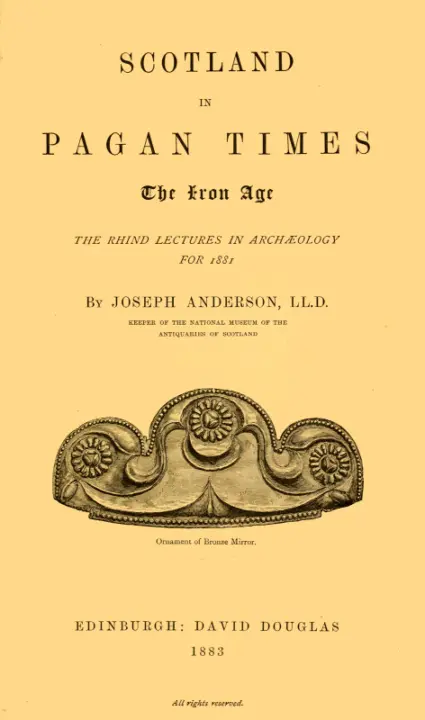
THE CLASSIC COLLECTION · 1883
"Scotland in Pagan Times; The Iron Age" by Joseph Anderson is a historical account written in the late 19th century. This work comprises a series of lectures focusing on the archaeological investigations of the Pagan period in Scotland, especially during the Iron Age. It aims to explore burial customs and artifacts from this era, providing insights into the culture and civilization of the time. The opening of the text sets the stage for a detailed examination of burial practices, distinctively separating Christian and Pagan customs, with Anderson emphasizing the archaeological importance of grave goods and cremation in Pagan burials. He discusses the transition from Pagan to Christian burial practices in Scotland, illustrated by the survival of certain elements in Christian ceremonies that have their roots in Pagan traditions. The section introduces foundational concepts, highlighting the significance of burial customs in understanding human culture, and suggests a methodical approach to analyzing archaeological evidence from this period.
Introduction adapted from the source catalogue; source summaries may be automatically generated.
Free to read · English · 90,489 words · No account needed
MAKE TIME FOR A GOOD BOOK
On by default. Untick to stop anonymous reading totals. Each page counts after 10 seconds in view. How this works.
Anonymous counting is on unless you have switched it off.
These vessels are figured and described by Mr. G. E. Roberts in the Mem. Soc. Anthrop. Lond., vol. i. p. 296.
No. 1, a flat-bottomed vessel, with an unsymmetrical four-sided outline, the corners slightly rounded, and the sides bulging from the bottom upwards, about 7 inches high.
No. 2, a tolerably symmetrical four-sided vessel of similar form, but thinner and better made, measuring 5½ inches in length, 5¼ inches in width, and 3½ inches high.
No. 3, a rude thick-sided vessel of the same form, 6½ inches long, 4½ inches high, and 4½ inches wide.
No. 4, a rudely-made and unsymmetrical vessel, oval in outline, flat-bottomed, the sides bulging from the bottom upwards, and slightly contracting towards the rim, about 4 inches in length, 3¾ inches in width, and 4 inches high.
No. 5, a small cup-shaped vessel, oval in shape, 4½ inches long, 3 inches broad, and 2¾ inches high.
No. 6, a rather neatly-made oval vessel, 4½ inches long, and 4 inches wide at the brim, contracting to 2½ inches long, and 2 inches wide at the base. It is the only one in the group which bears any ornament, the ornament consisting of two incised lines scored round the upper part of the vessel, immediately under the rim.
These burials in the Meikle Heog differ from all the others that have been described, inasmuch as they are burials unburnt. The character of the vessels is also different, inasmuch as they are not cinerary urns placed in the grave for the purpose of containing the burned bones of the interment. But the general form of the vessels is similar to that of those which are found in Orkney and the Fair Isle, containing burnt bones, and the character of the ornament and the nature of the material of which they are made is identical.
Two vessels of stone, of the same irregularly oval shape, but slightly more ornate in character (Fig. 58), were turned up by the plough on the farm of Aucorn, in the parish of Wick, in Caithness, in 1853. The larger vessel is flat-bottomed, oval, and furnished with handles projecting from its ends. It measures 17 inches in its longest diameter, and 16 inches in its shortest diameter at the mouth, and stands 13 inches high. The smaller vessel is without handles, measures 10 inches in greatest, and 9 inches in its least diameter at the mouth, and stands 8 inches high. The ornamentation of both these vessels is similar in character to that of all the others, consisting of incised lines drawn round the outside, immediately below the rim. Unfortunately their contents were neither examined nor preserved, but Mr. Rhind states that it has been observed that the grain grows greener and richer on the spot where they were turned up than anywhere else in the field; and he infers from this, as well as from the character of the vessels themselves, that they were deposited with an interment or interments after cremation.
Your reading position is saved on this browser. Take it to another device with a library code. Reading pages adapt to text, rather than matching a printed edition.
BEHIND THE BOOK
This eBook is for the use of anyone anywhere in the United States and most other parts of the world at no cost and with almost no restrictions whatsoever. You may copy it, give it away or re-use it under the terms of the Project Gutenberg License included with this eBook or online at www.gutenberg.org. If you are not located in the United States, you will have to check the laws of the country where you are located before using this eBook. Read the source licence.
The original source file, including credits and licence, is retained by this library. Request an original-format copy at no charge. Please include the book title and Project Gutenberg identifier #57812.
KEEP YOUR CURIOSITY GOING
Cécile Tormay

Moritz Busch
John L. Ransom
Frances Wright
Cécile Tormay

Mabel Potter Daggett