THE CLASSIC COLLECTION✦An outlaw’s diary: the CommuneCLASSIC FREE BOOKS
An outlaw’s diary: the Commune
Cécile Tormay
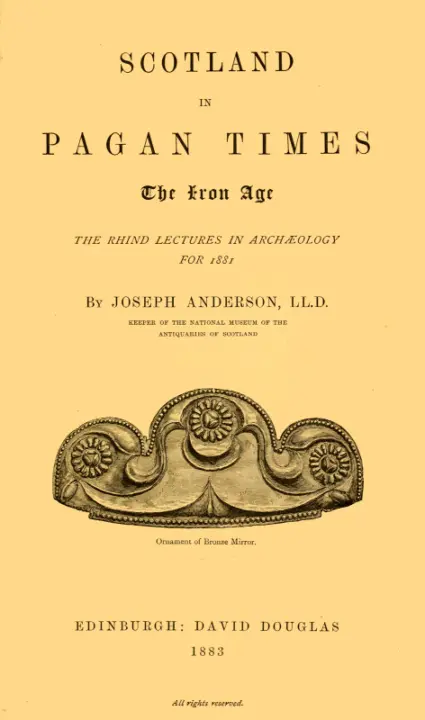
THE CLASSIC COLLECTION · 1883
"Scotland in Pagan Times; The Iron Age" by Joseph Anderson is a historical account written in the late 19th century. This work comprises a series of lectures focusing on the archaeological investigations of the Pagan period in Scotland, especially during the Iron Age. It aims to explore burial customs and artifacts from this era, providing insights into the culture and civilization of the time. The opening of the text sets the stage for a detailed examination of burial practices, distinctively separating Christian and Pagan customs, with Anderson emphasizing the archaeological importance of grave goods and cremation in Pagan burials. He discusses the transition from Pagan to Christian burial practices in Scotland, illustrated by the survival of certain elements in Christian ceremonies that have their roots in Pagan traditions. The section introduces foundational concepts, highlighting the significance of burial customs in understanding human culture, and suggests a methodical approach to analyzing archaeological evidence from this period.
Introduction adapted from the source catalogue; source summaries may be automatically generated.
Free to read · English · 90,489 words · No account needed
MAKE TIME FOR A GOOD BOOK
On by default. Untick to stop anonymous reading totals. Each page counts after 10 seconds in view. How this works.
Anonymous counting is on unless you have switched it off.
Including those found in the Viking cemetery at Pierowall, in Westray, Orkney, the total number of these brooches found in Scotland is thirty-two. The total number of Celtic brooches that I was able to enumerate was fourteen. The difference is striking, and the fact that the foreign form occurs in larger numbers than the native form is so opposed to what is naturally expected, that the explanation becomes of some interest. It is simple, but significant. The largeness of the larger number is an archæological result of Paganism. The smallness of the smaller number is an archæological result of Christianity. The effect of Paganism was that those who had brooches were buried with them. The effect of Christianity was that brooches ceased to be buried with those who had them. The tendency of the one system was to take all the brooches ultimately into the soil with the remains of the generations that wore them; the tendency of the other system was to keep the brooches from going underground. Hence we see that the preponderance of these foreign relics in the soil of Scotland (which is almost destitute of native relics of the same age and purpose) is an archæological result which is directly dependent on the difference between Paganism and Christianity.
I now proceed to notice other instances in which burials with grave-goods of a similar character, though differing more or less in certain special features, have been observed. It is but recently that they have attracted attention, and the interest and significance of their peculiar phenomena is only beginning to be understood.
About fifty years ago, a grave-mound situated between the chapel of St. Donan and the shore in the island of Eigg, was levelled by the tenant of the land. No observations of the phenomena of the burial were made, but the objects found were fortunately preserved.[35] The principal object found in this grave-mound was a sword-hilt of bronze (Fig. 36), 7½ inches in length. In its form it resembles the hilt of the Islay sword, but is greatly superior to it in the beauty of its ornamentation and the skill of its workmanship. Indeed, I know no finer or more elaborate piece of art workmanship of the kind, either in this country or in Norway. It is constructed in four pieces—the triangular pommel, the cross-piece under it, the grip, and the guard. Each of these has been cast and worked separately, and they are all united by [Illustration: Fig. 37.—Side view of Pommel of Sword-hilt.] the tang of the blade which passes up through them. The decoration is difficult to describe, but it is not difficult to perceive the harmony, elegance, and fitness of the general design. Each of the four parts is treated with reference to its decoration as a separate whole, but they also combine to give to the entire object a completely harmonious design. The triangular pommel is placed upon a cross-piece answering in character to the cross-piece below the grip, and the grip answers in character to both. The ends of the pommel are formed as heads of animals, the zoomorphism more suggested than expressed, and more distinct in the front view of the whole hilt (Fig. 36) than in the side view of the pommel alone as here represented (Fig. 37). The grip and the cross-piece below it are all decorated in the same style, with a beautiful pattern formed of a series of arcaded spaces with quadrate ornaments between. The patterns chased in the arcaded spaces are apparently zoomorphic in character, and the quadrate ornaments between them are plates of silver pinned on to the bronze, a circle being incised round every pin head, and each pair of circles connected by a line drawn from the right side of the one to the left side of the other, so as to resemble an S-shaped scroll. The edges of the grip (Fig. 38) are ornamented with three sunk panels of interlaced work alternating with four plain panels. The upper side of the guard (Fig. 39) has two ornaments of similar character, each consisting of four loops round a pellet, the bands composing the loops crossing each other in the centre of the figure. There is nothing that is distinctively Celtic in the style of this interlaced work. Indeed, there is so little of it, that it would be difficult, from this specimen alone, to form any opinion as to the relations of interlaced ornament to the system of decoration characteristic of the Viking period. I have already stated that the mere presence of interlaced work is not a feature which can be relied on as a certain indication either of the Celtic or the Scandinavian character of the ornament of which it forms a part. In consequence of the close intercourse which subsisted between the areas of the two distinctive schools of art during the Viking time, the influence of the one upon the other is traceable in such transitional styles as that of the Manx crosses and the decorations of the Skaill brooches to be hereafter described. And the Celtic manner, with a Scandinavian spirit, is distinctly discernible in the decoration of a sword-hilt (Fig. 40) found in a grave-mound of the Viking time at Ultuna, in Sweden.[36]
Your reading position is saved on this browser. Take it to another device with a library code. Reading pages adapt to text, rather than matching a printed edition.
BEHIND THE BOOK
This eBook is for the use of anyone anywhere in the United States and most other parts of the world at no cost and with almost no restrictions whatsoever. You may copy it, give it away or re-use it under the terms of the Project Gutenberg License included with this eBook or online at www.gutenberg.org. If you are not located in the United States, you will have to check the laws of the country where you are located before using this eBook. Read the source licence.
The original source file, including credits and licence, is retained by this library. Request an original-format copy at no charge. Please include the book title and Project Gutenberg identifier #57812.
KEEP YOUR CURIOSITY GOING
Cécile Tormay

Moritz Busch
John L. Ransom
Frances Wright
Cécile Tormay

Mabel Potter Daggett