THE CLASSIC COLLECTION✦An outlaw’s diary: the CommuneCLASSIC FREE BOOKS
An outlaw’s diary: the Commune
Cécile Tormay
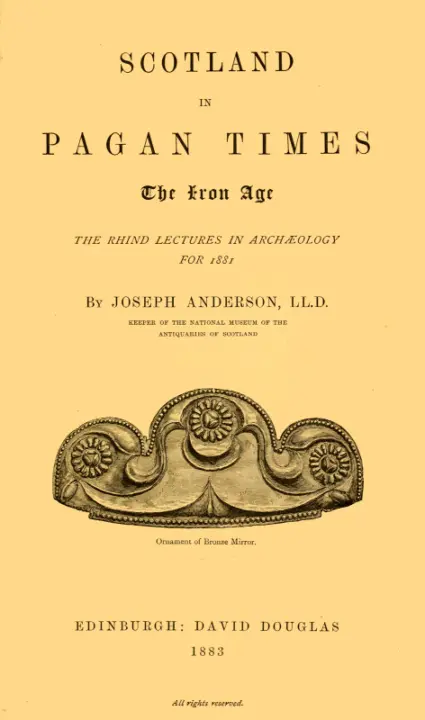
THE CLASSIC COLLECTION · 1883
"Scotland in Pagan Times; The Iron Age" by Joseph Anderson is a historical account written in the late 19th century. This work comprises a series of lectures focusing on the archaeological investigations of the Pagan period in Scotland, especially during the Iron Age. It aims to explore burial customs and artifacts from this era, providing insights into the culture and civilization of the time. The opening of the text sets the stage for a detailed examination of burial practices, distinctively separating Christian and Pagan customs, with Anderson emphasizing the archaeological importance of grave goods and cremation in Pagan burials. He discusses the transition from Pagan to Christian burial practices in Scotland, illustrated by the survival of certain elements in Christian ceremonies that have their roots in Pagan traditions. The section introduces foundational concepts, highlighting the significance of burial customs in understanding human culture, and suggests a methodical approach to analyzing archaeological evidence from this period.
Introduction adapted from the source catalogue; source summaries may be automatically generated.
Free to read · English · 90,489 words · No account needed
MAKE TIME FOR A GOOD BOOK
On by default. Untick to stop anonymous reading totals. Each page counts after 10 seconds in view. How this works.
Anonymous counting is on unless you have switched it off.
In 1845 a similar burial was discovered in the strath near Newton Distillery, also in Islay. No record of the circumstances is preserved, but two oval bowl-shaped brooches (Fig. 30) and an amber bead, which were found in the grave, are in the possession of Mr. John Campbell of Islay. The brooches are each 4⅛ inches in length, 2¾ inches in width, and 1 inch in height. The pins had been of iron and are gone, but the hinge and catch are still traceable. These brooches differ from those that have been already described, inasmuch as they are not double shelled but cast in one piece, that is, they are made of a single shell, which is chased, but not pierced in open-work patterns. The division and the arrangement of the patterns are much the same as in those first described, but there are no channels in the partitions for silver wires, and the partitions themselves are ornamented with a species of fret. The circular spaces at the junctions of the partitions have been ornamented with studs of paste pinned on, but studs and pins are both gone. The patterns of the ornamentation are executed with a graving tool, but they exhibit so little coherency of design that it is impossible to call them zoomorphic.[24]
Footnote 24:
A similar grave was found in Mull, and the brooches are in the possession of Lord Northampton at Torloisk, but I have no further information regarding them.
In the old Statistical Account of Tiree it is stated that, in digging at Cornaigbeg, there were found at different times human skeletons, and nigh them skeletons of horses. Swords, it is said, were also found, but diminished with rust,—silver-work preserved the handles; there were also shields and helmets. In March 1847 an oval bowl-shaped brooch of this special character, which had been found in Tiree, was exhibited to the Society by Sir John Graham Dalzell, but it was not left in the Museum, and it is not now known what became of it. But in 1872, the late Rev. Dr. Norman Macleod presented to the Museum a brooch of this character found in Tiree (Fig. 31), which is almost precisely of the same pattern as those first found in Islay. It is 4¼ inches in length, 2¼ inches in breadth, and 1½ inch in height. It is double, and is here figured with the upper and under shells separated from each other so as to show the manner in which they were fitted and pinned together, so that the smooth-gilded surface of the under shell might shine through the pierced work of the upper. This brooch also presents a peculiar appearance common to them all, but which, in this instance, is strongly marked. The interior of the under shell is impressed with the texture of coarse cloth so distinctly, that the size, number, and interweaving of the threads are as visible as in the web. The cloth seems to be coarse linen, and the appearance is really an impression cast in the metal. These under shells were probably cast in moulds prepared in this way—the side of the mould corresponding to the convex surface with its ornamental border was cut in soft stone, a thickness of wet cloth was then fitted into it corresponding to the thickness of the metal, and over this a lump of clay was rammed hard; the clay was lifted and the cloth removed, thus leaving a cavity for the metal;[25] the clay became one side of the mould and the stone the other, and, when the metal was run in, it produced a cast of the impression of the cloth retained upon the backing of clay. Thus these brooches present castings in metal of the textile fabrics of the eighth and ninth centuries, showing the thickness of its threads, the method of weaving, and the general finish of the fabric. But there is a still more interesting circumstance connected with them in respect to the cloth of the period when they were made and worn. In some instances they have not only preserved casts in the metal of the impression of cloth in the clay of the mould, but have actually preserved portions of the dress in which they were worn, or in which they were fixed when committed to the grave with the body of the wearer. I have already stated that they have usually had pins of iron, now represented by a lump of oxidation. In this brooch from Tiree, and also in one which I brought from Hakedalen, near Christiania, I have ascertained by careful examination of this lump of oxidation that it has enclosed and protected from decay a minute portion of puckered cloth which had been caught between the point of the thick pin and the iron catch into which it slipped when the brooch was fastened on the dress. I have been able to remove and mount for microscopical examination some small scraps of this cloth. It appears to be linen, but with a partial admixture of another fibre, which may be hemp, and I can detect no material difference between the cloth in the specimen from Norway and that from the island of Tiree on our own western coast.
Your reading position is saved on this browser. Take it to another device with a library code. Reading pages adapt to text, rather than matching a printed edition.
BEHIND THE BOOK
This eBook is for the use of anyone anywhere in the United States and most other parts of the world at no cost and with almost no restrictions whatsoever. You may copy it, give it away or re-use it under the terms of the Project Gutenberg License included with this eBook or online at www.gutenberg.org. If you are not located in the United States, you will have to check the laws of the country where you are located before using this eBook. Read the source licence.
The original source file, including credits and licence, is retained by this library. Request an original-format copy at no charge. Please include the book title and Project Gutenberg identifier #57812.
KEEP YOUR CURIOSITY GOING
Cécile Tormay

Moritz Busch
John L. Ransom
Frances Wright
Cécile Tormay

Mabel Potter Daggett