THE CLASSIC COLLECTION✦An outlaw’s diary: the CommuneCLASSIC FREE BOOKS
An outlaw’s diary: the Commune
Cécile Tormay
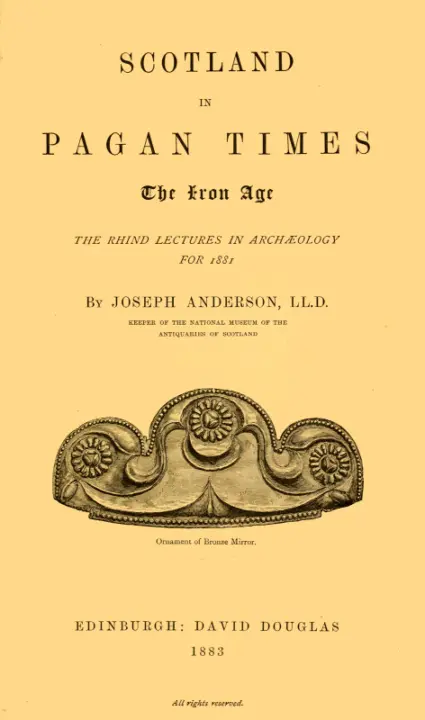
THE CLASSIC COLLECTION · 1883
"Scotland in Pagan Times; The Iron Age" by Joseph Anderson is a historical account written in the late 19th century. This work comprises a series of lectures focusing on the archaeological investigations of the Pagan period in Scotland, especially during the Iron Age. It aims to explore burial customs and artifacts from this era, providing insights into the culture and civilization of the time. The opening of the text sets the stage for a detailed examination of burial practices, distinctively separating Christian and Pagan customs, with Anderson emphasizing the archaeological importance of grave goods and cremation in Pagan burials. He discusses the transition from Pagan to Christian burial practices in Scotland, illustrated by the survival of certain elements in Christian ceremonies that have their roots in Pagan traditions. The section introduces foundational concepts, highlighting the significance of burial customs in understanding human culture, and suggests a methodical approach to analyzing archaeological evidence from this period.
Introduction adapted from the source catalogue; source summaries may be automatically generated.
Free to read · English · 90,489 words · No account needed
MAKE TIME FOR A GOOD BOOK
On by default. Untick to stop anonymous reading totals. Each page counts after 10 seconds in view. How this works.
Anonymous counting is on unless you have switched it off.
An iron object, having a wide socket at one end of a long shank (Fig.
9).
A conical iron object with the remains of wood adhering to the
interior surface (Fig. 10).
A number of fragments of corrugated iron (Fig. 11).
A hollow cylindrical object of bronze with a globular end, probably the mounting of the end of a small sheath (Fig. 13).
An iron axe-head, not differing greatly from the modern form, the eye
broken (Fig. 14).
An iron axe-head of similar form, but longer in the shank, the eye entire (also shown in Fig. 14).
The iron head of a small adze, nearly entire (Fig. 15).
The iron head of a hammer, entire (Fig. 16).
A pair of forge-tongs, partially broken (Fig. 17).
The broken fragments of a large iron pot, and its bow-handle, broken
(Fig. 18).
In grave No. 2 he found the following objects deposited with the
skeleton:—
A pair of oval bowl-shaped brooches of bronze, ornamented with pierced and chased work and with plaited bands of silver wire and studs, of which the pins only remain (Fig. 20).
The brass spring-pins of the two brooches (Fig. 19).
Portions of three pairs of discs of thin bronze, plated with silver, each pair connected by a narrow band, the discs ornamented with bosses arranged in circles, and the bands with borders all in repoussé work (Fig. 21).
A silver hair-pin with a globular head, ornamented with filigree work, and furnished with a ring of wire fastened by a peculiar twisting of one end round the other (Fig. 22).
A silver chain-like ornament, formed of fine silver wire knitted as a hollow tube, knotted at the two ends, and furnished at one end with a ring fastened by a peculiar twisting of the ends round each other (Fig. 23).
Seven beads of coloured glass, enamelled on the surface with patterns in different colours (Fig. 24).
A saucepan of thin bronze, with a long flat handle (Fig. 25).
A hemispherical lump of black glass, in shape nearly resembling the bottom of a bottle, and having its convex side rubbed and striated by use (Fig. 26).
A small object like a needle-case, of silver, broken, and containing what seems to be a portion of a broken needle of bronze.
Your reading position is saved on this browser. Take it to another device with a library code. Reading pages adapt to text, rather than matching a printed edition.
BEHIND THE BOOK
This eBook is for the use of anyone anywhere in the United States and most other parts of the world at no cost and with almost no restrictions whatsoever. You may copy it, give it away or re-use it under the terms of the Project Gutenberg License included with this eBook or online at www.gutenberg.org. If you are not located in the United States, you will have to check the laws of the country where you are located before using this eBook. Read the source licence.
The original source file, including credits and licence, is retained by this library. Request an original-format copy at no charge. Please include the book title and Project Gutenberg identifier #57812.
KEEP YOUR CURIOSITY GOING
Cécile Tormay

Moritz Busch
John L. Ransom
Frances Wright
Cécile Tormay

Mabel Potter Daggett