THE CLASSIC COLLECTION✦An outlaw’s diary: the CommuneCLASSIC FREE BOOKS
An outlaw’s diary: the Commune
Cécile Tormay
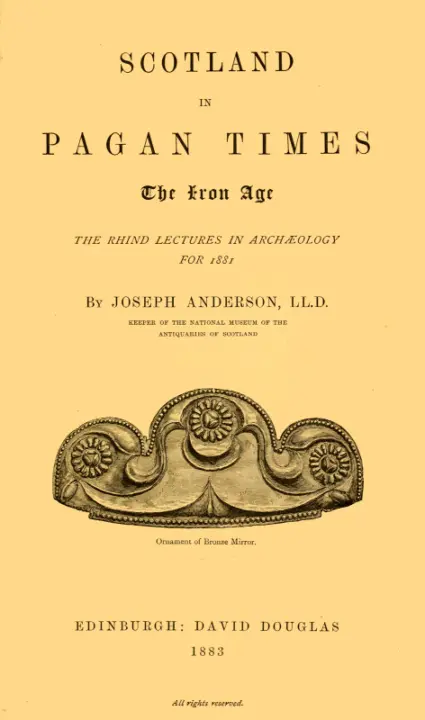
THE CLASSIC COLLECTION · 1883
"Scotland in Pagan Times; The Iron Age" by Joseph Anderson is a historical account written in the late 19th century. This work comprises a series of lectures focusing on the archaeological investigations of the Pagan period in Scotland, especially during the Iron Age. It aims to explore burial customs and artifacts from this era, providing insights into the culture and civilization of the time. The opening of the text sets the stage for a detailed examination of burial practices, distinctively separating Christian and Pagan customs, with Anderson emphasizing the archaeological importance of grave goods and cremation in Pagan burials. He discusses the transition from Pagan to Christian burial practices in Scotland, illustrated by the survival of certain elements in Christian ceremonies that have their roots in Pagan traditions. The section introduces foundational concepts, highlighting the significance of burial customs in understanding human culture, and suggests a methodical approach to analyzing archaeological evidence from this period.
Introduction adapted from the source catalogue; source summaries may be automatically generated.
Free to read · English · 90,489 words · No account needed
MAKE TIME FOR A GOOD BOOK
On by default. Untick to stop anonymous reading totals. Each page counts after 10 seconds in view. How this works.
Anonymous counting is on unless you have switched it off.
Among the rubbish thrown out in the course of the excavation there was found a beautiful spiral bronze bracelet of the form of a double serpent, decorated in that peculiar style of art which has been described in the third Lecture of this course as the precursor or earlier development of the art of the Celtic Christian time.[114] Here we find the earlier art associated with this peculiar type of structure, and with a manner of sepulture which is destitute of all indications of Christianity. It is associated also with wheel-made pottery of a type that is only found in situations suggestive of Roman intercourse, and therefore indicates a period when Christianity had not yet supplanted the Paganism of the country. It was also in a precisely similar association with one of these underground structures that the massive bronze armlets (Figs. 115, 116), described in the same Lecture, were discovered at Castle Newe. They also are decorated in this peculiar style of art and enriched with enamels. Their workmanship evinces skill and taste of a very high order, and the occurrence of these works of art in such associations may serve to remind us how greatly we should have erred if we had estimated the capacity and culture of the inhabitants of these structures by their architectural character alone, or if we had measured their condition and acquirements merely by the fact that they burrowed under ground.
Footnote 114:
This bracelet is described and figured as Fig. 140, at p. 160 of this volume in the Lecture on the Celtic Art of the Pagan Period.
Another structure of the same type (Fig. 260), but of larger dimensions, was discovered in 1871 in a field at Tealing. It was 80 feet in length measured along the curve, 3 feet wide at the entrance and widening gradually to 8½ feet at the inner end, where it is a little more than 6 feet high. It has checks for a door at a little distance within the entrance, and a second pair about 16 feet from the farther end. The usual evidences of occupation were found in the presence of ashes, charcoal, and animal bones throughout the excavation. The manufactured relics unfortunately have neither been described nor figured, although they constitute the largest and most varied collection of objects ever obtained from such a structure. They are enumerated by Mr. Jervise as follows:—A piece of the red lustrous ware commonly called Samian, a bracelet, bronze rings, and coarse pottery, no fewer than ten querns, a number of whorls and stone cups, and an article made of iron slightly mixed with brass. The occurrence of the red lustrous ware in these Earth-houses, as well as in the Brochs and Crannogs, is an indication of the period of the occupation of these structures which is of great significance. The large size of the gallery, in the present instance, and the occurrence in it of ten querns, indicate that it was frequented by a considerable number of people. It has another feature of interest in the presence, on one of the rude boulders which form the walls, of a number of cup-markings, one of which is surrounded by five concentric circles. Another stone with forty-six cup-markings on it lay on the margin of a circular paved space close to the entrance of the structure. These cup-markings form one of the enigmas of archæology. They are shallow pits, roughly hemispherical in form, hollowed by pointed tools in the surfaces of rocks, boulders, and standing stones. Sometimes they are on vertical surfaces, sometimes on horizontal surfaces, occasionally on the under surfaces of stones placed as the covers of cists. Most frequently the cups are simple rounded hollows, but very frequently they are surrounded by a series of concentric circles of varying number, and often a straight gutter proceeds from the central cup through the circles. They are sometimes hewn in groups upon the solid rock of a hillside, sometimes on earth-fast boulders, occasionally on the stones of stone circles, and often on stones in sepulchral cairns or in connection with cists. They are not confined to Scotland, or even to Britain. They are found in Scandinavia, in France, in Germany, and Switzerland. They appear on the Continent in associations which refer them to the Bronze Age at least, but they also occur in associations which show that the custom survived to the late Iron Age, and even in a modified form to Christian times. Their occurrence here, in connection with this underground structure, has therefore no special significance with respect to the age of the structure, and there is nothing in the association or the circumstances in which they occur in this particular instance which contributes to our knowledge of the purpose or significance of the markings themselves. They may or may not have been sculptured on the stone before it was taken to form part of this underground gallery, and the only thing they tell us for certain is that here, at some time or other, there was a custom of which traces are found scattered over a wide area of Western Europe.
Your reading position is saved on this browser. Take it to another device with a library code. Reading pages adapt to text, rather than matching a printed edition.
BEHIND THE BOOK
This eBook is for the use of anyone anywhere in the United States and most other parts of the world at no cost and with almost no restrictions whatsoever. You may copy it, give it away or re-use it under the terms of the Project Gutenberg License included with this eBook or online at www.gutenberg.org. If you are not located in the United States, you will have to check the laws of the country where you are located before using this eBook. Read the source licence.
The original source file, including credits and licence, is retained by this library. Request an original-format copy at no charge. Please include the book title and Project Gutenberg identifier #57812.
KEEP YOUR CURIOSITY GOING
Cécile Tormay

Moritz Busch
John L. Ransom
Frances Wright
Cécile Tormay

Mabel Potter Daggett