THE CLASSIC COLLECTION✦An outlaw’s diary: the CommuneCLASSIC FREE BOOKS
An outlaw’s diary: the Commune
Cécile Tormay
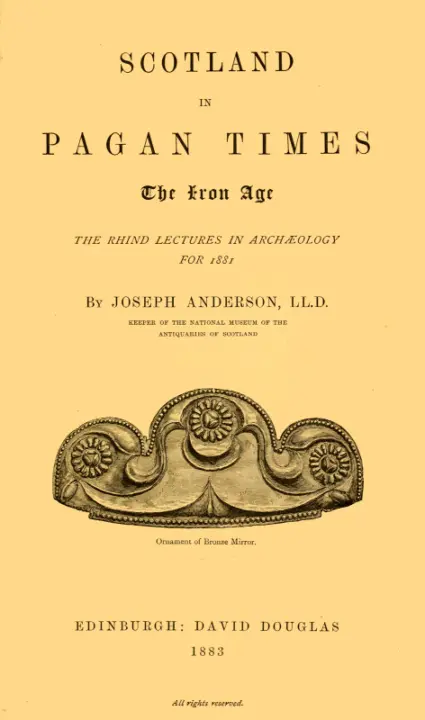
THE CLASSIC COLLECTION · 1883
"Scotland in Pagan Times; The Iron Age" by Joseph Anderson is a historical account written in the late 19th century. This work comprises a series of lectures focusing on the archaeological investigations of the Pagan period in Scotland, especially during the Iron Age. It aims to explore burial customs and artifacts from this era, providing insights into the culture and civilization of the time. The opening of the text sets the stage for a detailed examination of burial practices, distinctively separating Christian and Pagan customs, with Anderson emphasizing the archaeological importance of grave goods and cremation in Pagan burials. He discusses the transition from Pagan to Christian burial practices in Scotland, illustrated by the survival of certain elements in Christian ceremonies that have their roots in Pagan traditions. The section introduces foundational concepts, highlighting the significance of burial customs in understanding human culture, and suggests a methodical approach to analyzing archaeological evidence from this period.
Introduction adapted from the source catalogue; source summaries may be automatically generated.
Free to read · English · 90,489 words · No account needed
MAKE TIME FOR A GOOD BOOK
On by default. Untick to stop anonymous reading totals. Each page counts after 10 seconds in view. How this works.
Anonymous counting is on unless you have switched it off.
The Broch that has yielded the largest and most interesting collection of objects is that of Burrian in the island of North Ronaldsay, excavated by Dr. William Traill of Woodwick, the proprietor of the island. The structure was essentially similar to those that have been previously described. The wall of the tower was 15 feet thick at the base, enclosing an area of 30 feet in diameter. The greatest height of the wall remaining was 10 feet. The doorway was on the south-east side facing the sea. It was 3 feet 3 inches wide at the outer face of the wall, and had checks for a door consisting of two slabs projecting on either side of the passage so as to narrow the aperture to 2 feet 10 inches. Within the door-checks the passage widened to 4 feet 3 inches. There was but one chamber in the thickness of the wall on the north-east side of the tower. It measured 9 feet 9 inches by 5 feet 9 inches on the floor, and was about 5 feet high, the roof having fallen in. The entrance from the interior court to the chamber was 3 feet 3 inches high, and 2 feet 2 inches wide. [Illustration: Fig. 224.—Bone Implement from Broch of Burrian (5½ inches in length).] The objects found in the course of the excavations consisted of a large number of hammer-stones or oblong water-worn pebbles wasted at the ends by use, a number of querns and grain-rubbers, sinkstones, pieces of black vesicular lava, roughly pear-shaped, with holes bored through their smaller ends, and circular discs of thin slaty stone of various sizes. [Illustration: Fig. 225.—Bone Pins, with ornamental heads, from Broch of Burrian (actual size).] Among the objects made of bone, which were exceptionally numerous, were an implement of bone 5½ inches in length (Fig. 224), made from the radius or wing-bone of a bird by cutting it obliquely across at one end, and grinding the section smooth; ninety pins of bone varying in size from 4¾ inches to somewhat less than 1¼ inch in length, many of which have ornamental heads of the character shown in Fig. 225, while others of larger size are of the forms shown in Fig. 226, a large number are crutch-headed like Fig. 227, while one neatly-made pin with a rounded body (Fig. 228) is [Illustration: Fig. 226.—Bone Pins from Broch of Burrian (actual size).] cleverly ornamented by its head being carved in the similitude of two horses’ heads looking opposite ways, and another coarsely-made pin without a head (Fig. <span class='htmlonly'>229</span><span class='epubonly'>229</span>) is marked with transverse scorings. [Illustration: Fig. 227.—Crutch-headed Bone Pin from Broch of Burrian (actual size).] Besides the pins there are three needles of bone with elongated eyes, one broken, the others (Figs. 230, 231) 2¼ and 1¾ inches in length respectively. [Illustration: Figs. 228, 229.—Bone Pin with ornamental head, and pin with transverse markings, from Broch of Burrian (actual size).] There are also a number of pegs of bone, roughly finished, varying in length from 3 inches to 1½ inch, and from nearly ¼ inch to about ⅛ inch diameter. [Illustration: Figs. 230, 231.—Bone Needles from Broch of Burrian (actual size).] These have evidently been used in pegging slips of bone or wood, and several slips of bone, about 3½ inches in length, convex on one side and flat on the other, occur among the relics, two of them having the pegs still in the holes. There are also a large number of shaped pieces of bone and deer-horn which might have served as the handles of small implements—hafts of knives, and suchlike. Among the smaller objects of bone there are several button-like articles, one apparently the half of a square-shaped stud or button of ivory with a small hole for the shank discoloured by oxide of iron, and two others made from short sections of the shank-bone of a sheep. One of these has the iron shank still in the hole. Akin to these in the manner of their formation are several playing dice, manufactured from sheep [Illustration: Fig. 232.—One of a set of Dice made from a sheep shank-bone found in the Broch of Burrian (actual size).] shank-bones. They are simple sections of the shank-bone 1⅝ inch in length, with one or more of the sides rubbed smooth and marked with the customary numbers in the shape of dots and circles. The one here figured (Fig. 232) is ground smooth on one side, on which there are six points; on the convexity of the bone there are five points; on the naturally flattened side of the bone (which is broken) there are no markings to be seen at the ends, but the centre portion shows one marking. The second example has only one side of the bone remaining, which shows four points. The surface of the bone has scaled off the third example, and obliterated the numbers.[88] Among the miscellaneous articles of bone to which no definite use can be assigned, although they are obviously tools or implements intended for special purposes, there is one (Fig. 233), strongly made of a roughly cut bone, having a rounded point with two grooves cut in it so as to have prominent parallel ridges between and on either side of them. [Illustration: Fig. 233.—Tool of Bone found in the Broch of Burrian (actual size).] Among the objects of personal use are sixteen combs, most of them more or less broken, but several still in a fair state of preservation. [Illustration: Fig. 234.—Round-backed Comb of Bone from Broch of Burrian (half actual size).] [Illustration: Fig. 235.—Double-edged Comb of Bone from Broch of Burrian (half actual size).] One is round-backed and single-edged (Fig. 234), measuring 3 inches by 2 inches, the back pierced with three triplets of small holes, and ornamented with a profusion of dots and circle markings. It is formed of five thin slips of bone laid together lengthwise, and held in their places by two slips laid transversely across them on opposite sides, and fastened by four iron rivets. The teeth of the comb have been very regularly cut by a fine saw, and the saw-marks on the under edges of the transverse slips show that the cutting of the teeth was performed after the pieces of the comb were fastened together. The rest of the combs are all double-edged. One measuring 2¾ inches by 2 inches (Fig. 235), is formed of four slips of bone inserted between two transverse slips, and held together by three rivets of iron. [Illustration: Fig. 236.—Double-edged Comb of Bone from Broch of Burrian (5½ inches in length).] The transverse slips are ornamented by a single line incised along each border, and by four sets of two concentric circles with central dots ranged at equal distances along the centre of the slips. The teeth are widely but regularly cut, narrowing towards the points, and those towards the sides of the comb shorter than those in the middle. Another comb of the same character (Fig. 236) measures 5½ inches in length, by 2 inches in breadth. This is the largest comb obtained from a Broch. It is formed of six slips of bone enclosed between two transverse slips fastened by five rivets of iron. Above and below each rivet is an ornamented dot and circle marking. A similar marking is placed in the centre of each of the broad terminal teeth at either end of the comb. The transverse slips are much marked by the saw. The teeth are well cut and regular in length and thickness; they show strongly the marks of wear by use, chiefly towards their bases, where minute transverse lines are worn deeply into the corners of the teeth, almost completely encircling them. Besides these combs for the hair, there were found no fewer than eighteen of the long-handled combs, which are of such frequent occurrence among the relics recovered from Brochs. That shown in Fig. 233 appears to be of deerhorn, but they are mostly made from portions of the outer table of the jaw-bone of the whale. They vary in length from 3 inches to 5½ inches. [Illustration: Fig. 237.—Long-handled Comb from the Broch of Burrian, Orkney (4¾ inches in length).] They also vary considerably in the size and form of the teeth, some, like Fig. 238, having teeth that are short and pointed, and rounded in section, while the teeth of others, like those in Fig. 239, are longer, less pointed, and more rectangular in section. [Illustration: Fig. 238.—Long-handled Comb from the Broch of Burrian (4¼ inches in length).] It has been already stated that sixteen combs of the ordinary single and double-edged forms which are characteristic of the comb used for the hair were found in this Broch. [Illustration: Fig. 239.—Long-handled Comb from the Broch of Burrian (4 inches in length).] It is therefore probable that these eighteen long-handled combs were intended for some other purpose. They are not only unfitted by their clumsiness for this special and personal use, but the strength of the teeth, their coarseness, and the manner in which they are marked by the use to which they have been put are suggestive of implements for some manufacturing process rather than objects of the toilet. Another circumstance of their association is of some importance in the inquiry as to the nature of their special purpose. There is only one other implement which occurs with equal frequency in collections made from Brochs. In this same Broch, which yielded sixteen combs for the hair and eighteen of the long-handled implements, there were upwards of thirty spindle-whorls for spinning with the distaff and spindle. [Illustration: Fig. 240.—One of a number of Smoothing Implements of Bone from the Broch of Burrian (6½ inches in length).] As this implies the existence of a very considerable manufacture of thread, and as the presence of the industry of weaving is also suggested by the occurrence of a number of smoothing or calendering implements of bone (Fig. 240), which had seen much service, it is probable that these eighteen long-handled implements may have had some connection with the process of making cloth from the thread spun by the spindle-whorls. The evidence as to the special use of the implement is derived (1) from the specialty of its form—it is long-handled; and (2) from the marks of wear upon its teeth, which are more distinct towards the apices of the teeth than towards their bases. These marks are such as would result from combing fibres in the preparation of lint or even of wool for spinning; but for this use the implement is not well suited by its form, and the marks on the teeth are often such deeply-cut transverse lines, as would rather imply the contact and friction of threads. And it is the fact that a comb of this special form, long-handled, and having a few stout teeth on the end of the handle, was used in the operation of weaving when the warp was fixed upright, as it always was in the older form of loom. The purpose for which the comb was used was the driving of the weft home as each successive thread was passed through the upright sheds of the warp by the shuttle. Such weaving-combs were used by the Egyptians,[89] the Greeks, and the Romans,[90] and they continued in use throughout Europe even in late mediæval times. In some varieties of carpet-weaving, in which alone the upright mode of working is now retained, the weft is driven home by a similar instrument made of iron. The Hindoo weaver of the present day retains the form of the implement used by his remote ancestors, although the materials of which it is made are now wood and iron. [Illustration: Fig. 241.—Weaving-comb of Wood and Iron used in India (13 inches in length).] One such implement (Fig. <span class='htmlonly'>241</span><span class='epubonly'>241</span>) is in the National Museum. Although its teeth are of iron, a close examination suffices to show the marks of use, and in the iron comb as well as in those of bone, it is towards the apices and not towards the bases of the teeth that the transverse striations appear.[91]
Your reading position is saved on this browser. Take it to another device with a library code. Reading pages adapt to text, rather than matching a printed edition.
BEHIND THE BOOK
This eBook is for the use of anyone anywhere in the United States and most other parts of the world at no cost and with almost no restrictions whatsoever. You may copy it, give it away or re-use it under the terms of the Project Gutenberg License included with this eBook or online at www.gutenberg.org. If you are not located in the United States, you will have to check the laws of the country where you are located before using this eBook. Read the source licence.
The original source file, including credits and licence, is retained by this library. Request an original-format copy at no charge. Please include the book title and Project Gutenberg identifier #57812.
KEEP YOUR CURIOSITY GOING
Cécile Tormay

Moritz Busch
John L. Ransom
Frances Wright
Cécile Tormay

Mabel Potter Daggett