THE CLASSIC COLLECTION✦An outlaw’s diary: the CommuneCLASSIC FREE BOOKS
An outlaw’s diary: the Commune
Cécile Tormay
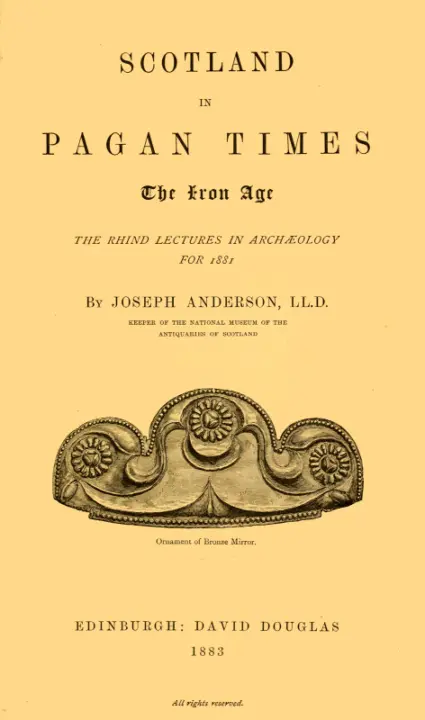
THE CLASSIC COLLECTION · 1883
"Scotland in Pagan Times; The Iron Age" by Joseph Anderson is a historical account written in the late 19th century. This work comprises a series of lectures focusing on the archaeological investigations of the Pagan period in Scotland, especially during the Iron Age. It aims to explore burial customs and artifacts from this era, providing insights into the culture and civilization of the time. The opening of the text sets the stage for a detailed examination of burial practices, distinctively separating Christian and Pagan customs, with Anderson emphasizing the archaeological importance of grave goods and cremation in Pagan burials. He discusses the transition from Pagan to Christian burial practices in Scotland, illustrated by the survival of certain elements in Christian ceremonies that have their roots in Pagan traditions. The section introduces foundational concepts, highlighting the significance of burial customs in understanding human culture, and suggests a methodical approach to analyzing archaeological evidence from this period.
Introduction adapted from the source catalogue; source summaries may be automatically generated.
Free to read · English · 90,489 words · No account needed
MAKE TIME FOR A GOOD BOOK
On by default. Untick to stop anonymous reading totals. Each page counts after 10 seconds in view. How this works.
Anonymous counting is on unless you have switched it off.
When excavated, the Broch of Yarhouse consisted of a circular wall, 12 to 13 feet thick, enclosing a central area, 30 feet in diameter. The height of the wall remaining was about 15 feet. The doorway which passes straight through the wall is about 6 feet high and 2½ wide, slightly narrower at top than at bottom, and well built with long flat slabs, some of which were 8 feet in length. The opening of the doorway into the interior area and recess above it are shown in Fig. 196. There were no guard-chambers or bar-holes, and the checks for the door were quite on the inner side of the wall. But this Broch stood on what was practically an island, cut off from the land by a ditch 25 to 30 feet wide, and the access to the doorway was carefully protected by the outworks to be subsequently described. Opening from the interior area to the left of the doorway was the entrance to the stair (Fig. 197), which also gave access to an oblong chamber at the stairfoot. The stair itself was 3 feet wide, and 16 steps up there was a landing, with a light hole or window looking into the interior of the Broch. Above the entrance to the stair there were also three windows, placed vertically over each other—all that remained of a vertical range of windows, such as we have seen in the case of Mousa, Dun Carloway, and the Glenelg Brochs. On the side of the area opposite to the doorway was an oblong chamber in the thickness of the wall, roofed in the usual manner by overlapping stones. In this Broch, as at Kintradwell, there was an interior wall, of inferior masonry, built against the main wall, and partially bonded into it at the door openings. This inner wall was 2½ feet thick, and rose to a height of 8 feet, where the wall-head formed a level scarcement all round the interior. Partition walls (shown at B in ground plan, Fig. 194) ran half way across the area from both sides of the doorway, and that on the right of the entrance bent at a right angle towards the Broch wall. These partitions were partly built, and partly formed of long slabs set on end. They rose to about 8 feet—the same height as the scarcement. The partitions and the inner wall forming the scarcement were founded on an accumulation of rubbish largely mixed with ashes and food refuse, which covered the original floor of the Broch to the depth of 12 to 14 inches. They were therefore clearly secondary constructions, made to adapt the Broch to the purposes of a secondary occupation. Outside the Broch wall are two long irregularly-shaped enclosures, and several smaller cells. The outer enclosure (D in plan, Fig. 194) is 100 feet in length, and varies in width from 6 to 20 feet. The length of the inner enclosure (C) is 70 feet, and its width about 12 feet. They have each a little cell, provided with door checks opening off them. In some places their walls remained entire to the height of 10 feet, without showing any sign of overlapping for a roof. Both these large oblong enclosures had irregular rows of long slabs set on end in their floors, as if to divide them into cattle stalls. A long covered way (A) leading to the entrance of the Broch traversed the N.E. end of these enclosures. It varied from about 3 feet wide at the door of the Broch to about 5 feet wide at the outer end, and had checks for doors at four different places in its length. The secondary character of all these exterior constructions was obvious from the fact that underneath their foundations there was a considerable depth of stones overlying the original soil, and mingled with ashes and food refuse. It was also evident that various occupations of the interior of the Broch had taken place from time to time, when the original floor had become covered with rubbish to a considerable depth. Partition walls were met with at three different levels, dividing the internal area on three different plans; the last being a partial partition, utilising only one side of the area, at a time when the original floor had become covered with 8 feet of stones and rubbish. The relics obtained in the course of the excavation were few in number compared with the size and apparent importance of the structure. No querns were found, but about a dozen grain rubbers and stones hollowed like mortars, large numbers of stone pestles, pounders, or hammer-stones, abraded at the ends by use; several whetstones (Figs. 198, 199), a large number of thin circular discs of slaty sandstone, from 2½ inches up to 14 or 15 inches in diameter, many stone balls 2½ to 3 inches diameter, a small rounded pebble of quartz, with a hole through it, a number of spindle-whorls of stone, and one of burnt clay. The objects in metal were a ring of bronze, half an inch in diameter, an armlet of bronze (Fig. 200), made of a wire 1⁄16-inch in diameter, square for half its length, and twisted so that the corners form a spiral pattern, the other half being the plain round wire. A few fragments of iron knives, and some indeterminate objects of small size, greatly corroded, were all the remains of iron implements that were found. The pottery was very abundant, but the fragments were in general small. Some were coarse and thick, others thin and fine; all unglazed, and entirely without ornament, except that some pieces showed a slightly everted lip. The animal remains included those of the reindeer (Figs. 201, 202) and red-deer, the horse, the ox, the sheep, the pig, the dog, and some undetermined birds and fish. Although the site is a long way from the sea, there was a considerable accumulation of the common shore shells, chiefly periwinkles and limpets. The occurrence of the remains of the reindeer among the refuse of the food of the occupants of the Brochs of the North of Scotland is a fact of much interest in various ways. It establishes the correctness of the statement made incidentally in the Orkneyinga Saga,[85] when, in recording the movements of Harald and Rognvald, Earls of Orkney, in the year 1158, the writer says that “every summer the Earls were wont to go over to Caithness, and up into the forests to hunt the red deer or the reindeer.” It also shows that in Scotland at least the association of reindeer remains with those of prehistoric man does not of itself or necessarily indicate extreme antiquity.
Your reading position is saved on this browser. Take it to another device with a library code. Reading pages adapt to text, rather than matching a printed edition.
BEHIND THE BOOK
This eBook is for the use of anyone anywhere in the United States and most other parts of the world at no cost and with almost no restrictions whatsoever. You may copy it, give it away or re-use it under the terms of the Project Gutenberg License included with this eBook or online at www.gutenberg.org. If you are not located in the United States, you will have to check the laws of the country where you are located before using this eBook. Read the source licence.
The original source file, including credits and licence, is retained by this library. Request an original-format copy at no charge. Please include the book title and Project Gutenberg identifier #57812.
KEEP YOUR CURIOSITY GOING
Cécile Tormay

Moritz Busch
John L. Ransom
Frances Wright
Cécile Tormay

Mabel Potter Daggett