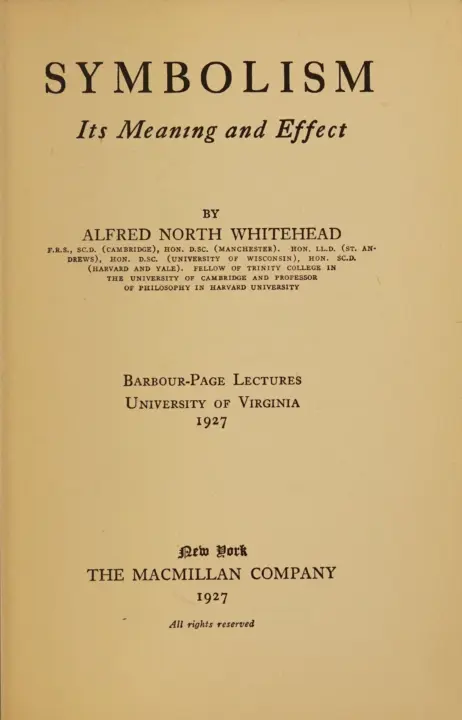
Symbolism, its meaning and effect
Alfred North Whitehead
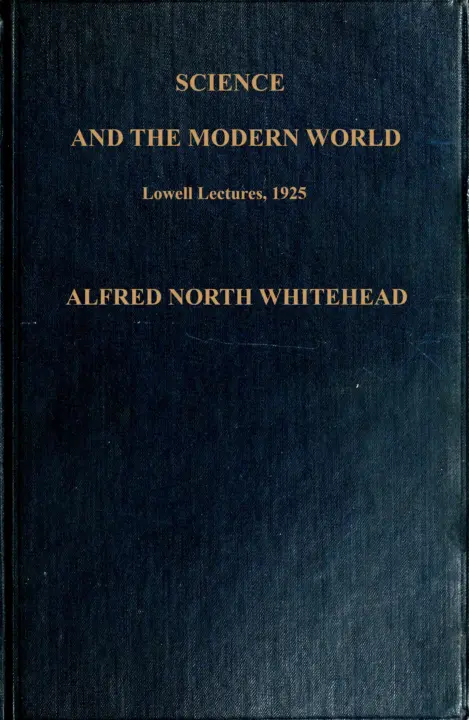
THE CLASSIC COLLECTION · 1925
"Science and the Modern World" by Alfred North Whitehead is a series of philosophical lectures presented in the early 20th century, specifically during the 1920s. This work examines the evolution of scientific thought and its profound impact on modern Western culture, framing science as a central force in shaping contemporary philosophy, religion, and ethical perspectives. Whitehead seeks to elucidate the historical context that led to the emergence of modern science and discusses how this scientific mindset has redefined humanity's understanding of nature and existence. At the start of the text, the author lays out his intention to explore the origins of modern scientific thought, tracing its roots back to significant intellectual upheavals that occurred during the Renaissance and the Reformation. He introduces critical figures such as Copernicus and Galileo, who challenged the accepted cosmologies of their times, and illustrates the transition from a predominantly theological worldview to one shaped by empirical observation and mathematical reasoning. Whitehead emphasizes the gradual yet transformative nature of this shift, asserting that the modern scientific mentality has recontextualized not only how people engage with nature but also the underlying metaphysical beliefs that influence wider societal structures.
Introduction adapted from the source catalogue; source summaries may be automatically generated.
Free to read · English · 79,948 words · No account needed
MAKE TIME FOR A GOOD BOOK
On by default. Untick to stop anonymous reading totals. Each page counts after 10 seconds in view. How this works.
Anonymous counting is on unless you have switched it off.
There have always been people who devoted their lives to definite regions of thought. In particular, lawyers and the clergy of the Christian churches form obvious examples of such specialism. But the full self-conscious realisation of the power of professionalism in knowledge in all its departments, and of the way to produce the professionals, and of the importance of knowledge to the advance of technology, and of the methods by which abstract knowledge can be connected with technology, and of the boundless possibilities of technological advance,—the realisation of all these things was first completely attained in the nineteenth century; and among the various countries, chiefly in Germany.
In the past human life was lived in a bullock cart; in the future it will be lived in an aeroplane; and the change of speed amounts to a difference in quality.
The transformation of the field of knowledge, which has been thus effected, has not been wholly a gain. At least, there are dangers implicit in it, although the increase of efficiency is undeniable. The discussion of various effects on social life arising from the new situation is reserved for my last lecture. For the present it is sufficient to note that this novel situation of disciplined progress is the setting within which the thought of the century developed.
In the period considered four great novel ideas were introduced into theoretical science. Of course, it is possible to show good cause for increasing my list far beyond the number four. But I am keeping to ideas which, if taken in their broadest signification, are vital to modern attempts at reconstructing the foundations of physical science.
Two of these ideas are antithetical, and I will consider them together. We are not concerned with details, but with ultimate influences on thought. One of the ideas is that of a field of physical activity pervading all space, even where there is an apparent vacuum. This notion had occurred to many people, under many forms. We remember the medieval axiom, nature abhors a vacuum. Also, Descartes’ vortices at one time, in the seventeenth century, seemed as if established among scientific assumptions. Newton believed that gravitation was caused by something happening in a medium. But, on the whole, in the eighteenth century nothing was made of any of these ideas. The passage of light was explained in Newton’s fashion by the flight of minute corpuscles, which of course left room for a vacuum. Mathematical physicists were far too busy deducing the consequences of the theory of gravitation to bother much about the causes; nor did they know where to look, if they had troubled themselves over the question. There were speculations, but their importance was not great. Accordingly, when the nineteenth century opened, the notion of physical occurrences pervading all space held no effective place in science. It was revived from two sources. The undulatory theory of light triumphed, thanks to Thomas Young and Fresnel. This demands that there shall be something throughout space which can undulate. Accordingly, the ether was produced, as a sort of all pervading subtle material. Again the theory of electromagnetism finally, in Clerk Maxwell’s hands, assumed a shape in which it demanded that there should be electromagnetic occurrences throughout all space. Maxwell’s complete theory was not shaped until the eighteen-seventies. But it had been prepared for by many great men, Ampère, Oersted, Faraday. In accordance with the current materialistic outlook, these electromagnetic occurrences also required a material in which to happen. So again the ether was requisitioned. Then Maxwell, as the immediate first-fruits of his theory, demonstrated that the waves of light were merely waves of his electromagnetic occurrences. Accordingly, the theory of electromagnetism swallowed up the theory of light. It was a great simplification, and no one doubts its truth. But it had one unfortunate effect so far as materialism was concerned. For, whereas quite a simple sort of elastic ether sufficed for light when taken by itself, the electromagnetic ether has to be endowed with just those properties necessary for the production of the electromagnetic occurrences. In fact, it becomes a mere name for the material which is postulated to underlie these occurrences. If you do not happen to hold the metaphysical theory which makes you postulate such an ether, you can discard it. For it has no independent vitality.
Your reading position is saved on this browser. Take it to another device with a library code. Reading pages adapt to text, rather than matching a printed edition.
Alfred North Whitehead

Alfred North Whitehead
Alfred North Whitehead
BEHIND THE BOOK
This eBook is for the use of anyone anywhere in the United States and most other parts of the world at no cost and with almost no restrictions whatsoever. You may copy it, give it away or re-use it under the terms of the Project Gutenberg License included with this eBook or online at www.gutenberg.org. If you are not located in the United States, you will have to check the laws of the country where you are located before using this eBook. Read the source licence.
The original source file, including credits and licence, is retained by this library. Request an original-format copy at no charge. Please include the book title and Project Gutenberg identifier #68611.
KEEP YOUR CURIOSITY GOING

David Patterson (Spirit) Hatch

David Patterson (Spirit) Hatch

David Patterson (Spirit) Hatch
Cécile Tormay

Moritz Busch
Coulson Kernahan