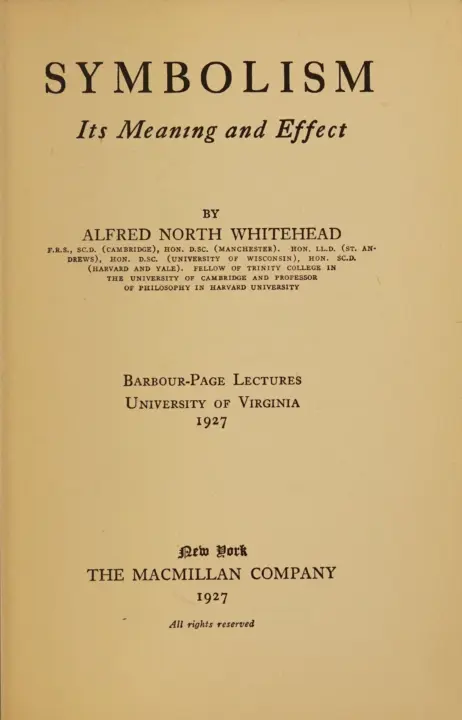
Symbolism, its meaning and effect
Alfred North Whitehead
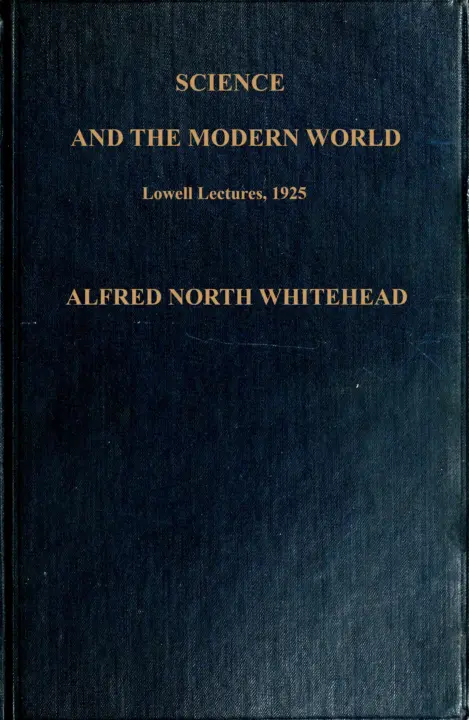
THE CLASSIC COLLECTION · 1925
"Science and the Modern World" by Alfred North Whitehead is a series of philosophical lectures presented in the early 20th century, specifically during the 1920s. This work examines the evolution of scientific thought and its profound impact on modern Western culture, framing science as a central force in shaping contemporary philosophy, religion, and ethical perspectives. Whitehead seeks to elucidate the historical context that led to the emergence of modern science and discusses how this scientific mindset has redefined humanity's understanding of nature and existence. At the start of the text, the author lays out his intention to explore the origins of modern scientific thought, tracing its roots back to significant intellectual upheavals that occurred during the Renaissance and the Reformation. He introduces critical figures such as Copernicus and Galileo, who challenged the accepted cosmologies of their times, and illustrates the transition from a predominantly theological worldview to one shaped by empirical observation and mathematical reasoning. Whitehead emphasizes the gradual yet transformative nature of this shift, asserting that the modern scientific mentality has recontextualized not only how people engage with nature but also the underlying metaphysical beliefs that influence wider societal structures.
Introduction adapted from the source catalogue; source summaries may be automatically generated.
Free to read · English · 79,948 words · No account needed
MAKE TIME FOR A GOOD BOOK
On by default. Untick to stop anonymous reading totals. Each page counts after 10 seconds in view. How this works.
Anonymous counting is on unless you have switched it off.
It is impossible to explain intelligently, in a short time and without technicalities, the details of the progress made by this school. I will, however, endeavour to explain the main point of a joint achievement of Maupertuis and Lagrange. Their results, in conjunction with some subsequent mathematical methods due to two great German mathematicians of the first half of the nineteenth century, Gauss and Riemann, have recently proved themselves to be the preparatory work necessary for the new ideas which Herz and Einstein have introduced into mathematical physics. Also they inspired some of the best ideas in Clerk Maxwell’s treatise, already mentioned in this lecture.
They aimed at discovering something more fundamental and more general than Newton’s laws of motion which were discussed in the previous lecture. They wanted to find some wider ideas, and in the case of Lagrange some more general means of mathematical exposition. It was an ambitious enterprise, and they were completely successful. Maupertuis lived in the first half of the eighteenth century, and Lagrange’s active life lay in its second half. We find in Maupertuis a tinge of the theologic age which preceded his birth. He started with the idea that the whole path of a material particle between any limits of time must achieve some perfection worthy of the providence of God. There are two points of interest in this motive principle. In the first place, it illustrates the thesis which I was urging in my first lecture that the way in which the medieval church had impressed on Europe the notion of the detailed providence of a rational personal God was one of the factors by which the trust in the order of nature had been generated. In the second place, though we are now all convinced that such modes of thought are of no direct use in detailed scientific enquiry, Maupertuis’ success in this particular case shows that almost any idea which jogs you out of your current abstractions may be better than nothing. In the present case what the idea in question did for Maupertuis was to lead him to enquire what general property of the path as a whole could be deduced from Newton’s laws of motion. Undoubtedly this was a very sensible procedure whatever one’s theological notions. Also his general idea led him to conceive that the property found would be a quantitative sum, such that any slight deviation from the path would increase it. In this supposition he was generalising Newton’s first law of motion. For an isolated particle takes the shortest route with uniform velocity. So Maupertuis conjectured that a particle travelling through a field of force would realise the least possible amount of some quantity. He discovered such a quantity and called it the integral action between the time limits considered. In modern phraseology it is the sum through successive small lapses of time of the difference between the kinetic and potential energies of the particle at each successive instant. This action, therefore, has to do with the interchange between the energy arising from motion and the energy arising from position. Maupertuis had discovered the famous theorem of least action. Maupertuis was not quite of the first rank in comparison with such a man as Lagrange. In his hands and in those of his immediate successors, his principle did not assume any dominating importance. Lagrange put the same question on a wider basis so as to make its answer relevant to actual procedure in the development of dynamics. His Principle of Virtual Work as applied to systems in motion is in effect Maupertuis’ principle conceived as applying at each instant of the path of the system. But Lagrange saw further than Maupertuis. He grasped that he had gained a method of stating dynamical truths in a way which is perfectly indifferent to the particular methods of measurement employed in fixing the positions of the various parts of the system. Accordingly, he went on to deduce equations of motion which are equally applicable whatever quantitative measurements have been made, provided that they are adequate to fix positions. The beauty and almost divine simplicity of these equations is such that these formulae are worthy to rank with those mysterious symbols which in ancient times were held directly to indicate the Supreme Reason at the base of all things. Later Herz—inventor of electromagnetic waves—based mechanics on the idea of every particle traversing the shortest path open to it under the circumstances constraining its motion; and finally Einstein, by the use of the geometrical theories of Gauss and Riemann, showed that these circumstances could be construed as being inherent in the character of space-time itself. Such, in barest outline, is the story of dynamics from Galileo to Einstein.
Your reading position is saved on this browser. Take it to another device with a library code. Reading pages adapt to text, rather than matching a printed edition.
Alfred North Whitehead
Alfred North Whitehead
Alfred North Whitehead
BEHIND THE BOOK
This eBook is for the use of anyone anywhere in the United States and most other parts of the world at no cost and with almost no restrictions whatsoever. You may copy it, give it away or re-use it under the terms of the Project Gutenberg License included with this eBook or online at www.gutenberg.org. If you are not located in the United States, you will have to check the laws of the country where you are located before using this eBook. Read the source licence.
The original source file, including credits and licence, is retained by this library. Request an original-format copy at no charge. Please include the book title and Project Gutenberg identifier #68611.
KEEP YOUR CURIOSITY GOING

David Patterson (Spirit) Hatch

David Patterson (Spirit) Hatch

David Patterson (Spirit) Hatch
Cécile Tormay

Moritz Busch
Coulson Kernahan