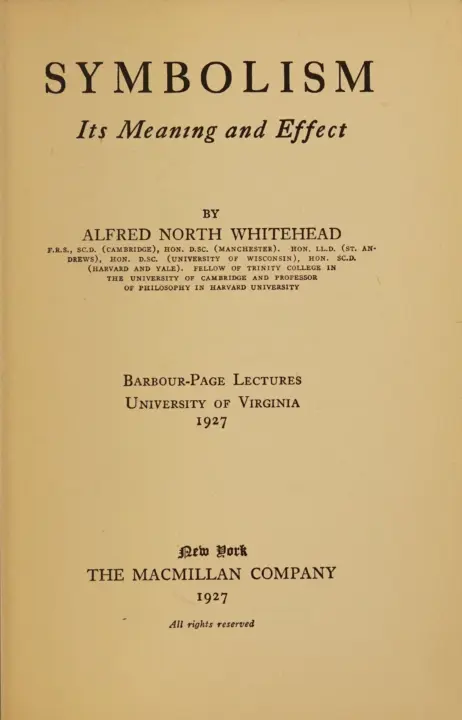
Symbolism, its meaning and effect
Alfred North Whitehead
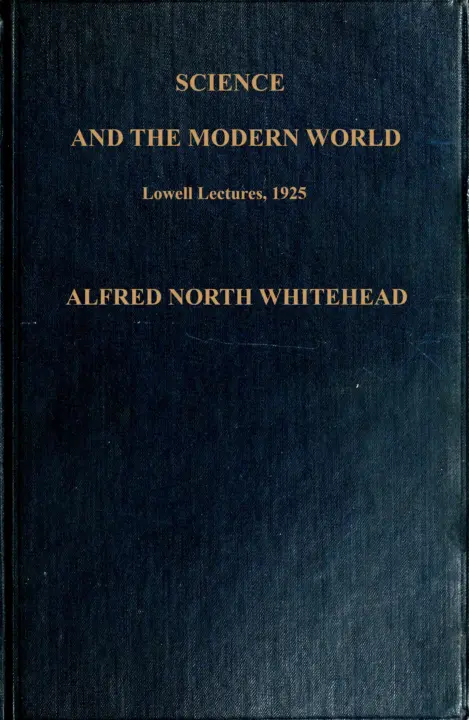
THE CLASSIC COLLECTION · 1925
"Science and the Modern World" by Alfred North Whitehead is a series of philosophical lectures presented in the early 20th century, specifically during the 1920s. This work examines the evolution of scientific thought and its profound impact on modern Western culture, framing science as a central force in shaping contemporary philosophy, religion, and ethical perspectives. Whitehead seeks to elucidate the historical context that led to the emergence of modern science and discusses how this scientific mindset has redefined humanity's understanding of nature and existence. At the start of the text, the author lays out his intention to explore the origins of modern scientific thought, tracing its roots back to significant intellectual upheavals that occurred during the Renaissance and the Reformation. He introduces critical figures such as Copernicus and Galileo, who challenged the accepted cosmologies of their times, and illustrates the transition from a predominantly theological worldview to one shaped by empirical observation and mathematical reasoning. Whitehead emphasizes the gradual yet transformative nature of this shift, asserting that the modern scientific mentality has recontextualized not only how people engage with nature but also the underlying metaphysical beliefs that influence wider societal structures.
Introduction adapted from the source catalogue; source summaries may be automatically generated.
Free to read · English · 79,948 words · No account needed
MAKE TIME FOR A GOOD BOOK
On by default. Untick to stop anonymous reading totals. Each page counts after 10 seconds in view. How this works.
Anonymous counting is on unless you have switched it off.
Education, 277, e.s.
Egyptians, 20, 43.
Einstein, 14, 41, 86, 88; 173, e.s.; 263.
Electron, 50, e.s.; 111, e.s.; 185, e.s.
Empty Events, 214.
Endurance, 121; 147, e.s.; 169, e.s.; 186, e.s.; 212.
Endurance, Vibratory, 51.
Energy, Physical, 51, e.s.
Environment, 155, e.s.
Envisagement, 148, e.s.
Epochs, 177.
Epochal Durations, 192.
Essence, 175.
Eternal Objects, 121, e.s.; 146, e.s.; 221, e.s.
Ether, 184.
Euripides, 14.
Event, 102; 168, e.s.
Evolution, 130; 142, e.s.
Exhaustion, Method of, 42.
Extension, 177.
Extensive Quantity, 178.
External Relations, 223, e.s.
Extrinsic Reality, 146.
Fallacy of Misplaced Concreteness, 72, e.s.; 82.
Faraday, 139.
Fate, 14.
Fermat, 78.
Finite Abstractive Hierarchy, 235.
Form, 230.
Force, 64, e.s.
Fourier, 85.
Francis of Assisi, 258.
Frederick, the Great, 89.
Frequency, 181, e.s.
Fresnel, 139.
Frost, Robert, 22.
Future, 245, e.s.
Galileo, 2, e.s.; 43, 45; 56, e.s.; 88, 162, 187; 255, e.s.
Galvani, 88.
Gauss, 86, 88.
Geometry, 31, e.s.
George II, 93.
Germany, 57.
Gibson, 206.
God, 17, 86, 129; 242, e.s.
Gradation of Envisagement, 247.
Gravitation, 65, 172.
Greece, 8, e.s.
Gregorovius, 265.
Giotto, 22.
Gregory, The Great, 21, 265.
Harvey, 56, 57.
Heath, Sir T. L., 180.
Hegel, 40.
Herz, 86, 88.
Historical Revolt, 11, e.s.; 55, 150.
Hooker, Richard, 13.
Hume, 5, 47, 61, 73; 80, e.s.; 107, 198.
Huyghens, 45; 57, e.s.; 256.
Idealism, 89; 127, e.s.
Immediate Occasion, 36, e.s.; 62.
Individual Essence, 222, e.s.
Induction, 34; 60, e.s.
Infinite Abstractive Hierarchy, 235.
Ingression, 99, e.s.; 222.
Integral Calculus, 42.
Internal Relations, 175; 223, e.s.
Intrinsic Reality, 146.
Invention, 136, e.s.
Ionian Philosophers, 9.
Irresistible Grace, 105.
Isolated Systems, 66.
Isolation of Eternal Objects, 230.
Isotopes, 260.
Italy, 57.
James, Henry, 3.
James, William, 3; 199, e.s.
Joseph, Hapsburgh Emperor, 89.
Justinian, 19, 20.
Kant, 47; 93, e.s.; 116, 142, 178; 193, e.s.
Kepler, 9, 45, 57, 67.
Lagrange, 84, e.s.
Laplace, 85, 142.
Lavoisier, 84, 146.
Law, Roman, 16.
Laws of Nature, 45, 150.
Least Action, 87, 150.
Lecky, 15, 16, 254.
Leibniz, 43, 44, 48, 57, 92, 115; 198, e.s.
Life, 58.
Limitation, 225, e.s.
Lloyd Morgan, Preface.
Location, Simple, 69, e.s.; 81, e.s.; 95.
Locke, John, 43, 47; 57, e.s.; 89, 94, 115, 198.
Locomotion, Vibratory, 184, e.s.
Logic, Abstract, 37, e.s.
Logic, Scholastic, 17.
Lucretius, 140.
Macaulay, 285.
Milton, 108, e.s.
Mind, 79.
Mass, 64, e.s.; 144.
Mathematics, 10, 23; 28, e.s.
Mathematics, Applied, 34, e.s.
Matter, 24, 94, 58, 144.
Matter (philosophical), 231.
Maupertuis, 85, e.s.
Max Müller, 178.
Maxwell, Clerk, 85, e.s.; 139, e.s.; 161.
Mechanical Explanation, 23.
Mechanism, 107, e.s.
Mechanistic Theory, 71.
Memory, 73.
Mersenne, 46.
Michelson, 162, e.s.
Mill, John Stuart, 110.
Modal Character of Space, 90, e.s.
Modal Limitation, 248, e.s.
Mode, 99.
Moral Responsibility, 109, e.s.
Motion, Laws of, 65, e.s.
Müller, Johannes, 141.
Narses, 19.
Natural Selection, 158.
Naturalism in Art, 22.
Newman, John Henry, 115, 255.
Newton, 8, 9, 15; 43, e.s.; 58, e.s.; 84, e.s.; 161; 255, e.s.
Not-Being, 227.
Objectivism, 124, e.s.
Occasions, Community of, 63.
Occupied Events, 215.
Oersted, 139.
Order of Nature, 5, e.s.; 39, e.s.; 55.
Organic Mechanism, 112, 151.
Organism, 51, e.s.; 58, 90; 105, e.s.; 111, e.s.; 145; 185,
e.s.; 209.
Padua, University of, 57, 58.
Paley, 107.
Papacy, 13, 20.
Pascal, 57, 78.
Past, 245, e.s.
Pasteur, Louis, 141, e.s.
Pelagius, 266.
Perception, 101.
Periodic Law (Mendeleëf), 141.
Periodicity, 45, e.s.
Perspective, 98.
Petavius, 255.
Philosophy, 122.
Physical Field, 138.
Physics, 57.
Plato, 10; 41, e.s.; 180.
Pope, Alexander, 108, e.s.
Possibility, 223.
Prehension, 97, e.s.; 207.
Prehensive Character of Space, 90, e.s.
Present, 245, e.s.
Primary Qualities, 76.
Primate, 185, e.s.
Prime Mover, 242, e.s.
Primordial Element, 51, e.s.
Process, 102.
Professionalism, 271, e.s.
Proton, 51, e.s.; 185, e.s.
Psychology, 88, 103.
Pusey, 115.
Pythagoras, 39, e.s.; 240.
Quality, 73, e.s.
Quantum Theory, 50; 181, e.s.
Your reading position is saved on this browser. Take it to another device with a library code. Reading pages adapt to text, rather than matching a printed edition.
Alfred North Whitehead

Alfred North Whitehead
Alfred North Whitehead
BEHIND THE BOOK
This eBook is for the use of anyone anywhere in the United States and most other parts of the world at no cost and with almost no restrictions whatsoever. You may copy it, give it away or re-use it under the terms of the Project Gutenberg License included with this eBook or online at www.gutenberg.org. If you are not located in the United States, you will have to check the laws of the country where you are located before using this eBook. Read the source licence.
The original source file, including credits and licence, is retained by this library. Request an original-format copy at no charge. Please include the book title and Project Gutenberg identifier #68611.
KEEP YOUR CURIOSITY GOING

David Patterson (Spirit) Hatch

David Patterson (Spirit) Hatch

David Patterson (Spirit) Hatch
Cécile Tormay

Moritz Busch
Coulson Kernahan