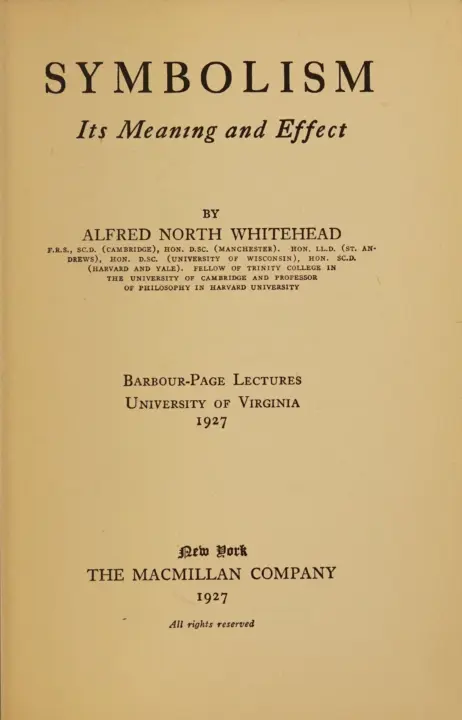
Symbolism, its meaning and effect
Alfred North Whitehead
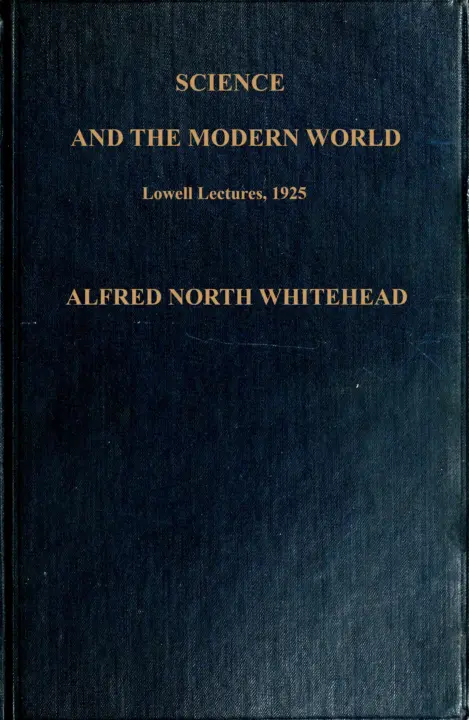
THE CLASSIC COLLECTION · 1925
"Science and the Modern World" by Alfred North Whitehead is a series of philosophical lectures presented in the early 20th century, specifically during the 1920s. This work examines the evolution of scientific thought and its profound impact on modern Western culture, framing science as a central force in shaping contemporary philosophy, religion, and ethical perspectives. Whitehead seeks to elucidate the historical context that led to the emergence of modern science and discusses how this scientific mindset has redefined humanity's understanding of nature and existence. At the start of the text, the author lays out his intention to explore the origins of modern scientific thought, tracing its roots back to significant intellectual upheavals that occurred during the Renaissance and the Reformation. He introduces critical figures such as Copernicus and Galileo, who challenged the accepted cosmologies of their times, and illustrates the transition from a predominantly theological worldview to one shaped by empirical observation and mathematical reasoning. Whitehead emphasizes the gradual yet transformative nature of this shift, asserting that the modern scientific mentality has recontextualized not only how people engage with nature but also the underlying metaphysical beliefs that influence wider societal structures.
Introduction adapted from the source catalogue; source summaries may be automatically generated.
Free to read · English · 79,948 words · No account needed
MAKE TIME FOR A GOOD BOOK
On by default. Untick to stop anonymous reading totals. Each page counts after 10 seconds in view. How this works.
Anonymous counting is on unless you have switched it off.
Accordingly the relationships (as in possibility) do not involve the individual essences of the eternal objects; they involve any eternal objects as relata, subject to the proviso that these relata have the requisite relational essences. [It is this proviso which, automatically and by the nature of the case, limits the ‘any’ of the phrase ‘any eternal objects.’] This principle is the principle of the Isolation of Eternal Objects in the realm of possibility. The eternal objects are isolated, because their relationships as possibilities are expressible without reference to their respective individual essences. In contrast to the realm of possibility, the inclusion of eternal objects within an actual occasion means that in respect to some of their possible relationships there is a togetherness of their individual essences. This realised togetherness is the achievement of an emergent value defined—or, shaped—by the definite eternal relatedness in respect to which the real togetherness is achieved. Thus the eternal relatedness is the form—the εἶδος—; the emergent actual occasion is the superject of informed value; value, as abstracted from any particular superject, is the abstract matter—the ὕλη—which is common to all actual occasions; and the synthetic activity which prehends valueless possibility into superjicient informed value is the substantial activity. This substantial activity is that which is omitted in any analysis of the static factors in the metaphysical situation. The analysed elements of the situation are the attributes of the substantial activity.
The difficulty inherent in the concept of finite internal relations among eternal objects is thus evaded by two metaphysical principles, (i) that the relationships of any eternal object A, considered as constitutive of A, merely involve other eternal objects as bare relata without reference to their individual essences, and (ii) that the divisibility of the general relationship of A into a multiplicity of finite relationships of A stands therefore in the essence of that eternal object. The second principle obviously depends upon the first. To understand A is to understand the how of a general scheme of relationship. This scheme of relationship does not require the individual uniqueness of the other relata for its comprehension. This scheme also discloses itself as being analysable into a multiplicity of limited relationships which have their own individuality and yet at the same time presupposes the total relationship within possibility. In respect to actuality there is first the general limitation of relationships, which reduces this general unlimited scheme to the four dimensional spatio-temporal scheme. This spatio-temporal scheme is, so to speak, the greatest common measure of the schemes of relationship (as limited by actuality) inherent in all the eternal objects. By this it is meant that, how select relationships of an eternal object (A) are realised in any actual occasion, is always explicable by expressing the status of A in respect to this spatio-temporal scheme, and by expressing in this scheme the relationship of the actual occasion to other actual occasions. A definite finite relationship involving the definite eternal objects of a limited set of such objects is itself an eternal object: it is those eternal objects as in that relationship. I will call such an eternal object ‘complex.’ The eternal objects which are the relata in a complex eternal object will be called the ‘components’ of that eternal object. Also if any of these relata are themselves complex, their components will be called ‘derivative components’ of the original complex object. Also the components of derivative components will also be called derivative components of the original object. Thus the complexity of an eternal object means its analysability into a relationship of component eternal objects. Also the analysis of the general scheme of relatedness of eternal objects means its exhibition as a multiplicity of complex eternal objects. An eternal object, such as a definite shade of green, which cannot be analysed into a relationship of components, will be called ‘simple.’
Your reading position is saved on this browser. Take it to another device with a library code. Reading pages adapt to text, rather than matching a printed edition.
Alfred North Whitehead

Alfred North Whitehead
Alfred North Whitehead
BEHIND THE BOOK
This eBook is for the use of anyone anywhere in the United States and most other parts of the world at no cost and with almost no restrictions whatsoever. You may copy it, give it away or re-use it under the terms of the Project Gutenberg License included with this eBook or online at www.gutenberg.org. If you are not located in the United States, you will have to check the laws of the country where you are located before using this eBook. Read the source licence.
The original source file, including credits and licence, is retained by this library. Request an original-format copy at no charge. Please include the book title and Project Gutenberg identifier #68611.
KEEP YOUR CURIOSITY GOING

David Patterson (Spirit) Hatch

David Patterson (Spirit) Hatch

David Patterson (Spirit) Hatch
Cécile Tormay

Moritz Busch
Coulson Kernahan