
A Hermit of Carmel, and Other Poems
George Santayana
THE CLASSIC COLLECTION · 1923
Scepticism and Animal Faith (1923) is a later work by Spanish-born American philosopher George Santayana. He intended it to be "merely the introduction to a new system of philosophy," a work that would later be called The Realms of Being, which constitutes the bulk of his philosophy, along with The Life of Reason.
Scepticism is Santayana's major treatise on epistemology; after its publication, he wrote no more on the topic. His preface begins humbly, with Santayana saying:
Here is one more system of philosophy. If the reader is tempted to smile, I can assure him that I smile with him...I am merely trying to express for the reader the principles to which he appeals when he smiles.
Moreover, he does not claim philosophical supremacy: I do not ask anyone to think in my terms if he prefers others. Let him clean better, if he can, the windows of his soul, that the variety and beauty of the prospect may spread more brightly before him.
While Santayana acknowledges the importance of skepticism to philosophy, and begins by doubting almost everything; from here, he seeks to find some kind of epistemological truths. Idealism is correct, claims Santayana, but is of no consequence. He makes this pragmatic claim by asserting that men do not live by the principles of idealism, even if it is true. We have functioned for eons without adhering to such principles, and may continue, pragmatically, as such. He posits the necessity of the eponymous "Animal Faith", which is belief in that which our senses tell us; "Philosophy begins in medias res", he assures us at the beginning of his treatise. (This summary is from Wikipedia.)
Introduction adapted from the source catalogue; source summaries may be automatically generated.
Free to read · English · 97,423 words · No account needed
MAKE TIME FOR A GOOD BOOK
On by default. Untick to stop anonymous reading totals. Each page counts after 10 seconds in view. How this works.
Anonymous counting is on unless you have switched it off.
Starting, as here I should, from absolute certitude—that is, from the obvious character of some essence—the first object of belief suggested by that assurance is the identity of this essence in various instances and in various contexts. This identity in divers cases is not tautological, as identity would be if I spoke of the identity of any essence with itself. Identity, to be significant, must be problematical. I must pick up my pebble twice, so that a juggler might without my knowledge have substituted another pebble for it in the interval; and when I say confidently, the same pebble, I may always be deceived. My own thought is not at all unlikely to play this trick on me; it is good at legerdemain. In attending a second time to what I call the same essence, I may really summon a different essence before me; my memory need not retain the first intuition so precisely that its disparity from the present one can be sensible to me now. Identity of essences given at different times evidently presupposes time—an immense postulate; and besides, it presupposes ability in thought to traverse time without confusion, so that having lived through two intuitions I may correctly distinguish them as events, whilst correctly identifying their common object. These are ambitious and highly questionable dogmas. Yet there is a circumstance in pure intuition of any essence which can insensibly lead me to those elaborate conclusions, and can lead me at the same time to posit the natural existence of myself, the possible dupe, having those intuitions and surviving them, and even the existence of my natural object, the persisting pebble, which those intuitions described unanimously.
This circumstance is closely connected with the property of essence which is most ideal and remote from existence, namely, its eternity. Eternity, taken intrinsically, has nothing to do with time, but is a form of being which time cannot usher in nor destroy; it is always equally real, silent, and indestructible, no matter what time may do, or what time it may be. But intuition peruses eternal being in time; consequently, so long as I am attending to an essence, this essence seems to me to endure; and when, after an interval, I revert to it or to any feature of it, this feature seems to me to be identical with what it was. This identity and this duration are not properly predicated of essence in its own realm; they are superfluous epithets essentially, and almost insults, because they substitute a questionable for an unquestionable subsistence in the essence. Yet the epithets are well meant, and indicate fairly enough the aspect which essences present to moving thought when it plays upon them. Intuition finds essence by watching, by exerting animal attention. Now when he watches, an animal thinks that what he watches is watching him with the same intensity and variability of attention which he is exerting; for attention is fundamentally an animal uneasiness, fostered by the exigences of life amid other material beings that can change and jump. Stillness or constancy in any object accordingly does not seem to an animal eternity in an essence; it seems rather a suspension of motion in a thing, a pause for breath, an ominous and awful silence. He is superstitious about the eternity of essences, as about all their other properties. This breathless and ghostly duration which he attributes to essences, treating them like living things, is his confused temporal translation of their eternity, mixing it with existence, which is the negation of eternity. Thus he assimilates it to the quasi-permanence in himself which is transfused with change; for of course he is far from perceiving that if essences were not natively eternal and nonexistent, it would be impossible for crawling existence to change from one form to another. This illusion is inevitable. The dubious and iterative duration proper to animal life, when the lungs breathe and the mind is appetitive, seems to this mind a pulsation in all being.
Your reading position is saved on this browser. Take it to another device with a library code. Reading pages adapt to text, rather than matching a printed edition.
George Santayana

George Santayana
George Santayana
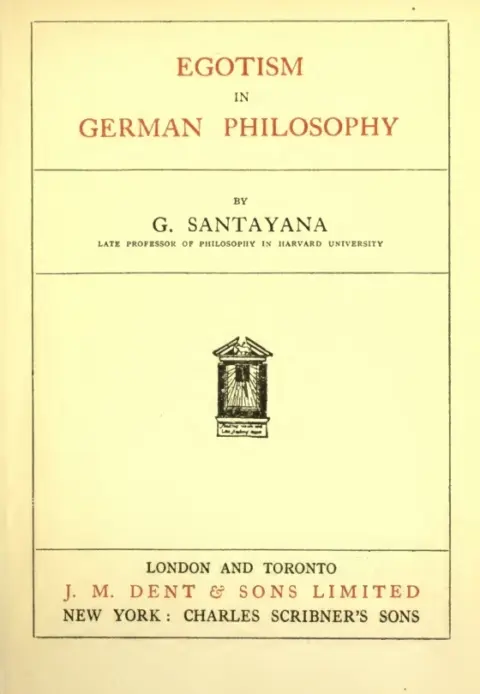
George Santayana
BEHIND THE BOOK
This eBook is for the use of anyone anywhere in the United States and most other parts of the world at no cost and with almost no restrictions whatsoever. You may copy it, give it away or re-use it under the terms of the Project Gutenberg License included with this eBook or online at www.gutenberg.org. If you are not located in the United States, you will have to check the laws of the country where you are located before using this eBook. Read the source licence.
The original source file, including credits and licence, is retained by this library. Request an original-format copy at no charge. Please include the book title and Project Gutenberg identifier #77155.
KEEP YOUR CURIOSITY GOING

Charles G. (Charles Griffith) Ross
Hannah Webster Foster

Emily Lawless
Edwin Hamlin Carr

Charles De Lano Hine
Andrew Ure