
A Hermit of Carmel, and Other Poems
George Santayana
THE CLASSIC COLLECTION · 1923
Scepticism and Animal Faith (1923) is a later work by Spanish-born American philosopher George Santayana. He intended it to be "merely the introduction to a new system of philosophy," a work that would later be called The Realms of Being, which constitutes the bulk of his philosophy, along with The Life of Reason.
Scepticism is Santayana's major treatise on epistemology; after its publication, he wrote no more on the topic. His preface begins humbly, with Santayana saying:
Here is one more system of philosophy. If the reader is tempted to smile, I can assure him that I smile with him...I am merely trying to express for the reader the principles to which he appeals when he smiles.
Moreover, he does not claim philosophical supremacy: I do not ask anyone to think in my terms if he prefers others. Let him clean better, if he can, the windows of his soul, that the variety and beauty of the prospect may spread more brightly before him.
While Santayana acknowledges the importance of skepticism to philosophy, and begins by doubting almost everything; from here, he seeks to find some kind of epistemological truths. Idealism is correct, claims Santayana, but is of no consequence. He makes this pragmatic claim by asserting that men do not live by the principles of idealism, even if it is true. We have functioned for eons without adhering to such principles, and may continue, pragmatically, as such. He posits the necessity of the eponymous "Animal Faith", which is belief in that which our senses tell us; "Philosophy begins in medias res", he assures us at the beginning of his treatise. (This summary is from Wikipedia.)
Introduction adapted from the source catalogue; source summaries may be automatically generated.
Free to read · English · 97,423 words · No account needed
MAKE TIME FOR A GOOD BOOK
On by default. Untick to stop anonymous reading totals. Each page counts after 10 seconds in view. How this works.
Anonymous counting is on unless you have switched it off.
I will disregard the vehemence with which these saintly scholastics denounce the world and the sinful nature that attaches me to it. I like the theatre, not because I cannot perceive that the play is a fiction, but because I do perceive it; if I thought the thing a fact, I should detest it: anxiety would rob me of all my imaginative pleasure. Even as it is, I often wish the spectacle were less barbarous; but I am not angry because each scene does not last for ever, and is likely to be followed by a thousand others which I shall not witness. Such is the nature of endless comedy, and of experience. But I wish to retain the valuable testimony of the Indians to the non-existence of the obvious. This testimony is the more valuable because the spectacle present to their eyes was tropical; harder, therefore, to master and to smile at than are the political and romantic medleys which fill the mind of Europe. Yet amidst the serpents and hyænas, the monkeys and parrots of their mental jungle, those sages could sit unmoved, too holily incredulous for fear. How infinite, how helpless, how deserving of forgiveness creative error becomes to the eye of understanding, that loves only in pity, and has no concupiscence for what it loves! How like unhappy animals western philosophers seem in comparison, with their fact-worship, their thrift, their moral intolerance, their imaginative poverty, their political zeal, and their subservience to intellectual fashion!
It makes no difference for my purposes if the cosmology of the Indians was fanciful. It could hardly be more extraordinary than the constitution of the material world is in fact, nor more decidedly out of scale with human data; truth and fancy in this matter equally convict the human senses of illusion. Nor am I out of sympathy with their hope of escaping from the universal hurly-burly into some haven of peace. A philosopher has a haven in himself, of which I suspect the fabled bliss to follow in other lives, or after total emancipation from living, is only a poetic symbol: he has pleasure in truth, and an equal readiness to enjoy the scene or to quit it. Liberation is never complete while life lasts, and is nothing afterwards; but it flows in a measure from this very conviction that all experience is illusion, when this conviction is morally effective, as it was with the Indians. Their belief in transmigration or in Karma is superfluous in this regard, since a later experience could only change the illusion without perfecting the liberation. Yet the mention of some ulterior refuge or substance is indispensable to the doctrine of illusion, and though it may be expressed mythically must be taken to heart too. It points to other realms of being—such as those which I call the realms of matter, truth, and spirit—which by nature cannot be data of intuition but must be posited (if recognised by man at all) by an instinctive faith expressed in action. Whether these ulterior realms exist or not is their own affair: existence may be proper to some, like matter or spirit, and not to others, like truth. But as to the data of intuition, their non-existent and illusory character is implied in the fact that they are given. A datum is by definition a theme of attention, a term in passing thought, a visioned universal. The realm in which it lies, and in which flying intuition discloses it for a moment, is the very realm of non-existence, of inert or ideal being. The Indians, in asserting the non-existence of every term in possible experience, not only free the spirit from idolatry, but free the realm of spirit (which is that of intuition) from limitation; because if nothing that appears exists, anything may appear without the labour and expense of existing; and fancy is invited to range innocently—fancies not murdering other fancies as an existence must murder other existences. While life lasts, the field is thus cleared for innocent poetry and infinite hypothesis, without suffering the judgement to be deceived nor the heart enslaved.
Your reading position is saved on this browser. Take it to another device with a library code. Reading pages adapt to text, rather than matching a printed edition.
George Santayana

George Santayana
George Santayana
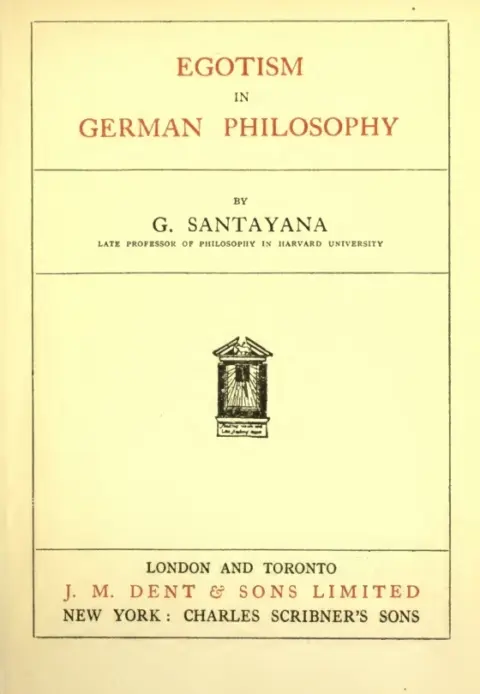
George Santayana
BEHIND THE BOOK
This eBook is for the use of anyone anywhere in the United States and most other parts of the world at no cost and with almost no restrictions whatsoever. You may copy it, give it away or re-use it under the terms of the Project Gutenberg License included with this eBook or online at www.gutenberg.org. If you are not located in the United States, you will have to check the laws of the country where you are located before using this eBook. Read the source licence.
The original source file, including credits and licence, is retained by this library. Request an original-format copy at no charge. Please include the book title and Project Gutenberg identifier #77155.
KEEP YOUR CURIOSITY GOING

Charles G. (Charles Griffith) Ross
Hannah Webster Foster

Emily Lawless
Edwin Hamlin Carr

Charles De Lano Hine
Andrew Ure