
A Hermit of Carmel, and Other Poems
George Santayana
THE CLASSIC COLLECTION · 1923
Scepticism and Animal Faith (1923) is a later work by Spanish-born American philosopher George Santayana. He intended it to be "merely the introduction to a new system of philosophy," a work that would later be called The Realms of Being, which constitutes the bulk of his philosophy, along with The Life of Reason.
Scepticism is Santayana's major treatise on epistemology; after its publication, he wrote no more on the topic. His preface begins humbly, with Santayana saying:
Here is one more system of philosophy. If the reader is tempted to smile, I can assure him that I smile with him...I am merely trying to express for the reader the principles to which he appeals when he smiles.
Moreover, he does not claim philosophical supremacy: I do not ask anyone to think in my terms if he prefers others. Let him clean better, if he can, the windows of his soul, that the variety and beauty of the prospect may spread more brightly before him.
While Santayana acknowledges the importance of skepticism to philosophy, and begins by doubting almost everything; from here, he seeks to find some kind of epistemological truths. Idealism is correct, claims Santayana, but is of no consequence. He makes this pragmatic claim by asserting that men do not live by the principles of idealism, even if it is true. We have functioned for eons without adhering to such principles, and may continue, pragmatically, as such. He posits the necessity of the eponymous "Animal Faith", which is belief in that which our senses tell us; "Philosophy begins in medias res", he assures us at the beginning of his treatise. (This summary is from Wikipedia.)
Introduction adapted from the source catalogue; source summaries may be automatically generated.
Free to read · English · 97,423 words · No account needed
MAKE TIME FOR A GOOD BOOK
On by default. Untick to stop anonymous reading totals. Each page counts after 10 seconds in view. How this works.
Anonymous counting is on unless you have switched it off.
My endeavour has been to restore these things to their natural places, without forgetting the assumptions on which they rest. But the chief difference between my criticism of knowledge and theirs lies in the conception of knowledge itself. The Germans call knowledge Wissenschaft, as if it were something to be found in books, a catalogue of information, and an encyclopædia of the sciences. But the question is whether all this Wissenschaft is knowledge or only learning. My criticism is criticism of myself: I am talking of what I believe in my active moments, as a living animal, when I am really believing something: for when I am reading books belief in me is at its lowest ebb; and I lend myself to the suasion of eloquence with the same pleasure (when the book is well written) whether it be the Arabian Nights or the latest philosophy. My criticism is not essentially a learned pursuit, though habit may sometimes make my language scholastic; it is not a choice between artificial theories; it is the discipline of my daily thoughts and the account I actually give to myself from moment to moment of my own being and of the world around me. I should be ashamed to countenance opinions which, when not arguing, I did not believe. It would seem to me dishonest and cowardly to militate under other colours than those under which I live. Merely learned views are not philosophy; and therefore no modern writer is altogether a philosopher in my eyes, except Spinoza; and the critics of knowledge in particular seem to me as feeble morally as they are technically.
I should like, therefore, to turn to the ancients and breathe again a clear atmosphere of frankness and honour; but in the present business they are not very helpful. The Indians were poets and mystics; and while they could easily throw off the conventions of vulgar reason, it was often only to surrender themselves to other conventions, far more misleading to a free spirit, such as the doctrine of transmigration of souls; and when, as in Buddhism, they almost vanquished that illusion, together with every other, their emasculated intellect had nothing to put in its place. The Greeks on the contrary were rhetoricians; they seldom or never reverted to the immediate for a foothold in thought, because the immediate lies below the level of language and of political convention. But they were disputatious, and in that sense no opinion escaped their criticism. In this criticism they simply pitted one plausible opinion against another, supporting each in turn by all conceivable arguments, based on no matter what prejudices or presumptions. The result of this forensic method was naturally a suspense of rational judgement, favourable now to frivolity and now to superstition. The frivolity appeared in the Sophists who, seeing that nothing was certain, impudently assumed as true whatever it was socially convenient to advocate. Protagoras seems to have reduced this bad habit to an honest system, when he taught that each occasion is, for itself, the ultimate judge of truth. This, taken psychologically, is evidently the case: a mind cannot judge on other subjects nor on other evidences than are open to it when judging. But the judging moment need not judge truly; and to maintain (as Protagoras does in Plato’s Dialogue and as some pragmatists have done in our day) that all momentary opinions are equal in truth, though not equal in value, is to fail in radical scepticism: for it is to assume many moments, and knowledge (utterly inexplicable on these principles) of their several sequences and import; and to assume something even more wanton, a single standard of value by which to judge them all. Such incoherence is not surprising in sophists whose avowed purpose in philosophising is to survive and succeed in this world, or perhaps in the next. Worldly people will readily admit that some ideas are better than others, even if both sets are equally false. The interest in truth for its own sake is not a worldly interest, but the human soul is capable of it; and there might be spirits directed on the knowledge of truth as upon their only ultimate good, as there might be spirits addressed exclusively to music. Which arts and sciences are worth pursuing, and how far, is a question for the moralist, to be answered in each case in view of the faculties and genius of the persons concerned, and their opportunities. Socrates may humorously eschew all science that is useless to cobblers; he thereby expresses his plebeian hard sense, and his Hellenic joy in discourse and in moral apologues; but if he allows this pleasant prejudice to blind him to the possibility of physical discoveries, or of cogent mathematics, he becomes a simple sophist. The moralist needs true knowledge of nature—even a little astronomy—in order to practise the art of life in a becoming spirit; and an agnosticism which was not merely personal, provisional, and humble would be the worst of dogmas.
Your reading position is saved on this browser. Take it to another device with a library code. Reading pages adapt to text, rather than matching a printed edition.
George Santayana

George Santayana
George Santayana
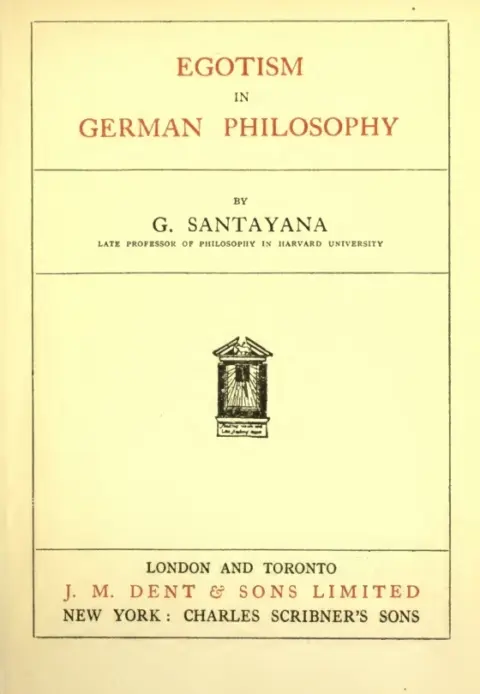
George Santayana
BEHIND THE BOOK
This eBook is for the use of anyone anywhere in the United States and most other parts of the world at no cost and with almost no restrictions whatsoever. You may copy it, give it away or re-use it under the terms of the Project Gutenberg License included with this eBook or online at www.gutenberg.org. If you are not located in the United States, you will have to check the laws of the country where you are located before using this eBook. Read the source licence.
The original source file, including credits and licence, is retained by this library. Request an original-format copy at no charge. Please include the book title and Project Gutenberg identifier #77155.
KEEP YOUR CURIOSITY GOING

Charles G. (Charles Griffith) Ross
Hannah Webster Foster

Emily Lawless
Edwin Hamlin Carr

Charles De Lano Hine
Andrew Ure