
A Hermit of Carmel, and Other Poems
George Santayana
THE CLASSIC COLLECTION · 1923
Scepticism and Animal Faith (1923) is a later work by Spanish-born American philosopher George Santayana. He intended it to be "merely the introduction to a new system of philosophy," a work that would later be called The Realms of Being, which constitutes the bulk of his philosophy, along with The Life of Reason.
Scepticism is Santayana's major treatise on epistemology; after its publication, he wrote no more on the topic. His preface begins humbly, with Santayana saying:
Here is one more system of philosophy. If the reader is tempted to smile, I can assure him that I smile with him...I am merely trying to express for the reader the principles to which he appeals when he smiles.
Moreover, he does not claim philosophical supremacy: I do not ask anyone to think in my terms if he prefers others. Let him clean better, if he can, the windows of his soul, that the variety and beauty of the prospect may spread more brightly before him.
While Santayana acknowledges the importance of skepticism to philosophy, and begins by doubting almost everything; from here, he seeks to find some kind of epistemological truths. Idealism is correct, claims Santayana, but is of no consequence. He makes this pragmatic claim by asserting that men do not live by the principles of idealism, even if it is true. We have functioned for eons without adhering to such principles, and may continue, pragmatically, as such. He posits the necessity of the eponymous "Animal Faith", which is belief in that which our senses tell us; "Philosophy begins in medias res", he assures us at the beginning of his treatise. (This summary is from Wikipedia.)
Introduction adapted from the source catalogue; source summaries may be automatically generated.
Free to read · English · 97,423 words · No account needed
MAKE TIME FOR A GOOD BOOK
On by default. Untick to stop anonymous reading totals. Each page counts after 10 seconds in view. How this works.
Anonymous counting is on unless you have switched it off.
What evidence is there for the existence of nature, in this sense of the word? If I speak of the universe at large, there can be no evidence. Of course the universe must be what it is, it must have a character, it must exemplify an essence; but taken as a whole, it may be a chaos, in which nothing is predeterminate, nor progressive, nor persistent, and in which the parts are self-centred and the events spontaneous. A philosopher who took his own life as a model for conceiving all other things, ought perhaps to incline to this view; because he is himself, transcendentally speaking, an absolute centre, and being ignorant of the sources of his thoughts and actions, may presume that they have no sources. If under these circumstances he still has the weakness (for it would be a weakness) to believe in anything else, say in other monads, he would doubtless allow them an equal liberty; so that in his universe of monads there would be no common space, no common time, no common type of character or development, no mutual influence or kindred destiny. I think the inner life of animals, if we treated each as a moral romance, apart from its physical setting and influence, would actually present such a chaos: especially if we imagine what may be the lives of creatures in other parts of the stellar universe, or out of any relation with ourselves at all. Such a loose universe could not properly be called nature. It would not have given us birth, it would not have nurtured us, it would not surround us with any constant influences or familiar aspects, it would not bring any seeds to maturity for our encouragement or warning.
Evidences for the existence of nature must be sought elsewhere, in a region which a monadologist would regard as internal to each monad, in that the substances posited by me in obedience to my vital instincts seem to me to behave as if they were parts of nature. Nature is the great counterpart of art. What I tuck under my pillow at night, I find there in the morning. Economy increases my possessions. People all grow old. Accidents have discoverable causes. There is a possible distinction between wisdom and folly. But how should all this be, and how could experience, or the shocks that punctuate it, teach me anything to the purpose, or lend me any assurance in life not merely a reinforced blindness and madness on my part, unless substances standing and moving in ordered ways surrounded me, and I was living in the midst of nature? Certainly a partial sceptic like Berkeley, closing one eye in the interests of a sentimental religion, may conceive that nature is not a system of evolving substances round him affecting his own growth, but a perpetual illusion, like a dream: a story told him in the dark, a consecutive miracle of grace or of punishment by which a divine spirit dazzles and conducts his spirit, without any medium or any occasion. But if this fairy-tale is to hold good, and to justify the arts of life and maintain the distinction between vice and virtue, I must be able to discern the ways of Providence in their routine; everything will happen exactly as if nature existed, and unrolled itself in a mechanical, inexorable, and often shocking way; my idealism will merely allow me to admit miracles, and to hope that to-morrow everything will be well. If I regard the world of appearance as a mask which the deity wears inevitably, the very essence of the creator being to create such a world, the difference between belief in God and belief in nature will be merely verbal, and I may say with Spinoza, Deus sive natura. If on the contrary God is approachable in himself and would prove a better companion than nature and sweeter to commune with, why should he terrify me or delude me with this unworthy disguise? Why should he have preferred to manifest himself by creating appearances rather than by creating substances? What secret necessity could have compelled him to create anything at all, or whispered in his ear these irresponsible designs? If nature behaves as nature would, is it not simply nature? If God were there instead would he not behave like God? Or if I say that I have no right to presume how God should behave, but that wisdom counsels me to learn his ways by experience, what difference remains between God and nature, and are they more than two names for the same thing?
Your reading position is saved on this browser. Take it to another device with a library code. Reading pages adapt to text, rather than matching a printed edition.
George Santayana

George Santayana
George Santayana
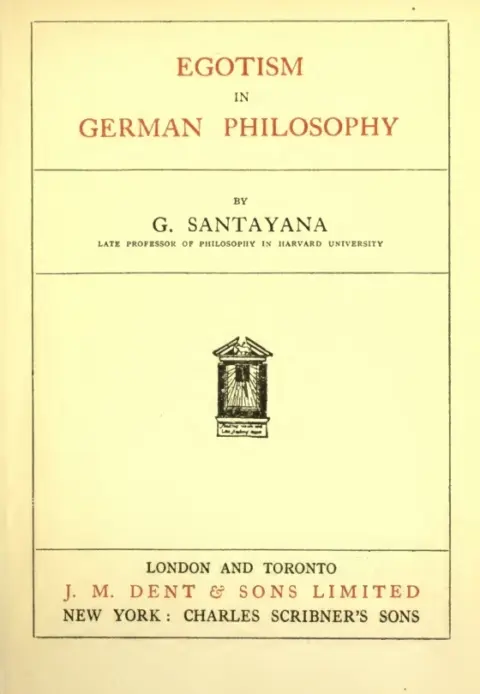
George Santayana
BEHIND THE BOOK
This eBook is for the use of anyone anywhere in the United States and most other parts of the world at no cost and with almost no restrictions whatsoever. You may copy it, give it away or re-use it under the terms of the Project Gutenberg License included with this eBook or online at www.gutenberg.org. If you are not located in the United States, you will have to check the laws of the country where you are located before using this eBook. Read the source licence.
The original source file, including credits and licence, is retained by this library. Request an original-format copy at no charge. Please include the book title and Project Gutenberg identifier #77155.
KEEP YOUR CURIOSITY GOING

Charles G. (Charles Griffith) Ross
Hannah Webster Foster

Emily Lawless
Edwin Hamlin Carr

Charles De Lano Hine
Andrew Ure