
A Hermit of Carmel, and Other Poems
George Santayana
THE CLASSIC COLLECTION · 1923
Scepticism and Animal Faith (1923) is a later work by Spanish-born American philosopher George Santayana. He intended it to be "merely the introduction to a new system of philosophy," a work that would later be called The Realms of Being, which constitutes the bulk of his philosophy, along with The Life of Reason.
Scepticism is Santayana's major treatise on epistemology; after its publication, he wrote no more on the topic. His preface begins humbly, with Santayana saying:
Here is one more system of philosophy. If the reader is tempted to smile, I can assure him that I smile with him...I am merely trying to express for the reader the principles to which he appeals when he smiles.
Moreover, he does not claim philosophical supremacy: I do not ask anyone to think in my terms if he prefers others. Let him clean better, if he can, the windows of his soul, that the variety and beauty of the prospect may spread more brightly before him.
While Santayana acknowledges the importance of skepticism to philosophy, and begins by doubting almost everything; from here, he seeks to find some kind of epistemological truths. Idealism is correct, claims Santayana, but is of no consequence. He makes this pragmatic claim by asserting that men do not live by the principles of idealism, even if it is true. We have functioned for eons without adhering to such principles, and may continue, pragmatically, as such. He posits the necessity of the eponymous "Animal Faith", which is belief in that which our senses tell us; "Philosophy begins in medias res", he assures us at the beginning of his treatise. (This summary is from Wikipedia.)
Introduction adapted from the source catalogue; source summaries may be automatically generated.
Free to read · English · 97,423 words · No account needed
MAKE TIME FOR A GOOD BOOK
On by default. Untick to stop anonymous reading totals. Each page counts after 10 seconds in view. How this works.
Anonymous counting is on unless you have switched it off.
I answer that it does so by animal presumption, positing whatsoever object instinct is materially predisposed to cope with, as in hunger, love, fighting, or the expectation of a future. But before developing this reply, let me make one observation. Since intuition of essence is not knowledge, knowledge can never lie in an overt comparison of one datum with another datum given at the same time; even in pure dialectic, the comparison is with a datum believed to have been given formerly. If both terms were simply given they would compose a complex essence, without the least signification. Only when one of the terms is indicated by intent, without being given exhaustively, can the other term serve to define the first more fully, or be linked with it in an assertion which is not mere tautology. An object of faith—and knowledge is one species of faith—can never, even in the most direct perception, come within the circle of intuition. Intuition of things is a contradiction in terms. If philosophers wish to abstain from faith, and reduce themselves to intuition of the obvious, they are free to do so, but they will thereby renounce all knowledge, and live on passive illusions. No fact, not even the fact that these illusions exist, would ever be, or would ever have been, anything but the false idea that they had existed. There would be nothing but the realm of essence, without any intuition of any part of it, nor of the whole: so that we should be driven back to a nihilism which only silence and death could express consistently; since the least actual assertion of it, by existing, would contradict it.
Even such acquaintance with the realm of essence as constitutes some science or recognisable art—like mathematics or music—lies in intending and positing great stretches of essence not now given, so that the essences now given acquire significance and become pregnant, to my vital feeling, with a thousand things which they do not present actually, but which I know where to look for eventually, and how to await. Suppose a moment ago I heard a clap of thunder, loud and prolonged, but that the physical shock has subsided and I am conscious of repose and silence. I may find some difficulty, although the thing was so recent, in rehearsing even now the exact volume, tone, and rumblings of that sound; yet I know the theme perfectly, in the sense that when it thunders again, I can say with assurance whether the second crash was longer, louder, or differently modulated. In such a case I have no longer an intuition of the first thunder-clap, but a memory of it which is knowledge; and I can define on occasion, up to a certain point and not without some error, the essence given in that particular past intuition. Thus even pure essences can become objects of intent and of tentative knowledge when they are not present in intuition but are approached and posited indirectly, as the essences given on another particular occasion or signified by some particular word. The word or the occasion are natural facts, and my knowledge is focussed upon them in the first instance by ordinary perception or conception of nature: and the essence I hope to recover is elicited gradually, imaginatively, perhaps incorrectly, at the suggestion of those assumed facts, according to my quickness of wit, or my familiarity with the conventions of that art or science. In this way it becomes possible and necessary to learn about essences as if they were things, not initially by a spontaneous and complete intuition, but by coaxing the mind until possibly, at the end, it beholds them clearly. This is the sort of intuition which is mediated by language and by works of fine art; also by logic and mathematics, as they are learned from teachers and out of books. It is not happy intuition of some casual datum: it is laborious recovery, up to a certain point, of the sort of essence somebody else may have intuited. Whereas intuition, which reveals an essence directly, is not knowledge, because it has no ulterior object, the designation of some essence by some sign does convey knowledge, to an intelligent pupil, of what that essence was. Obviously such divination of essences present elsewhere, so that they become present here also, in so far as it is knowledge, is trebly faith. Faith first in the document, as a genuine natural fact and not a vapid fancy of my own; for instance, belief that there is a book called the Bible, really handed down from the ancient Jews and the early Christians, and that I have not merely dreamt of such a book. Faith then in the significance of that document, that it means some essence which it is not; in this instance, belief that the sacred writers were not merely speaking with tongues but were signifying some intelligible points in history and philosophy. Faith finally in my success in interpreting that document correctly, so that the essences it suggests to me now are the very essences it expressed originally: in other words, the belief that when I read the Bible I understand it as it was meant, and not fantastically.
Your reading position is saved on this browser. Take it to another device with a library code. Reading pages adapt to text, rather than matching a printed edition.
George Santayana

George Santayana
George Santayana
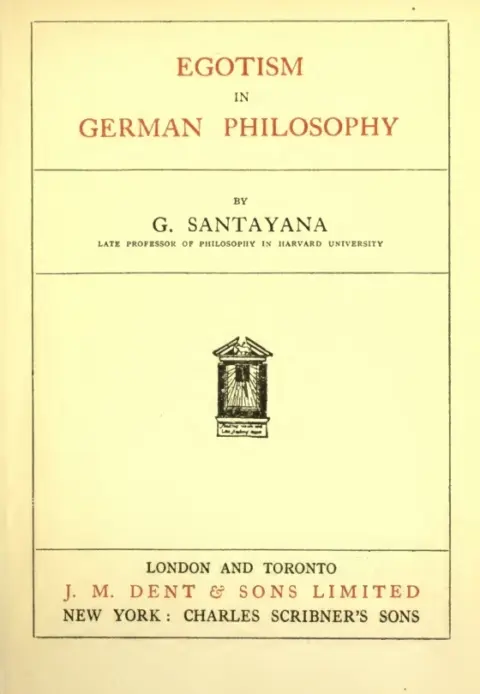
George Santayana
BEHIND THE BOOK
This eBook is for the use of anyone anywhere in the United States and most other parts of the world at no cost and with almost no restrictions whatsoever. You may copy it, give it away or re-use it under the terms of the Project Gutenberg License included with this eBook or online at www.gutenberg.org. If you are not located in the United States, you will have to check the laws of the country where you are located before using this eBook. Read the source licence.
The original source file, including credits and licence, is retained by this library. Request an original-format copy at no charge. Please include the book title and Project Gutenberg identifier #77155.
KEEP YOUR CURIOSITY GOING

Charles G. (Charles Griffith) Ross
Hannah Webster Foster

Emily Lawless
Edwin Hamlin Carr

Charles De Lano Hine
Andrew Ure