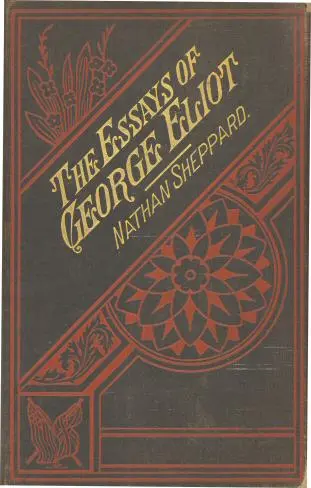
The Essays of “George Eliot” Complete
George Eliot
THE CLASSIC COLLECTION · 1910
"Scenes of Clerical Life" by George Eliot is a collection of three short stories published in 1858. Eliot's first published fiction introduces readers to the lives of Anglican clergymen in the fictional English Midlands town of Milby. Set during the late eighteenth and early nineteenth centuries, these interconnected tales explore religious reform, tensions between established and dissenting churches, and social issues including poverty, alcoholism, and domestic violence. Each story centers on a different clergyman navigating faith and community in changing times.
Introduction adapted from the source catalogue; source summaries may be automatically generated.
Free to read · English · 146,764 words · No account needed
MAKE TIME FOR A GOOD BOOK
On by default. Untick to stop anonymous reading totals. Each page counts after 10 seconds in view. How this works.
Anonymous counting is on unless you have switched it off.
‘Why, it’s struck six i’ the kitchen a’ready. It’s nonsense to look for him comin’ now. So you may’s well ring for th’ urn. Now Sally’s got th’ heater in the fire, we may’s well hev th’ urn in, though he doesn’t come. I niver see’d the like o’ you, Mr. Jerome, for axin’ people an’ givin’ me the trouble o’ gettin’ things down an’ hevin’ crumpets made, an’ after all they don’t come. I shall hev to wash every one o’ these tea-things myself, for there’s no trustin’ Sally--she’d break a fortin i’ crockery i’ no time!’
‘But why will you give yourself sich trouble, Susan? Our everyday tea-things would ha’ done as well for Mr. Tryan, an’ they’re a deal convenenter to hold.’
‘Yes, that’s just your way, Mr. Jerome, you’re al’ys a-findin’ faut wi’ my chany, because I bought it myself afore I was married. But let me tell you, I knowed how to choose chany if I didn’t know how to choose a husband. An’ where’s Lizzie? You’ve niver left her i’ the garden by herself, with her white frock on an’ clean stockins?’
‘Be easy, my dear Susan, be easy; Lizzie’s come in wi’ Sally. She’s hevin’ her pinafore took off, I’ll be bound. Ah! there’s Mr. Tryan a-comin’ through the gate.’
Mrs. Jerome began hastily to adjust her damask napkin and the expression of her countenance for the reception of the clergyman, and Mr. Jerome went out to meet his guest, whom he greeted outside the door.
‘Mr. Tryan, how do you do, Mr. Tryan? Welcome to the White House! I’m glad to see you, sir--I’m glad to see you.’
If you had heard the tone of mingled good-will, veneration, and condolence in which this greeting was uttered, even without seeing the face that completely harmonized with it, you would have no difficulty in inferring the ground-notes of Mr. Jerome’s character. To a fine ear that tone said as plainly as possible--‘Whatever recommends itself to me, Thomas Jerome, as piety and goodness, shall have my love and honour. Ah, friends, this pleasant world is a sad one, too, isn’t it? Let us help one another, let us help one another.’ And it was entirely owing to this basis of character, not at all from any clear and precise doctrinal discrimination, that Mr. Jerome had very early in life become a Dissenter. In his boyish days he had been thrown where Dissent seemed to have the balance of piety, purity, and good works on its side, and to become a Dissenter seemed to him identical with choosing God instead of mammon. That race of Dissenters is extinct in these days, when opinion has got far ahead of feeling, and every chapel-going youth can fill our ears with the advantages of the Voluntary system, the corruptions of a State Church, and the Scriptural evidence that the first Christians were Congregationalists. Mr. Jerome knew nothing of this theoretic basis for Dissent, and in the utmost extent of his polemical discussion he had not gone further than to question whether a Christian man was bound in conscience to distinguish Christmas and Easter by any peculiar observance beyond the eating of mince-pies and cheese-cakes. It seemed to him that all seasons were alike good for thanking God, departing from evil and doing well, whereas it might be desirable to restrict the period for indulging in unwholesome forms of pastry. Mr. Jerome’s dissent being of this simple, non-polemical kind, it is easy to understand that the report he heard of Mr. Tryan as a good man and a powerful preacher, who was stirring the hearts of the people, had been enough to attract him to the Paddiford Church, and that having felt himself more edified there than he had of late been under Mr. Stickney’s discourses at Salem, he had driven thither repeatedly in the Sunday afternoons, and had sought an opportunity of making Mr. Tryan’s acquaintance. The evening lecture was a subject of warm interest with him, and the opposition Mr. Tryan met with gave that interest a strong tinge of partisanship; for there was a store of irascibility in Mr. Jerome’s nature which must find a vent somewhere, and in so kindly and upright a man could only find it in indignation against those whom he held to be enemies of truth and goodness. Mr. Tryan had not hitherto been to the White House, but yesterday, meeting Mr. Jerome in the street, he had at once accepted the invitation to tea, saying there was something he wished to talk about. He appeared worn and fatigued now, and after shaking hands with Mrs. Jerome, threw himself into a chair and looked out on the pretty garden with an air of relief.
Your reading position is saved on this browser. Take it to another device with a library code. Reading pages adapt to text, rather than matching a printed edition.
George Eliot
George Eliot
George Eliot

George Eliot & Elizabeth Barrett Browning & Robert Browning & Percy Bysshe Shelley
BEHIND THE BOOK
This eBook is for the use of anyone anywhere in the United States and most other parts of the world at no cost and with almost no restrictions whatsoever. You may copy it, give it away or re-use it under the terms of the Project Gutenberg License included with this eBook or online at www.gutenberg.org. If you are not located in the United States, you will have to check the laws of the country where you are located before using this eBook. Read the source licence.
The original source file, including credits and licence, is retained by this library. Request an original-format copy at no charge. Please include the book title and Project Gutenberg identifier #17780.
KEEP YOUR CURIOSITY GOING
Coulson Kernahan

Maurice Baring
Frances Wright
Cécile Tormay

Frederic Jesup Stimson

W. H. P. (William Henry Pope) Jarvis