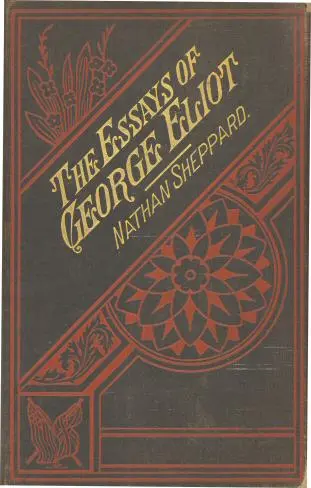
The Essays of “George Eliot” Complete
George Eliot
THE CLASSIC COLLECTION · 1910
"Scenes of Clerical Life" by George Eliot is a collection of three short stories published in 1858. Eliot's first published fiction introduces readers to the lives of Anglican clergymen in the fictional English Midlands town of Milby. Set during the late eighteenth and early nineteenth centuries, these interconnected tales explore religious reform, tensions between established and dissenting churches, and social issues including poverty, alcoholism, and domestic violence. Each story centers on a different clergyman navigating faith and community in changing times.
Introduction adapted from the source catalogue; source summaries may be automatically generated.
Free to read · English · 146,764 words · No account needed
MAKE TIME FOR A GOOD BOOK
On by default. Untick to stop anonymous reading totals. Each page counts after 10 seconds in view. How this works.
Anonymous counting is on unless you have switched it off.
Happily coal was cheap in the neighbourhood of Shepperton, and Mr. Hackit would any time let his horses draw a load for ‘the parson’ without charge; so there was a blazing fire in the sitting-room, and not without need, for the vicarage garden, as they looked out on it from the bow-window, was hard with black frost, and the sky had the white woolly look that portends snow.
Breakfast over, Mr. Barton mounted to his study, and occupied himself in the first place with his letter to Mr. Oldinport. It was very much the same sort of letter as most clergymen would have written under the same circumstances, except that instead of perambulate, the Rev. Amos wrote preambulate, and instead of ‘if haply’, ‘if happily’, the contingency indicated being the reverse of happy. Mr. Barton had not the gift of perfect accuracy in English orthography and syntax, which was unfortunate, as he was known not to be a Hebrew scholar, and not in the least suspected of being an accomplished Grecian. These lapses, in a man who had gone through the Eleusinian mysteries of a university education, surprised the young ladies of his parish extremely; especially the Misses Farquhar, whom he had once addressed in a letter as Dear Mads., apparently an abbreviation for Madams. The persons least surprised at the Rev. Amos’s deficiencies were his clerical brethren, who had gone through the mysteries themselves.
At eleven o’clock, Mr. Barton walked forth in cape and boa, with the sleet driving in his face, to read prayers at the workhouse, euphemistically called the ‘College’. The College was a huge square stone building, standing on the best apology for an elevation of ground that could be seen for about ten miles around Shepperton. A flat ugly district this; depressing enough to look at even on the brightest days. The roads are black with coal-dust, the brick houses dingy with smoke; and at that time--the time of handloom weavers--every other cottage had a loom at its window, where you might see a pale, sickly-looking man or woman pressing a narrow chest against a board, and doing a sort of treadmill work with legs and arms. A troublesome district for a clergyman; at least to one who, like Amos Barton, understood the ‘cure of souls’ in something more than an official sense; for over and above the rustic stupidity furnished by the farm-labourers, the miners brought obstreperous animalism, and the weavers an acrid Radicalism and Dissent. Indeed, Mrs. Hackit often observed that the colliers, who many of them earned better wages than Mr. Barton, ‘passed their time in doing nothing but swilling ale and smoking, like the beasts that perish’ (speaking, we may presume, in a remotely analogical sense); and in some of the alehouse corners the drink was flavoured by a dingy kind of infidelity, something like rinsings of Tom Paine in ditch-water. A certain amount of religious excitement created by the popular preaching of Mr. Parry, Amos’s predecessor, had nearly died out, and the religious life of Shepperton was falling back towards low-water mark. Here, you perceive, was a terrible stronghold of Satan; and you may well pity the Rev. Amos Barton, who had to stand single-handed and summon it to surrender. We read, indeed, that the walls of Jericho fell down before the sound of trumpets; but we nowhere hear that those trumpets were hoarse and feeble. Doubtless they were trumpets that gave forth clear ringing tones, and sent a mighty vibration through brick and mortar. But the oratory of the Rev. Amos resembled rather a Belgian railway-horn, which shows praiseworthy intentions inadequately fulfilled. He often missed the right note both in public and private exhortation, and got a little angry in consequence. For though Amos thought himself strong, he did not feel himself strong. Nature had given him the opinion, but not the sensation. Without that opinion he would probably never have worn cambric bands, but would have been an excellent cabinetmaker and deacon of an Independent church, as his father was before him (he was not a shoemaker, as Mr. Pilgrim had reported). He might then have sniffed long and loud in the corner of his pew in Gun Street Chapel; he might have indulged in halting rhetoric at prayer-meetings, and have spoken faulty English in private life; and these little infirmities would not have prevented him, honest faithful man that he was, from being a shining light in the dissenting circle of Bridgeport. A tallow dip, of the long-eight description, is an excellent thing in the kitchen candlestick, and Betty’s nose and eye are not sensitive to the difference between it and the finest wax; it is only when you stick it in the silver candlestick, and introduce it into the drawing-room, that it seems plebeian, dim, and ineffectual. Alas for the worthy man who, like that candle, gets himself into the wrong place! It is only the very largest souls who will be able to appreciate and pity him--who will discern and love sincerity of purpose amid all the bungling feebleness of achievement.
Your reading position is saved on this browser. Take it to another device with a library code. Reading pages adapt to text, rather than matching a printed edition.
George Eliot
George Eliot
George Eliot

George Eliot & Elizabeth Barrett Browning & Robert Browning & Percy Bysshe Shelley
BEHIND THE BOOK
This eBook is for the use of anyone anywhere in the United States and most other parts of the world at no cost and with almost no restrictions whatsoever. You may copy it, give it away or re-use it under the terms of the Project Gutenberg License included with this eBook or online at www.gutenberg.org. If you are not located in the United States, you will have to check the laws of the country where you are located before using this eBook. Read the source licence.
The original source file, including credits and licence, is retained by this library. Request an original-format copy at no charge. Please include the book title and Project Gutenberg identifier #17780.
KEEP YOUR CURIOSITY GOING
Coulson Kernahan

Maurice Baring
Frances Wright
Cécile Tormay

Frederic Jesup Stimson

W. H. P. (William Henry Pope) Jarvis