THE CLASSIC COLLECTION✦Tirzah Ann’s summer trip, and other sketchesCLASSIC FREE BOOKS
Tirzah Ann’s summer trip, and other sketches
Marietta Holley
THE CLASSIC COLLECTION · 1892
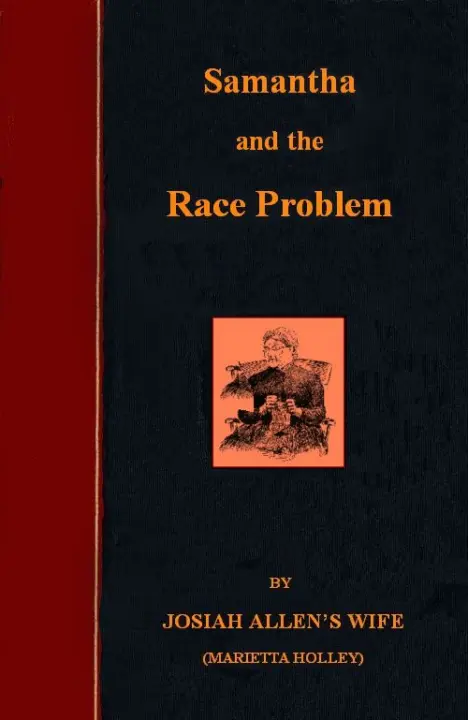
"Samantha on the Race Problem" by Marietta Holley is a satirical novel written in the late 19th century. This work often captures the voice and perspectives of the protagonist, Samantha, as she navigates social issues in American society, particularly focusing on race relations during the Reconstruction era. Through her character and anecdotes, the author explores the complexities of race, ignorance, and the varying perceptions of Southern and Northern attitudes toward African Americans. The opening of the novel introduces us to Samantha and her husband Josiah Allen as they host a visit from their cousin, John Richard Allen, a colporter who has worked among freedmen in the South. This visit ignites a heated discussion about the "race problem," revealing the differing views between John Richard's experiences and Josiah's dismissive stance. As they engage in an argument over the realities of race relations, John Richard warns of a brewing storm of unrest and animosity, challenging Josiah’s complacent attitude. Samantha attempts to mediate the conflicting perspectives while reflecting on her own beliefs regarding the implications of this societal issue, setting the stage for deeper explorations of character interactions and social commentary throughout the narrative.
Introduction adapted from the source catalogue; source summaries may be automatically generated.
Free to read · English · 90,773 words · No account needed
MAKE TIME FOR A GOOD BOOK
On by default. Untick to stop anonymous reading totals. Each page counts after 10 seconds in view. How this works.
Anonymous counting is on unless you have switched it off.
God grant more wisdom to the great commonwealth of this nation, those whose wills are spoken out by their ballots, to the makers and the doers of law.
But I am a eppisodin’, and to resoom, and continue on.
Felix and Hester, by some good chance, or by the grace of God, had not been obliged yet to leave their pretty home, so they worked on, tryin’ to be so peaceable and friendly that no fault could be found with them.
Col. Seybert’s attention when he wuz at Seybert Court wuz very annoyin’ to Hester, but she dared not tell Felix, fearin’ that he would avenge himself on the Colonel, and bloodshed would result.
So she tried to be very careful. She had an old negro woman stay with her; she took in work all she could at home, and when she went out to work she wuz prudent and watchful, and, fortunately for her peace of mind, the Colonel made short stays at his home—he found more potent attractions elsewhere.
So stood matters when Felix wuz appointed Justice of the Peace at Eden
Centre.
He wuz honestly appointed and honestly elected.
Victor had always declined any office, and had Felix taken his advice he would also have refused the office.
But perhaps Felix had some ambition. And maybe he had some curiosity to see what honesty and a pure purpose could accomplish in political matters, to see what such a marvellous thing could amount to.
Anyway, he accepted the nomination and received the office.
And the night after he wuz elected he and Hester talked the matter over with some pardonable pride as they sot in the door of their pretty little parlor in the warm moonlight.
The creepin’ vines on the trellis cast pleasant shadows of leaf and blossom down over their heads and on the pretty carpet at their feet.
This carpet Hester had bought with her own money and wuz proud of.
The moonlight lay there warm and bright, weavin’ its magic tapestry of rose leaf and swingin’ vine tendrils long after they wuz asleep in their little white-draped room near by.
Baby Ned lay fast asleep, with a smile on his moist, flushed face, in his love-guarded cradle near them.
The little boy did not dream of anything less sweet and peaceful than his mother’s good-night kiss that had been his last wakin’ remembrance.
But about midnight other shadows, black and terrible ones, trod out and defaced the swayin’, tremblin’ rose images and silvery moonlight on the floor.
Tall men in black masks, a rough, brutal gang, surrounded the place and crashed in the door of the little cottage.
Your reading position is saved on this browser. Take it to another device with a library code. Reading pages adapt to text, rather than matching a printed edition.
Marietta Holley
Marietta Holley
Marietta Holley

Marietta Holley
BEHIND THE BOOK
This eBook is for the use of anyone anywhere in the United States and most other parts of the world at no cost and with almost no restrictions whatsoever. You may copy it, give it away or re-use it under the terms of the Project Gutenberg License included with this eBook or online at www.gutenberg.org. If you are not located in the United States, you will have to check the laws of the country where you are located before using this eBook. Read the source licence.
The original source file, including credits and licence, is retained by this library. Request an original-format copy at no charge. Please include the book title and Project Gutenberg identifier #61608.
KEEP YOUR CURIOSITY GOING
Coulson Kernahan

Maurice Baring
Frances Wright
Cécile Tormay

Frederic Jesup Stimson

W. H. P. (William Henry Pope) Jarvis