THE CLASSIC COLLECTION✦Tirzah Ann’s summer trip, and other sketchesCLASSIC FREE BOOKS
Tirzah Ann’s summer trip, and other sketches
Marietta Holley
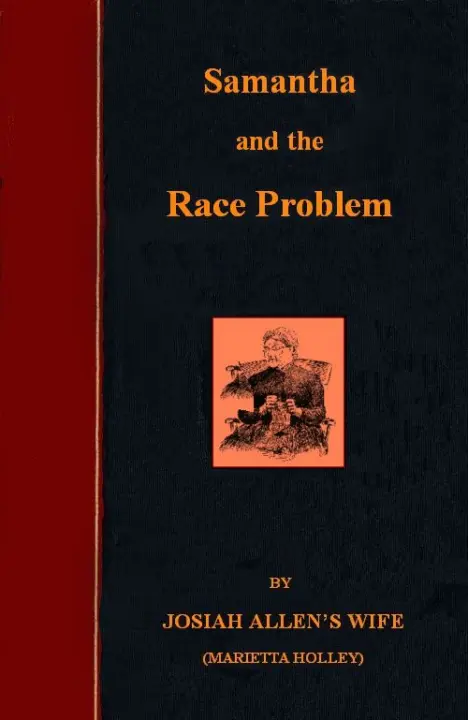
THE CLASSIC COLLECTION · 1892
"Samantha on the Race Problem" by Marietta Holley is a satirical novel written in the late 19th century. This work often captures the voice and perspectives of the protagonist, Samantha, as she navigates social issues in American society, particularly focusing on race relations during the Reconstruction era. Through her character and anecdotes, the author explores the complexities of race, ignorance, and the varying perceptions of Southern and Northern attitudes toward African Americans. The opening of the novel introduces us to Samantha and her husband Josiah Allen as they host a visit from their cousin, John Richard Allen, a colporter who has worked among freedmen in the South. This visit ignites a heated discussion about the "race problem," revealing the differing views between John Richard's experiences and Josiah's dismissive stance. As they engage in an argument over the realities of race relations, John Richard warns of a brewing storm of unrest and animosity, challenging Josiah’s complacent attitude. Samantha attempts to mediate the conflicting perspectives while reflecting on her own beliefs regarding the implications of this societal issue, setting the stage for deeper explorations of character interactions and social commentary throughout the narrative.
Introduction adapted from the source catalogue; source summaries may be automatically generated.
Free to read · English · 90,773 words · No account needed
MAKE TIME FOR A GOOD BOOK
On by default. Untick to stop anonymous reading totals. Each page counts after 10 seconds in view. How this works.
Anonymous counting is on unless you have switched it off.
And then he sort o’ satisfies himself by lookin’ at one side of a idee, while I always want to walk round it and see what is on the other side on it, and turn it over and see what is under it, etc., etc.
But anon he bust out agin, and his axent was one that must be replied to; I felt it wouldn’t do to ignore it any longer.
Sez he, “I am dead sick of all this talk about the Race Problem.”
“Then why,” sez I, mildly but firmly, “why do you insist on talkin’ on
it?”
“I want to tell you my feelin’s,” sez he.
Sez I, “I know ’em, Josiah Allen.”
And then I sot demute, and hoped I had averte the storm—or, ruther, I would call it the squall, for I didn’t expect a hard tempest, more of a drizzle.
So I knit fast, and sot in hope.
But anon he begun agin:
“I am sick on’t. I believe more’n half the talk is for effect. I don’t believe the South is a bleedin’; I hain’t seen no blood. I don’t believe the niggers are a rizen, I hain’t seen ’em a gettin’ up. I believe it is all folderol.”
And then I sez, a lookin’ up from my knittin’ work:
“Be mejum, Josiah Allen; you don’t live there. You hain’t so good a judge as if you lived in the South; you hain’t so good a judge as John Richard is, for he has lived right there.”
And he snapped out real snappish:
“Wall, there is lots of places I never lived in, hain’t there? But anybody can know sunthin’, whether they live anywhere or not.”
But I kep’ on real mejum and a talkin’ deep reason, I know well.
“When anybody is a passin’ through deep waters, Josiah Allen, they can feel the cold waves and the chill as nobody can who is on dry land.”
And then Josiah said them inflammatory words agin that he had hurled at the head of John Richard, and that had gaulded him so. He sez in a loud, defiant axent, “Oh shaw!”
And I sez, “You hain’t there, Josiah Allen, and you hain’t so well qualified to shaw, and shaw accordin’ to principle, as if you wuz there.”
“Wall, I say, and contend for it,” sez he, almost hotly, “that there is too much dumb talk. Why don’t the niggers behave themselves, and why don’t the Southerners treat ’em as I treat Ury?
Your reading position is saved on this browser. Take it to another device with a library code. Reading pages adapt to text, rather than matching a printed edition.
Marietta Holley
Marietta Holley
Marietta Holley
Marietta Holley
BEHIND THE BOOK
This eBook is for the use of anyone anywhere in the United States and most other parts of the world at no cost and with almost no restrictions whatsoever. You may copy it, give it away or re-use it under the terms of the Project Gutenberg License included with this eBook or online at www.gutenberg.org. If you are not located in the United States, you will have to check the laws of the country where you are located before using this eBook. Read the source licence.
The original source file, including credits and licence, is retained by this library. Request an original-format copy at no charge. Please include the book title and Project Gutenberg identifier #61608.
KEEP YOUR CURIOSITY GOING
Coulson Kernahan

Maurice Baring
Frances Wright
Cécile Tormay

Frederic Jesup Stimson

W. H. P. (William Henry Pope) Jarvis