THE CLASSIC COLLECTION✦Tirzah Ann’s summer trip, and other sketchesCLASSIC FREE BOOKS
Tirzah Ann’s summer trip, and other sketches
Marietta Holley
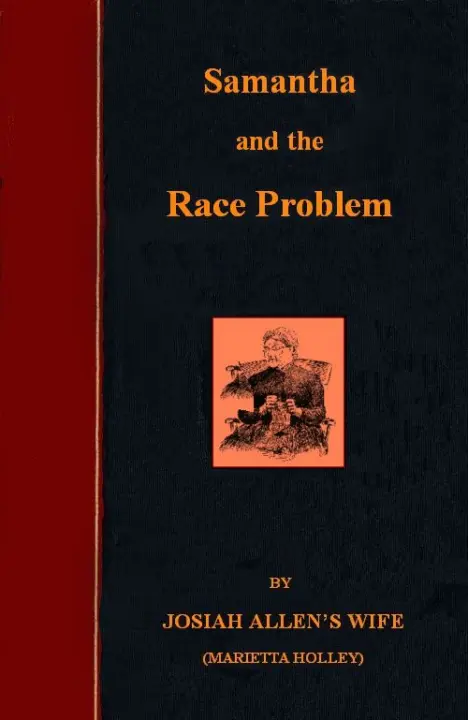
THE CLASSIC COLLECTION · 1892
"Samantha on the Race Problem" by Marietta Holley is a satirical novel written in the late 19th century. This work often captures the voice and perspectives of the protagonist, Samantha, as she navigates social issues in American society, particularly focusing on race relations during the Reconstruction era. Through her character and anecdotes, the author explores the complexities of race, ignorance, and the varying perceptions of Southern and Northern attitudes toward African Americans. The opening of the novel introduces us to Samantha and her husband Josiah Allen as they host a visit from their cousin, John Richard Allen, a colporter who has worked among freedmen in the South. This visit ignites a heated discussion about the "race problem," revealing the differing views between John Richard's experiences and Josiah's dismissive stance. As they engage in an argument over the realities of race relations, John Richard warns of a brewing storm of unrest and animosity, challenging Josiah’s complacent attitude. Samantha attempts to mediate the conflicting perspectives while reflecting on her own beliefs regarding the implications of this societal issue, setting the stage for deeper explorations of character interactions and social commentary throughout the narrative.
Introduction adapted from the source catalogue; source summaries may be automatically generated.
Free to read · English · 90,773 words · No account needed
MAKE TIME FOR A GOOD BOOK
On by default. Untick to stop anonymous reading totals. Each page counts after 10 seconds in view. How this works.
Anonymous counting is on unless you have switched it off.
When I got back from my walk I went into the kitchen to get some cool water to put some posies in I had picked by the way, and there sot old Aunt Clo’, and most imegiatly after my entrance she announced to me that Rosy, her granddaughter, had got a little boy, and that Dan, Maggie’s colored coachman, wuz the father of it.
Aunt Clo’ did not seem to be excited in any way about it; she simply told it as a bit of news, rather onpleasant than otherwise, as it necessitated more work on her part.
As for the immorality, the wrong-doing connected with it, she showed no
signs of feelin’.
But Maggie wuz aroused; there wuz a pink spot on both cheeks when I
told her about it.
She wuz settin’ in her pretty room, and near her lay Boy asleep on some cushions on the sofa. She wuz readin’ a love letter from Thomas Jefferson, for he wuz away for a few days, and his letters to her wuz always love letters.
There she sot in her safe and happy love-guarded home, by the side of Boy, whom she held clost in her heart because he wuz the image of her lover husband, Thomas J. Allen.
There she sot in her pretty white dress, with her pure, happy face—the flower, so I told myself as I looked at her, of long years of culture and refinement, and I couldn’t help comparin’ her in my mind with the ignorant and onthinkin’ soul that another boy had been give to.
But I told Maggie, for I thought I had ought to, and her eyes grew
darker, and a red spot shone on both cheeks; and sez she the first
thing:
“Dan must marry her at once.”
Sez I, “Mebby he won’t.”
“Why, he must,” sez Maggie; “it is right that he should; I shall make
him.”
“Wall,” sez I, “you must do what you think is right. I am fairly dumbfounded, and don’t know what to do,” sez I.
Maggie got up sort o’ quick and rung the bell, and asked to have Dan
sent up to her room.
And pretty soon he come in, a tall, hulkin’ chap, good-natered but utterly irresponsible, so he seemed to me, black as a coal.
And Maggie laid his sins down before him as soft as she could and still be just, and ended by tellin’ him that he must marry Rosy.
This seemed to astound him that she should ask it; he looked injured
and aggrieved.
But Maggie pressed the point. He stood twirlin’ his old cap in his hand
in silence.
Your reading position is saved on this browser. Take it to another device with a library code. Reading pages adapt to text, rather than matching a printed edition.
Marietta Holley
Marietta Holley
Marietta Holley
Marietta Holley
BEHIND THE BOOK
This eBook is for the use of anyone anywhere in the United States and most other parts of the world at no cost and with almost no restrictions whatsoever. You may copy it, give it away or re-use it under the terms of the Project Gutenberg License included with this eBook or online at www.gutenberg.org. If you are not located in the United States, you will have to check the laws of the country where you are located before using this eBook. Read the source licence.
The original source file, including credits and licence, is retained by this library. Request an original-format copy at no charge. Please include the book title and Project Gutenberg identifier #61608.
KEEP YOUR CURIOSITY GOING
Coulson Kernahan

Maurice Baring
Frances Wright
Cécile Tormay

Frederic Jesup Stimson

W. H. P. (William Henry Pope) Jarvis