THE CLASSIC COLLECTION✦Tirzah Ann’s summer trip, and other sketchesCLASSIC FREE BOOKS
Tirzah Ann’s summer trip, and other sketches
Marietta Holley
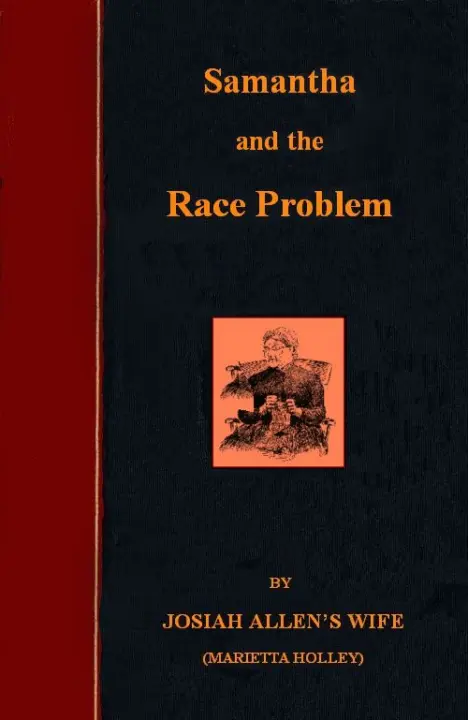
THE CLASSIC COLLECTION · 1892
"Samantha on the Race Problem" by Marietta Holley is a satirical novel written in the late 19th century. This work often captures the voice and perspectives of the protagonist, Samantha, as she navigates social issues in American society, particularly focusing on race relations during the Reconstruction era. Through her character and anecdotes, the author explores the complexities of race, ignorance, and the varying perceptions of Southern and Northern attitudes toward African Americans. The opening of the novel introduces us to Samantha and her husband Josiah Allen as they host a visit from their cousin, John Richard Allen, a colporter who has worked among freedmen in the South. This visit ignites a heated discussion about the "race problem," revealing the differing views between John Richard's experiences and Josiah's dismissive stance. As they engage in an argument over the realities of race relations, John Richard warns of a brewing storm of unrest and animosity, challenging Josiah’s complacent attitude. Samantha attempts to mediate the conflicting perspectives while reflecting on her own beliefs regarding the implications of this societal issue, setting the stage for deeper explorations of character interactions and social commentary throughout the narrative.
Introduction adapted from the source catalogue; source summaries may be automatically generated.
Free to read · English · 90,773 words · No account needed
MAKE TIME FOR A GOOD BOOK
On by default. Untick to stop anonymous reading totals. Each page counts after 10 seconds in view. How this works.
Anonymous counting is on unless you have switched it off.
After the funeral crowd had dispersed I sot down under a pine-tree with spreading branches, and thought I would rest awhile.
And even as I sot there another funeral wended its way into the old yard, which did not surprise me so much, nor would it any deep philosopher of human nater. For we well know when things get to happenin’ they will keep right on.
Human events go by waves, as it wuz—suicides, joys, broken dishes, griefs, visitors, etc., etc. So I sot there a moralizin’ some on the queerness of this world, as I see the rough coffin a bein’ lowered into the ground.
But one thing struck me as being singular—there wuz no mourners to be
seen.
After a while I got up and asked a cheerful-lookin’ negro “where the
mourners wuz?”
“Wall, misses,” sez he, “I spoze I am about as much of a mourner as
there is.”
He looked anything but mournful, but he went on:
“I married dis ole man’s stepdaughter, an’ consequentially she died. An’ den dis ole man got a kick from a mule, an’ laid he flat on his back; den he got his head stove in with a chimbly fallin’ on it; den de airysipples sot in, an’ de rheumaticks, an’ nurality, an’ foh years desese has jes’ fed on him, an’ de ultamatim of it wuz he died. An’ I spoze I am jes’ about as much of a mourner heah as you’ll find.”
And sayin’ this, the radiant-faced mourner turned away and joined some
friends.
As I turned back I met the colored preacher and his wife, who wuz evidently takin’ a short road home acrost the graveyard.
She wuz a good-lookin’ mulatto woman, and I passed the time of day with her by sayin’, “How do you do?” and etc.
And bein’ one that is always on the search for information, I fell into talk with her and her husband, and likin’ their looks, I finally asked him what his name wuz.
And he said, “My name is Mary Johnson.”
Sez I, “You mean your wife’s name is Mary.”
“No,” sez he, “my name is Mary.”
And then he went on and told me that he wuz the youngest of twelve boys, and his father wuz so mad at his havin’ been a boy that he named him, jest in spite, Mary.
Wall, we had quite a good visit there, but short.
He told me he had been a slave in his young days.
Your reading position is saved on this browser. Take it to another device with a library code. Reading pages adapt to text, rather than matching a printed edition.
Marietta Holley
Marietta Holley
Marietta Holley
Marietta Holley
BEHIND THE BOOK
This eBook is for the use of anyone anywhere in the United States and most other parts of the world at no cost and with almost no restrictions whatsoever. You may copy it, give it away or re-use it under the terms of the Project Gutenberg License included with this eBook or online at www.gutenberg.org. If you are not located in the United States, you will have to check the laws of the country where you are located before using this eBook. Read the source licence.
The original source file, including credits and licence, is retained by this library. Request an original-format copy at no charge. Please include the book title and Project Gutenberg identifier #61608.
KEEP YOUR CURIOSITY GOING
Coulson Kernahan

Maurice Baring
Frances Wright
Cécile Tormay

Frederic Jesup Stimson

W. H. P. (William Henry Pope) Jarvis