THE CLASSIC COLLECTION✦Tirzah Ann’s summer trip, and other sketchesCLASSIC FREE BOOKS
Tirzah Ann’s summer trip, and other sketches
Marietta Holley
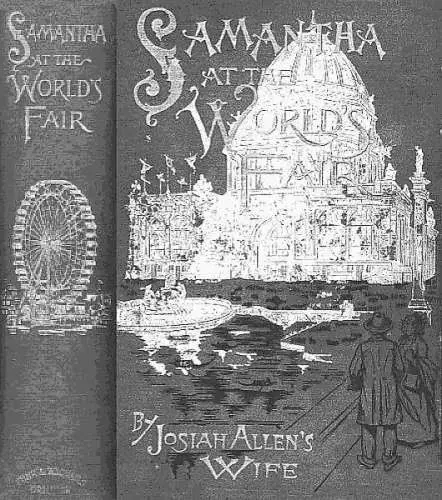
THE CLASSIC COLLECTION · 1893
"Samantha at the World's Fair" by Marietta Holley is a satirical novel written in the late 19th century. This work follows Samantha Allen, a witty and intelligent woman, as she prepares to attend the World's Fair in Chicago alongside her husband Josiah. The narrative explores themes of progress, societal issues, and the quirks of family relations, all delivered with Holley's characteristic humor and commentary on contemporary social issues. At the start of the story, Samantha reflects on her admiration for Christopher Columbus and his discoveries, which she wishes to honor through her attendance at the fair. In a twist of fate, she and her husband meet a distant relative, Christopher Columbus Allen, who arrives at their home just as they are making preparations for their trip to the World's Fair. This coincidence serves as a humorous thread that intertwines with Samantha's contemplations about history, family, and the expectations of society. The opening sets the tone for a blend of personal ambition and social commentary, suggesting that readers can expect a thoughtful yet entertaining exploration of these themes throughout the book.
Introduction adapted from the source catalogue; source summaries may be automatically generated.
Free to read · English · 139,602 words · No account needed
MAKE TIME FOR A GOOD BOOK
On by default. Untick to stop anonymous reading totals. Each page counts after 10 seconds in view. How this works.
Anonymous counting is on unless you have switched it off.
The most advanced thought on religion, art, science, philanthropy, and every branch of these noble and riz-up subjects wuz listened to there by my own rapt and orstruck ears. And not only the good and eloquent of my own Christian race, but Moslem, Buddhist, and Hindoo. Teachers of every religious and philosophical system wuz heard, givin' friendly idees, and dretful riz-up ones, on every subject designed to increase progress, prosperity, and the peace of mankind.
What subjects could be bigger than these, and more important to the World and Jonesville? Not any; not one.
And what solid comfort I took through the hull caboodle of 'em--Peace Societies, Temperance, Wimmen's Rights, Sabbath Schools, Kindergarten, Christian Science, Woman's protective union, Improvement in dress, etc., etc., and etcetry.
I sot happy as a queen through 'em all, and so did the girls, a-listenin' to every topic hearn on the great subject of makin' the old world happier and better behaved.
Josiah didn't seem to care so much about it.
He would often excuse himself--sometimes he would have a headache, but most always his headaches would improve so that he could git out into the city somewhere or onto the Fair ground. He would most always recooperate pretty soon after we started to the Congress, or Lecture Hall, or wherever our intellectual treat wuz.
And when I'd come home I'd find him pretty chipper.
And then often the children would come after us in a carriage and take us all over the city and out into the suburbs, and display all the strange sights to us, or they would take us to the beautiful parks, through the long, smooth, beautiful boulevards.
And no city in the world can go ahead of Chicago in this, or so it seems to me--the number and beauty of their parks, and the approaches to them. There wuz a considerable number of railroads to cross, and I wuz afraid of bein' killed time and agin a-crossin' of 'em, and would mention the fact anon, if not oftener; but I didn't git killed, not once.
Wall, so Time run along; roses and ripe fruit wreathed his old hour-glass, and we didn't hardly realize how fast he wuz a-swingin' his old scythe, and how rapid he was a-walkin'.
Isabelle had promised to come and stay a week with me jest as soon as a
room was vacant.
And so the day that Gertrude Plank left I writ a affectionate note to her, and reminded her of her promise, and that I should expect her that evenin' without fail.
Your reading position is saved on this browser. Take it to another device with a library code. Reading pages adapt to text, rather than matching a printed edition.
Marietta Holley
Marietta Holley
Marietta Holley

Marietta Holley
BEHIND THE BOOK
This eBook is for the use of anyone anywhere in the United States and most other parts of the world at no cost and with almost no restrictions whatsoever. You may copy it, give it away or re-use it under the terms of the Project Gutenberg License included with this eBook or online at www.gutenberg.org. If you are not located in the United States, you will have to check the laws of the country where you are located before using this eBook. Read the source licence.
The original source file, including credits and licence, is retained by this library. Request an original-format copy at no charge. Please include the book title and Project Gutenberg identifier #18091.
KEEP YOUR CURIOSITY GOING
Coulson Kernahan

Maurice Baring
Frances Wright
Cécile Tormay

Frederic Jesup Stimson

W. H. P. (William Henry Pope) Jarvis