THE CLASSIC COLLECTION✦Tirzah Ann’s summer trip, and other sketchesCLASSIC FREE BOOKS
Tirzah Ann’s summer trip, and other sketches
Marietta Holley
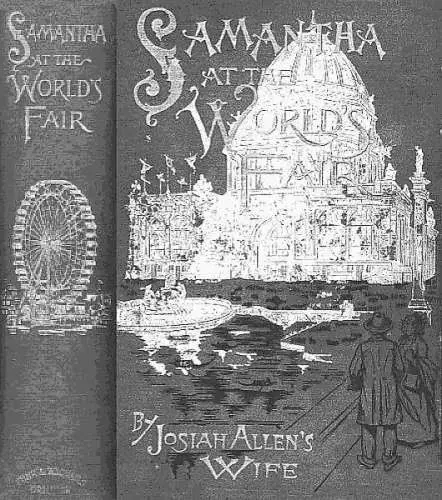
THE CLASSIC COLLECTION · 1893
"Samantha at the World's Fair" by Marietta Holley is a satirical novel written in the late 19th century. This work follows Samantha Allen, a witty and intelligent woman, as she prepares to attend the World's Fair in Chicago alongside her husband Josiah. The narrative explores themes of progress, societal issues, and the quirks of family relations, all delivered with Holley's characteristic humor and commentary on contemporary social issues. At the start of the story, Samantha reflects on her admiration for Christopher Columbus and his discoveries, which she wishes to honor through her attendance at the fair. In a twist of fate, she and her husband meet a distant relative, Christopher Columbus Allen, who arrives at their home just as they are making preparations for their trip to the World's Fair. This coincidence serves as a humorous thread that intertwines with Samantha's contemplations about history, family, and the expectations of society. The opening sets the tone for a blend of personal ambition and social commentary, suggesting that readers can expect a thoughtful yet entertaining exploration of these themes throughout the book.
Introduction adapted from the source catalogue; source summaries may be automatically generated.
Free to read · English · 139,602 words · No account needed
MAKE TIME FOR A GOOD BOOK
On by default. Untick to stop anonymous reading totals. Each page counts after 10 seconds in view. How this works.
Anonymous counting is on unless you have switched it off.
And then the talk I hearn--22 miles of river frontage sweepin' up from the lake into the heart of the city, where the giant elevators unload their huge traffic. He told us what the revenue of the city wuz yearly, $25,000,000, 25 millions--the idee!
And Jonesville, fifty years older than Chicago, thinks she has done well if she has 3 dollars and 25 cents in her treasury.
Why, that man used so many immense sums in his talk, that I got all muddled up, and a ort seemed to me almost like a million--I felt queer.
And then the system of Parks and Boulevards, the finest in the world--100 miles of them beautiful pleasure drives. I believe, from what I see afterwards, that he told the truth, for no city, it seems to me, could improve on that long, broad, beautiful way, smooth and tree-bordered, edged with stately homes, leadin' into the matchless beauty of the Parks.
But anon, when I felt that I wuz bein' crushed down beneath a gigantic weight of figgers, and estimates, elevators, population, hite, depth, underground tunnels, and systems of drainage--though every one of 'em wuz a grand and likely subject and awful big--but I felt that I wuz a-bein' crushed by 'em--I felt that the Practical, the Real wuz a crushin' me down--the weight, and noise, and size of the mighty iron wheel of Progress, that duz roll faster in Chicago than in any other place on earth, it seems to me. But I felt so trodden down by it, and flattened out, that I thought I would love to see sunthin' or other different, sunthin' kinder spiritual, and meditate a spell on some of the onseen forces that underlays all human endeavor.
So, at my request, we went out of our way a little, so I could set my eyes on that Temple dreamed out by a woman and wrought a good deal by faith, some like the walls of Jericho, only different, for whereas they fell by faith, this wuz riz up by it.
And my feelin's as I looked at that Temple wuz large and noble-sized as
you will find anywhere.
A Temple consecrated not so much to the Almighty in Heaven, who don't need it, as to God in Humanity--to the help of the Divine as it shows itself half buried and lost in the clay of the human--a help to relieve the God powers from the trammels of the fiend--
A Temple--not so much to set, and pray, and sing in, about the beauties of our Heavenly home, as to build up God's kingdom on earth, show forth His praise in helpin' His poor, and weak, and sinful.
Your reading position is saved on this browser. Take it to another device with a library code. Reading pages adapt to text, rather than matching a printed edition.
Marietta Holley
Marietta Holley
Marietta Holley

Marietta Holley
BEHIND THE BOOK
This eBook is for the use of anyone anywhere in the United States and most other parts of the world at no cost and with almost no restrictions whatsoever. You may copy it, give it away or re-use it under the terms of the Project Gutenberg License included with this eBook or online at www.gutenberg.org. If you are not located in the United States, you will have to check the laws of the country where you are located before using this eBook. Read the source licence.
The original source file, including credits and licence, is retained by this library. Request an original-format copy at no charge. Please include the book title and Project Gutenberg identifier #18091.
KEEP YOUR CURIOSITY GOING
Coulson Kernahan

Maurice Baring
Frances Wright
Cécile Tormay

Frederic Jesup Stimson

W. H. P. (William Henry Pope) Jarvis