THE CLASSIC COLLECTION✦Tirzah Ann’s summer trip, and other sketchesCLASSIC FREE BOOKS
Tirzah Ann’s summer trip, and other sketches
Marietta Holley
THE CLASSIC COLLECTION · 1892
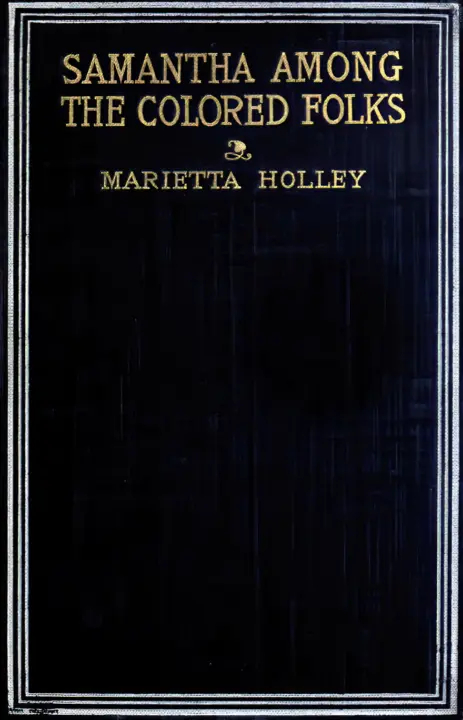
"Samantha Among the Colored Folks: 'My Ideas on the Race Problem'" by Marietta Holley is a social commentary written in the late 19th century. Through the lens of the main character, Samantha, a determined and insightful woman, the book addresses the complexities of race relations and societal expectations in post-Civil War America. Throughout the narrative, Samantha interacts with various relatives, particularly her cousin John Richard, a colporter devoted to uplifting the freedmen, who ignites discussions around race, equality, and the moral responsibilities of individuals. The opening of the story introduces Samantha in her domestic realm as she prepares for the unexpected visit of her cousin John Richard, who has dedicated years to working among the freedmen in the South. As they engage in conversations about race and the prevailing attitudes towards African Americans, tensions rise between Samantha's husband, Josiah, and John Richard. The discourse reveals Josiah's skepticism about the so-called "Race Problem," while John Richard passionately argues that societal indifference could lead to future calamities. As Samantha navigates these discussions, her perspective begins to shift, suggesting a growing awareness of the deeper complexities surrounding race and moral duty. This foundational chapter sets the stage for a rich exploration of cultural conflicts, personal beliefs, and the intricacies of human relationships.
Introduction adapted from the source catalogue; source summaries may be automatically generated.
Free to read · English · 90,896 words · No account needed
MAKE TIME FOR A GOOD BOOK
On by default. Untick to stop anonymous reading totals. Each page counts after 10 seconds in view. How this works.
Anonymous counting is on unless you have switched it off.
“For years, Samantha, I have had it in my head what I would put on your tombstun if I should live to stand up under the hard, hard blow of havin’ to rare one up over you.
“I have thought I should have it read as follers, and to wit, namely:
“‘Here lies Samantha, wife of Deacon Josiah Allen, Esquire, of Jonesville. Deacon in the Methodist Church, salesman in the Jonesville cheese factory, and a man beloved and respected by every one who knows him but to love him, and names him but to praise.’
“Its endin’ in poetry, Samantha, wuz jest what I knew wuz touchin’, dumb touchin’, and would be apt to please you; and it is always a man’s aim to write the obituarys of his former deceased pardner in a way that would suit her and be pleasin’ to her.”
Sez I calmly, “Yes, I should know a man wrote that if I read it in the darkest night that ever rolled, and I wuz blindfolded.”
“Wall,” sez he anxiously, “don’t it suit you? Don’t you think it is uneek, sunthin’ new and strikin’?”
“Oh, no,” sez I, “no, it hain’t nuthin’ new at all; but mebby it is strikin’—or that is,” sez I, “it depends on who is struck.”
“Wall,” sez he, “it is dumb discouragin’, after a man racks his brains to try to get up sunthin’ strong and beautiful, to think a woman can’t be tickled and animated with it.”
Sez I calmly, “I hain’t said that I wuzn’t suited with it.” And sez I with still more severe axents, for I see he looked disappointed, “I will say further, Josiah, that it meets my expectations fully; it is jest what I should expect a male pardner to write.”
“Wall,” sez he, lookin’ pleaseder and more satisfieder, “I thought you would appreciate it after you thought it over for a spell.”
“I do, Josiah,” sez I, turnin’ over the sock I wuz a mendin’ and attacktin’ a new weak spot in the heel, “I do appreciate it fully.”
Josiah looked real tickled and sort o’ proud, and I kep’ on in calm axents and a darnin’ too, for the hole wuz big, and night wuz a descendin’ down onto us. And I could hear Aunt Mela’s preparations for supper down below, and I wanted to get the sock done before I went down-stairs. So I sez, sez I:
Your reading position is saved on this browser. Take it to another device with a library code. Reading pages adapt to text, rather than matching a printed edition.
Marietta Holley
Marietta Holley
Marietta Holley
Marietta Holley
BEHIND THE BOOK
This eBook is for the use of anyone anywhere in the United States and most other parts of the world at no cost and with almost no restrictions whatsoever. You may copy it, give it away or re-use it under the terms of the Project Gutenberg License included with this eBook or online at www.gutenberg.org. If you are not located in the United States, you will have to check the laws of the country where you are located before using this eBook. Read the source licence.
The original source file, including credits and licence, is retained by this library. Request an original-format copy at no charge. Please include the book title and Project Gutenberg identifier #66411.
KEEP YOUR CURIOSITY GOING
Coulson Kernahan

Maurice Baring
Frances Wright
Cécile Tormay

Frederic Jesup Stimson

W. H. P. (William Henry Pope) Jarvis