THE CLASSIC COLLECTION✦Tirzah Ann’s summer trip, and other sketchesCLASSIC FREE BOOKS
Tirzah Ann’s summer trip, and other sketches
Marietta Holley
THE CLASSIC COLLECTION · 1892
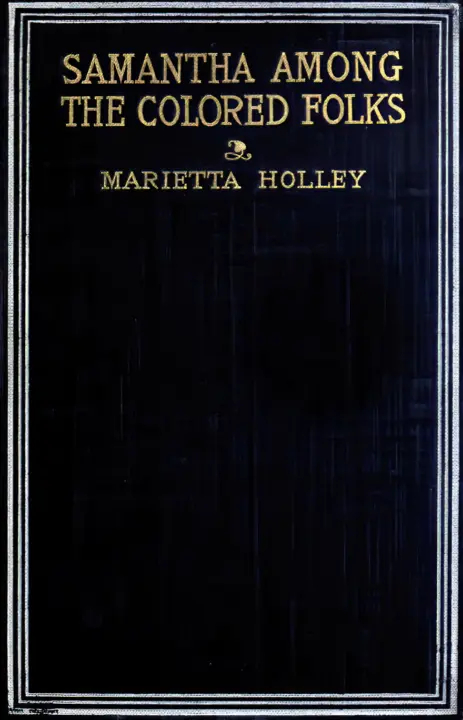
"Samantha Among the Colored Folks: 'My Ideas on the Race Problem'" by Marietta Holley is a social commentary written in the late 19th century. Through the lens of the main character, Samantha, a determined and insightful woman, the book addresses the complexities of race relations and societal expectations in post-Civil War America. Throughout the narrative, Samantha interacts with various relatives, particularly her cousin John Richard, a colporter devoted to uplifting the freedmen, who ignites discussions around race, equality, and the moral responsibilities of individuals. The opening of the story introduces Samantha in her domestic realm as she prepares for the unexpected visit of her cousin John Richard, who has dedicated years to working among the freedmen in the South. As they engage in conversations about race and the prevailing attitudes towards African Americans, tensions rise between Samantha's husband, Josiah, and John Richard. The discourse reveals Josiah's skepticism about the so-called "Race Problem," while John Richard passionately argues that societal indifference could lead to future calamities. As Samantha navigates these discussions, her perspective begins to shift, suggesting a growing awareness of the deeper complexities surrounding race and moral duty. This foundational chapter sets the stage for a rich exploration of cultural conflicts, personal beliefs, and the intricacies of human relationships.
Introduction adapted from the source catalogue; source summaries may be automatically generated.
Free to read · English · 90,896 words · No account needed
MAKE TIME FOR A GOOD BOOK
On by default. Untick to stop anonymous reading totals. Each page counts after 10 seconds in view. How this works.
Anonymous counting is on unless you have switched it off.
And as my mind roamed back and recalled the various things I had heard of his doin’, I most imegiatly made up my mind that, neighbor or not, if this thing kep’ on I should have to gin him a piece of my mind.
And there Genieve sot, the good, pretty, patient creeter, a hearin’ her own people run down to the lowest notch. I felt as if I should sink, but felt that before I did sink I should speak.
He went on to tell what a dretful state the country wuz in, and all a owin’ to the colored race; and sez he:
“The niggers don’t take any interest in the welfare of the country. What do they care what becomes of the nation if they can get their pan of bacon and hominy?
“A mule stands up before their eyes higher than any idea of Justice or
Liberty.
“They are liars, they are thieves, they are lazy, they are hangers-on to the skirts of civilization, they can never stand upright, they have got to be carried all their days. And it is this mass of ignorance, and superstition, and vice that you Northerners want to see ruling us white men of the South.
“They can’t read nor write, nor understand an intelligible remark hardly; and yet these are the men that you want to have vote and get put in as rulers over us.
“Well, we will not submit to it, that is all there is about it; and if war comes, the sooner the better, for we will die fighting for our freedom. It is bad enough for us Southerners to be ruled by Northern men, but when it comes to being ruled by beasts, animals that are no higher than brutes, we will not submit.”
Sez I, for I would speak up, and I did:
“Hain’t there plenty of intelligent educated colored people now, graduates of schools and colleges—lawyers, teachers, ministers, etc., etc.?”
“Oh, yes, a few,” he admitted reluctantly.
I knew there wuz a hundred thousand of ’em, if there wuz one.
And I sez, “Hain’t the condition of your poor whites here in the South about as bad as the negroes, mentally and morally and physically?”
“Well, yes,” he admitted that it wuz. “But,” sez he, “that don’t alter the dangerous state of affairs. The interests of a community cannot be placed in the hands of an ignorant, vicious rabble without terrible peril and danger. And when it is too late the country will awake to this truth.”
Your reading position is saved on this browser. Take it to another device with a library code. Reading pages adapt to text, rather than matching a printed edition.
Marietta Holley
Marietta Holley
Marietta Holley
Marietta Holley
BEHIND THE BOOK
This eBook is for the use of anyone anywhere in the United States and most other parts of the world at no cost and with almost no restrictions whatsoever. You may copy it, give it away or re-use it under the terms of the Project Gutenberg License included with this eBook or online at www.gutenberg.org. If you are not located in the United States, you will have to check the laws of the country where you are located before using this eBook. Read the source licence.
The original source file, including credits and licence, is retained by this library. Request an original-format copy at no charge. Please include the book title and Project Gutenberg identifier #66411.
KEEP YOUR CURIOSITY GOING
Coulson Kernahan

Maurice Baring
Frances Wright
Cécile Tormay

Frederic Jesup Stimson

W. H. P. (William Henry Pope) Jarvis