THE CLASSIC COLLECTION✦Tirzah Ann’s summer trip, and other sketchesCLASSIC FREE BOOKS
Tirzah Ann’s summer trip, and other sketches
Marietta Holley
THE CLASSIC COLLECTION · 1890
"Samantha Among the Brethren, Complete" by Marietta Holley is a satirical novel written in the late 19th century. The book focuses on the life of Samantha, a strong-willed and opinionated woman, as she navigates the complexities of gender roles within her community, particularly in relation to the church and domestic life. With her husband, Josiah Allen, as a recurring character who embodies traditional male perspectives, Samantha's discussions often revolve around women's rights and societal expectations. The opening of "Samantha Among the Brethren" introduces readers to Samantha's character, highlighting her assertiveness and belief in women's contributions to religion and society, which she articulates while discussing the exclusion of women from church conferences. As her husband Josiah expresses skepticism about women's roles in religious leadership, Samantha passionately argues for their rightful place, drawing from historical and biblical references. Their lively banter sets the tone for the novel, showcasing the humor and complexity of marital dynamics and the dialogues surrounding women's empowerment during the time. The stage is set for a narrative filled with wit, social commentary, and Samantha's determined spirit.
Introduction adapted from the source catalogue; source summaries may be automatically generated.
Free to read · English · 73,681 words · No account needed
MAKE TIME FOR A GOOD BOOK
On by default. Untick to stop anonymous reading totals. Each page counts after 10 seconds in view. How this works.
Anonymous counting is on unless you have switched it off.
Now, Mr. President, all this twaddle about the women being in is based upon the pretence that one woman is there now. The certificate shows that they were women, though as yet no action has been taken in regard to them at all. If they were in, they were in with a constitutional challenge. I champion the holy cause of women. I stand here to champion their cause against their being introduced into this body without their own sex having had the opportunity of expressing their opinion upon the subject. I stand here to protect them against being connected with movements without law or contrary to law, and those who wish to bring them in and those who say it is the constitution of the man and prejudice (my friend, Dr. Potts, said prejudice), they are persons, indeed, to stand up here as, par excellence the champions of women! Is it the constitution of the men? Have you read the letter of Mrs. Caroline Wright in the Christian Advocate, one of our most distinguished American Methodist women? She does not wish to see them here. It is the constitution of the woman in that case, and I am opposed to their being admitted until the general sentiment of the women and the men of our Church have an opportunity of being heard upon it.
Now, Mr. President, note these facts.... This is not a fact, but my opinion. I solemnly believe that there was never an hour in the Methodist Episcopal Church when it was in so great danger as it is to-day, not on account of the admission of these women, two of whom I believe to be as competent to sit in judgment on this question as any man on this floor. That is not the question, as I propose to show. I assert freely, here and now, if the women are in under the Restrictive Rules, no power ought to put them out. If they are not in under the Restrictive Rules, nothing has been done since, in my judgment, bearing upon it. I am astounded that these brethren fancy that this question has no bearing at all on the meaning of that rule. That is a wonderful thing. But we affirm that when the Church voted to introduce lay delegation, it not only did not intend to introduce women, but it did intend to fill up the whole body with men. That is what we affirm. If we can prove it, it is a tower of help to us. If we cannot prove it, we cannot make out our case. But our contention is, that the Church did not undertake to put women in, and it did undertake to fill up the capacities and relations of the body with men. Now, look at it. No man goes to the dictionary to find the meaning of the word "layman." There is not a man that can find out the meaning of our Restrictive Rules from the dictionary. No living man can make out the meaning of a word in the Restrictive Rules from Webster's dictionary. You must get it from the history of the Church. Who is the "General Superintendent" by Webster or Worcester? The Methodist Episcopacy is the thing that is protected by the Restrictive Rules. The dictionary does not tell how the Chartered Fund shall be taken care of. Now they talk about laymen. They do not seem, I think, to understand the history of the thing. Some of them do not appear to understand the history of the English language. Why was the word "layman" ever introduced? Because there was a separate class of clergy men in the world, but there was not a class of clergywomen in the world. If there had been, there would have been a term for laywomen and for clergywomen. And the word was invented to distinguish the laymen from the clergymen. Had there been clergywomen, there would have been laywomen. The "laity" means all the people, men, women, and children. A woman is one of the laity, and so is every child in the country or in the Church one of the laity. But when you speak of man acting as a unit he is a layman, but you never say a laywoman. You say: a woman. Abraham Lincoln said, "All these things are done and suffered, that government of the people, for the people, and by the people should not perish from the earth." Now, people, the dictionary says, are men, women, and children. Did Abraham Lincoln mean that any women or children can take any part in the government of the nation? No, no, no! He meant this. When he stood up and delivered his inaugural speech, he said this, "The intent of the lawmaker is the law."
Your reading position is saved on this browser. Take it to another device with a library code. Reading pages adapt to text, rather than matching a printed edition.
Marietta Holley
Marietta Holley
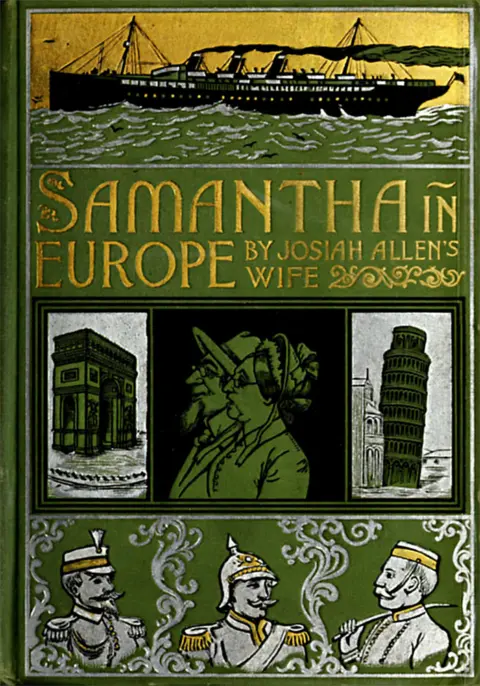
Marietta Holley

Marietta Holley
BEHIND THE BOOK
This eBook is for the use of anyone anywhere in the United States and most other parts of the world at no cost and with almost no restrictions whatsoever. You may copy it, give it away or re-use it under the terms of the Project Gutenberg License included with this eBook or online at www.gutenberg.org. If you are not located in the United States, you will have to check the laws of the country where you are located before using this eBook. Read the source licence.
The original source file, including credits and licence, is retained by this library. Request an original-format copy at no charge. Please include the book title and Project Gutenberg identifier #9450.
KEEP YOUR CURIOSITY GOING
Coulson Kernahan

Maurice Baring
Frances Wright
Cécile Tormay

Frederic Jesup Stimson

W. H. P. (William Henry Pope) Jarvis