THE CLASSIC COLLECTION✦Tirzah Ann’s summer trip, and other sketchesCLASSIC FREE BOOKS
Tirzah Ann’s summer trip, and other sketches
Marietta Holley
THE CLASSIC COLLECTION · 1890
"Samantha Among the Brethren, Complete" by Marietta Holley is a satirical novel written in the late 19th century. The book focuses on the life of Samantha, a strong-willed and opinionated woman, as she navigates the complexities of gender roles within her community, particularly in relation to the church and domestic life. With her husband, Josiah Allen, as a recurring character who embodies traditional male perspectives, Samantha's discussions often revolve around women's rights and societal expectations. The opening of "Samantha Among the Brethren" introduces readers to Samantha's character, highlighting her assertiveness and belief in women's contributions to religion and society, which she articulates while discussing the exclusion of women from church conferences. As her husband Josiah expresses skepticism about women's roles in religious leadership, Samantha passionately argues for their rightful place, drawing from historical and biblical references. Their lively banter sets the tone for the novel, showcasing the humor and complexity of marital dynamics and the dialogues surrounding women's empowerment during the time. The stage is set for a narrative filled with wit, social commentary, and Samantha's determined spirit.
Introduction adapted from the source catalogue; source summaries may be automatically generated.
Free to read · English · 73,681 words · No account needed
MAKE TIME FOR A GOOD BOOK
On by default. Untick to stop anonymous reading totals. Each page counts after 10 seconds in view. How this works.
Anonymous counting is on unless you have switched it off.
Why, sir, the government of the Methodist Episcopal Church exists for the ministry and membership of the Church. The ministry and the membership of the Church do not exist for the government. The world was made for man, and not man for the world. That is the fundamental idea in the government of God, as He treats us as human beings. That is the fundamental idea in the government of the Methodist Episcopal Church, as we are enlisted in the support of that government as ministers and members of the Church. Now under this system of ecclesiastical government a time came in our history when we submitted a grave question to the membership of the Church. It was not a question simply of petition, asking the membership to send petitions up to the General Conference. On the contrary, it was submitting a constitutional question not simply to the male members of the Church, for that grand and noble man of the Methodist Church, Dr. David Sherman of the New England Conference, moved himself to strike out the word "male" from the report of the Committee on Lay Delegation. It came to a vote, and it was stricken out, two to one in the vote. When that was done, then the General Conference of our Church submitted to the membership of the Church the question of lay delegation. But back of the question of lay delegation was as grave a question, and that was granting the right of suffrage to the women of the Church. The General Conference assumed the responsibility of giving to the women the right to vote. It may be questioned this way; it may be explained that way; but the facts abide that the General Conference granted to the women of the Church the right to vote on a great and important question in ecclesiastical law. Now if you run a parallel along the line of our government--and it has often been said that there are parallels in the government of the United States corresponding to lines of legislation and legislative action in the government of the Church--you will find that the right of suffrage in the country at the ballot-box has been a gradual growth. One of the most sacred rights that a man, an American citizen, enjoys is the right to cast a ballot for the man or men he would have legislate for him; and for no trivial reason can that right, when once granted to the American citizen, be taken away from him. Go to the State of Massachusetts, and trace the history of citizen suffrage, and you find it commenced in this way: First, a man could vote under the government there who was a member of the Church. Next, he could vote if he were a freeholder. A little later on he could vote if he paid a poll-tax. In the government, and under the legislation of our Church, first the women were granted the right to vote on the principle of lay delegation, not on the "plan" of lay delegation, but on the "principle" of lay delegation. That was decided by Bishop Simpson in the New Hampshire Conference, and by Bishop Janes afterward in one of the New York Conferences. On the principle of lay delegation, the women of the Church were granted the right of suffrage; presently they appeared in the Quarterly Conference, to vote as class-leaders, stewards, and Sunday-school superintendents; and it created a little excitement, a feverish state of feeling in the Church, and the General Conference simply passed a resolution or a rule interpreting that action on the part of women claiming this privilege in the Quarterly Conference as being a "right," and it was continued. Presently, as the right of suffrage of women passed on and grew, they voted in the Electoral Conferences, and there was no outcry made against it. I have yet to hear of any Bishop in the Church, or any presiding elder, or any minister challenging the right of women to vote in Electoral Conferences or Quarterly Conferences; and yet for sixteen years they have been voting in these bodies; voting to send laymen here to legislate; to send laymen to the General Conference to elect Bishops and Editors and Book Agents and Secretaries. They come to where votes count in making up this body; they have been voting sixteen years, and only now, when the logical result of the right of suffrage that the General Conference gave to women appears and confronts us by women coming here to vote as delegates, do we rise up and protest. I believe that it is at the wrong time that the protest comes. It should have come when the right to vote was granted to women in the Church. It is sixteen years too late, and as was very wisely said by Dr. Potts, the objection comes not so much from the Constitution of the Church as from the "constitution of the men," who challenge these women.
Your reading position is saved on this browser. Take it to another device with a library code. Reading pages adapt to text, rather than matching a printed edition.
Marietta Holley
Marietta Holley
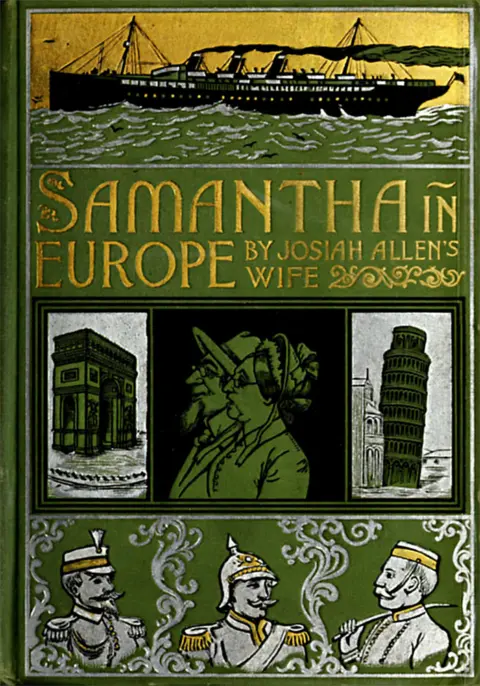
Marietta Holley
Marietta Holley
BEHIND THE BOOK
This eBook is for the use of anyone anywhere in the United States and most other parts of the world at no cost and with almost no restrictions whatsoever. You may copy it, give it away or re-use it under the terms of the Project Gutenberg License included with this eBook or online at www.gutenberg.org. If you are not located in the United States, you will have to check the laws of the country where you are located before using this eBook. Read the source licence.
The original source file, including credits and licence, is retained by this library. Request an original-format copy at no charge. Please include the book title and Project Gutenberg identifier #9450.
KEEP YOUR CURIOSITY GOING
Coulson Kernahan

Maurice Baring
Frances Wright
Cécile Tormay

Frederic Jesup Stimson

W. H. P. (William Henry Pope) Jarvis