THE CLASSIC COLLECTION✦Tirzah Ann’s summer trip, and other sketchesCLASSIC FREE BOOKS
Tirzah Ann’s summer trip, and other sketches
Marietta Holley
THE CLASSIC COLLECTION · 1890
"Samantha Among the Brethren, Complete" by Marietta Holley is a satirical novel written in the late 19th century. The book focuses on the life of Samantha, a strong-willed and opinionated woman, as she navigates the complexities of gender roles within her community, particularly in relation to the church and domestic life. With her husband, Josiah Allen, as a recurring character who embodies traditional male perspectives, Samantha's discussions often revolve around women's rights and societal expectations. The opening of "Samantha Among the Brethren" introduces readers to Samantha's character, highlighting her assertiveness and belief in women's contributions to religion and society, which she articulates while discussing the exclusion of women from church conferences. As her husband Josiah expresses skepticism about women's roles in religious leadership, Samantha passionately argues for their rightful place, drawing from historical and biblical references. Their lively banter sets the tone for the novel, showcasing the humor and complexity of marital dynamics and the dialogues surrounding women's empowerment during the time. The stage is set for a narrative filled with wit, social commentary, and Samantha's determined spirit.
Introduction adapted from the source catalogue; source summaries may be automatically generated.
Free to read · English · 73,681 words · No account needed
MAKE TIME FOR A GOOD BOOK
On by default. Untick to stop anonymous reading totals. Each page counts after 10 seconds in view. How this works.
Anonymous counting is on unless you have switched it off.
"No church, no sanctuary, no religius observances."
"Why," sez I, "that wouldn't hinder folks from goin' to church. Folks seem to get to theatres, lectures, and disolvin' views on time, and better time than they do to meetin'," sez I. "In your opinin' it hain't necessary to beat a drum and sound on a bugle as the Salvation Army duz, to call folks to meetin'; you are dretful hard on them, so I hear."
"Yes, they make a senseless, vulgar, onnecessary racket, disturbin' and agrivatin' to saint and sinner."
"But," sez I, "they say they do it for the sake of religion."
"Religion hain't to be found in drum-sticks," sez he bitterly.
"No," sez I, "nor in a bell clapper."
"Oh," sez he, "that is a different thing entirely, that is to call worshippers together, that is necessary."
Sez I, "One hain't no more necessary than the other in my opinion."
Sez he, "Look how fur back in the past the sweet bells have sounded
out."
"Yes," sez I candidly, "and in the sweet past they wuz necessary," sez I. "In the sweet past, there wuzn't a clock nor a watch, the houses wuz fur apart, and they needed bells. But now there hain't a house but what is runnin' over with clocks--everybody knows the time; they know it so much that time is fairly a drug to 'em. Why, they time themselves right along through the day, from breakfast to midnight. Time their meals, their business, their pleasures, their music, their lessons, their visits, their visitors, their pulse beats, and their dead beats. They time their joys and their sorrows, and everything and everybody, all through the week, and why should they stop short off Sundays? Why not time themselves on goin' to meetin'? They do, and you know it. There hain't no earthly need of the bells to tell the time to go to meetin', no more than there is to tell the time to put on the tea-kettle to get supper. If folks want to go to meetin' they will get there, bells or no bells, and if they don't want to go, bells hain't a-goin' to get 'em started.
"Take a man with the Sunday World jest brung in, a-layin' on a lounge, with his feet up in a chair, and kinder lazy in the first place, bells hain't a-goin' to start him.
"And take a woman with her curl papers not took down, and a new religeus novel in her hand, and a miliner that disapinted her the night before, and bells hain't a-goin' to start her. No, the great bell of Moscow won't start 'em.
Your reading position is saved on this browser. Take it to another device with a library code. Reading pages adapt to text, rather than matching a printed edition.
Marietta Holley
Marietta Holley
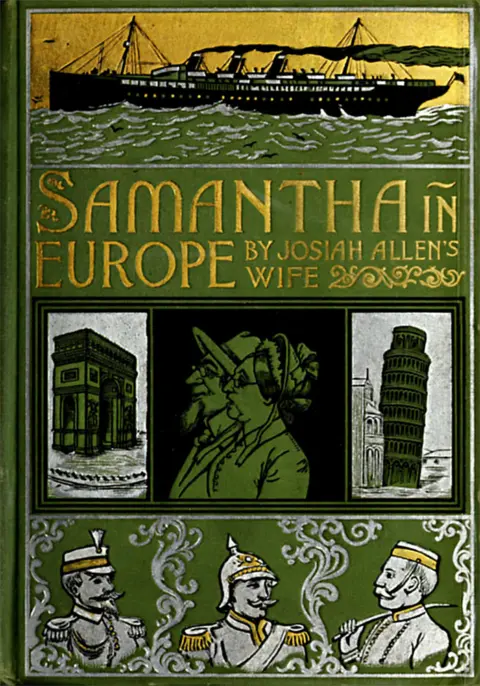
Marietta Holley

Marietta Holley
BEHIND THE BOOK
This eBook is for the use of anyone anywhere in the United States and most other parts of the world at no cost and with almost no restrictions whatsoever. You may copy it, give it away or re-use it under the terms of the Project Gutenberg License included with this eBook or online at www.gutenberg.org. If you are not located in the United States, you will have to check the laws of the country where you are located before using this eBook. Read the source licence.
The original source file, including credits and licence, is retained by this library. Request an original-format copy at no charge. Please include the book title and Project Gutenberg identifier #9450.
KEEP YOUR CURIOSITY GOING
Coulson Kernahan

Maurice Baring
Frances Wright
Cécile Tormay

Frederic Jesup Stimson

W. H. P. (William Henry Pope) Jarvis