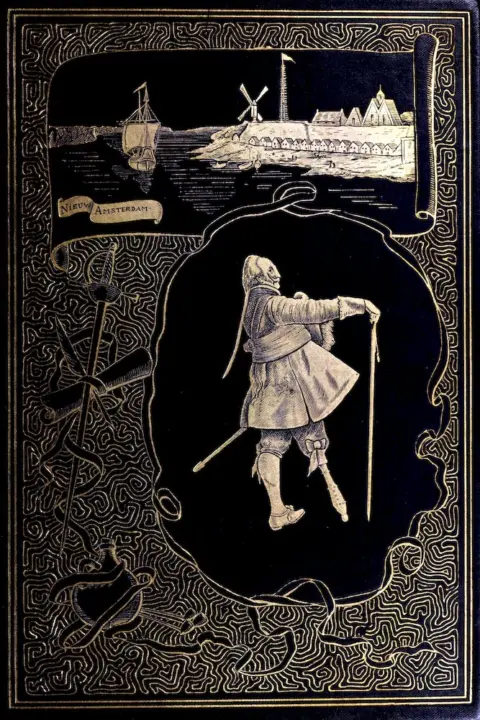
Knickerbocker’s history of New York, vol. 2 (of 2)
Washington Irving
THE CLASSIC COLLECTION · 1807
Salmagundi; or The Whim-whams and Opinions of Launcelot Langstaff, Esq. & Others, commonly referred to as Salmagundi, was a 19th-century satirical periodical created and written by American writer Washington Irving, his oldest brother William, and James Kirke Paulding. The collaborators produced twenty issues at irregular intervals between January 24, 1807 and January 15, 1808. (This summary is from Wikipedia.)
Introduction adapted from the source catalogue; source summaries may be automatically generated.
Free to read · English · 122,790 words · No account needed
MAKE TIME FOR A GOOD BOOK
On by default. Untick to stop anonymous reading totals. Each page counts after 10 seconds in view. How this works.
Anonymous counting is on unless you have switched it off.
How oft in musing mood my heart recalls, From gray-beard father Time’s oblivious halls, The modes and maxims of my early day, Long in those dark recesses stow’d away: Drags once more to the cheerful realms of light Those buckram fashions, long since lost in night, And makes, like Endor’s witch, once more to rise My grogram grandames to my raptured eyes! Shades of my fathers! in your pasteboard skirts, Your broidered waistcoats and your plaited shirts, Your formal bag-wigs—wide-extended cuffs, Your five-inch chitterlings and nine-inch ruffs Gods! how ye strut, at times, in all your state, Amid the visions of my thoughtful pate! I see ye move the solemn minuet o’er, The modest foot scarce rising from the floor; No thundering rigadoon with boisterous prance, No pigeon-wing disturb your contre-danse. But silent as the gentle Lethe’s tide, Adown the festive maze ye peaceful glide! Still in my mental eye each name appears— Each modest beauty of departed years; Close by mamma I see her stately march, Or sit, in all the majesty of starch;— When for the dance a stranger seeks her hand. I see her doubting, hesitating stand; Yield to his claim with most fastidious grace, And sigh for her intended in his place! Ah! golden days; when every gentle fair On sacred Sabbath conn’d with pious care Her Holy Bible, or her prayer-book o’er, Or studied honest Bunyan’s drowsy lore; Travell’d with him the “Pilgrim’s Progress” through, And storm’d the famous town of Man-soul too:— Beat Eye and Ear-gate up with thundering jar, And fought triumphant through the “Holy War;” Or if, perchance, to lighter works inclined, They sought with novels to relax the mind, ’Twas “Grandison’s politely” formal page, Or “Clelia” or “Pamela” were the rage. No plays were then—theatrics were unknown— A learned pig, a dancing monkey shown, The feats of Punch, a cunning juggler’s sleight, Were sure to fill each bosom with delight. An honest, simple, humdrum race we were, Undazzled yet by fashion’s wildering glare; Our manners unreserved, devoid of guile, We knew not then the modern monster, Style: Style, that with pride each empty bosom swells, Puffs boys to manhood, little girls to belles. Scarce from the nursery freed, our gentle fair Are yielded to the dancing-master’s care; And, ere the head one mite of sense can gain, Are introduced ‘mid folly’s frippery train. A stranger’s grasp no longer gives alarms, Our fair surrender to their very arms. And in the insidious waltz[56] will swim and twine, And whirl and languish tenderly divine! O, how I hate this loving, hugging dance; This imp of Germany brought up in France: Nor can I see a niece its windings trace, But all the honest blood glows in my face. “Sad, sad refinement this,” I often say; ’Tis modesty indeed refined away! Let France its whim, its sparkling wit supply, The easy grace that captivates the eye; But curse their waltz—their loose, lascivious arts, “That smooth our manners, to corrupt our hearts!”[57] Where now those books, from which in days of yore Our mothers gained their literary store? Alas! stiff-skirted Grandison gives place To novels of a new and rakish race; And honest Bunyan’s pious dreaming lore, To the lascivious rhapsodies of Moore. And, last of all, behold the mimic stage, Its morals lend to polish off the age; With flimsy farce, a comedy miscall’d, Garnished with vulgar cant, and proverbs bald, With puns most puny, and a plenteous store Of smutty jokes, to catch a gallery roar. Or see, more fatal, graced with every art To charm and captivate the female heart, The false, “the gallant, gay Lothario” smiles.[58] And loudly boasts his base seductive wiles— In glowing colors paint Calista’s wrongs, And with voluptuous scenes the tale prolongs. When Cooper lends his fascinating powers, Decks vice itself in bright alluring flowers, Pleased with his manly grace, his youthful fire, Our fair are lured the villain to admire; While humbler virtue, like a stalking horse, Struts clumsily and croaks in honest Morse. Ah, hapless days! when trials thus combined. In pleasing garb assail the female mind; When every smooth, insidious snare is spread To sap the morals and delude the head! Not Shadrach, Meshach, and Abed-nego, To prove their faith and virtue here below, Could more an angel’s helping hand require To guide their steps uninjured through the fire, Where had but heaven its guardian aid denied, The holy trio in the proof had died. If, then, their manly vigor sought supplies From the bright stranger in celestial guise, Alas! can we from feebler natures claim, To brave seduction’s ordeal, free from blame; To pass through fire unhurt like golden ore, Though ANGEL MISSIONS bless the earth no more!
Your reading position is saved on this browser. Take it to another device with a library code. Reading pages adapt to text, rather than matching a printed edition.
Washington Irving
Washington Irving
Washington Irving
Washington Irving
BEHIND THE BOOK
This eBook is for the use of anyone anywhere in the United States and most other parts of the world at no cost and with almost no restrictions whatsoever. You may copy it, give it away or re-use it under the terms of the Project Gutenberg License included with this eBook or online at www.gutenberg.org. If you are not located in the United States, you will have to check the laws of the country where you are located before using this eBook. Read the source licence.
The original source file, including credits and licence, is retained by this library. Request an original-format copy at no charge. Please include the book title and Project Gutenberg identifier #77926.
KEEP YOUR CURIOSITY GOING

Charles G. (Charles Griffith) Ross
Hannah Webster Foster

Emily Lawless
Edwin Hamlin Carr

Charles De Lano Hine
Andrew Ure