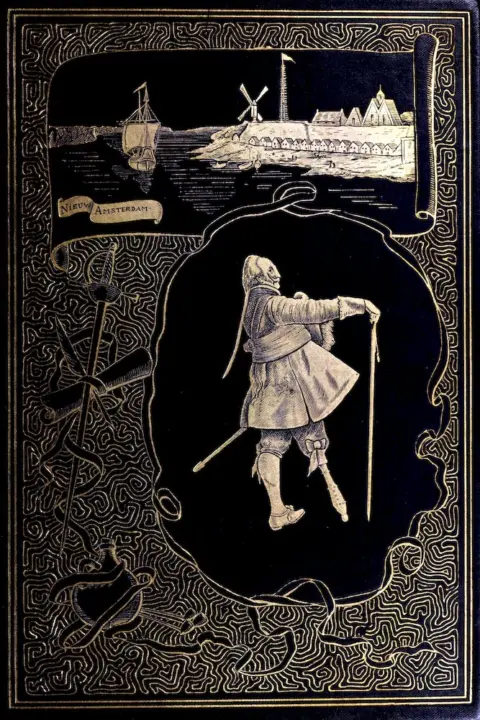
Knickerbocker’s history of New York, vol. 2 (of 2)
Washington Irving
THE CLASSIC COLLECTION · 1807
Salmagundi; or The Whim-whams and Opinions of Launcelot Langstaff, Esq. & Others, commonly referred to as Salmagundi, was a 19th-century satirical periodical created and written by American writer Washington Irving, his oldest brother William, and James Kirke Paulding. The collaborators produced twenty issues at irregular intervals between January 24, 1807 and January 15, 1808. (This summary is from Wikipedia.)
Introduction adapted from the source catalogue; source summaries may be automatically generated.
Free to read · English · 122,790 words · No account needed
MAKE TIME FOR A GOOD BOOK
On by default. Untick to stop anonymous reading totals. Each page counts after 10 seconds in view. How this works.
Anonymous counting is on unless you have switched it off.
Though the family is apparently small, yet, like most old establishments of the kind, it does not want for honorary members. It is the city rendezvous of the Cocklofts; and we are continually enlivened by the company of half a score of uncles, aunts, and cousins, in the fortieth remove, from all parts of the country, who profess a wonderful regard for Cousin Christopher, and overwhelm every member of his household, down to the cook in the kitchen, with their attentions. We have for three weeks past been greeted with the company of two worthy old spinsters, who came down from the country to settle a lawsuit. They have done little else but retail stories of their village neighbors, knit stockings, and take snuff all the time they have been here; the whole family are bewildered with churchyard tales of sheeted ghosts, white horses without heads, and with large goggle eyes in their buttocks; and not one of the old servants dare budge an inch after dark without a numerous company at his heels. My cousin’s visitors, however, always return his hospitality with due gratitude, and now and then remind him of their fraternal regard, by a present of a pot of apple sweetmeats, or a barrel of sour cider at Christmas. Jeremy displays himself to great advantage among his country relations, who all think him a prodigy, and often stand astounded, in “gaping wonderment,” at his natural philosophy. He lately frightened a simple old uncle almost out of his wits, by giving it as his opinion that the earth would one day be scorched to ashes by the eccentric gambols of the famous comet, so much talked of; and positively asserted that this world revolved round the sun, and that the moon was certainly inhabited.
The family mansion bears equal marks of antiquity with its inhabitants. As the Cocklofts are remarkable for their attachment to everything that has remained long in the family, they are bigoted toward their old edifice, and I dare say would sooner have it crumble about their ears than abandon it. The consequence is, it has been so patched up and repaired, that it has become as full of whims and oddities as its tenants; requires to be nursed and humored like a gouty old codger of an alderman, and reminds one of the famous ship in which a certain admiral circumnavigated the globe, which was so patched and timbered, in order to preserve so great a curiosity, that at length not a particle of the original remained. Whenever the wind blows, the old mansion makes a most perilous groaning; and every storm is sure to make a day’s work for the carpenter, who attends upon it as regularly as the family physician. This predilection for everything that has been long in the family shows itself in every particular. The domestics are all grown gray in the service of our house. We have a little, old, crusty, gray-headed negro, who has lived through two or three generations of the Cocklofts, and of course has become a personage of no little importance in the household. He calls all the family by their Christian names; tells long stories about how he dandled them on his knee when they were children; and is a complete Cockloft chronicle for the last seventy years. The family carriage was made in the last French war, and the old horses were most indubitably foaled in Noah’s ark: resembling marvelously, in gravity of demeanor, those sober animals which may be seen any day of the year in the streets of Philadelphia walking their snail’s pace, a dozen in a row, and harmoniously jingling their bells. Whimwhams are the inheritance of the Cocklofts, and every member of the household is a humorist sui generis, from the master down to the footman. The very cats and dogs are humorists; and we have a little runty scoundrel of a cur, who whenever the church bells ring, will run to the street door, turn up his nose in the wind, and howl most piteously. Jeremy insists that this is owing to a peculiar delicacy in the organization of his ears, and supports his position by many learned arguments which nobody can understand; but I am of opinion that it is a mere Cockloft whimwham, which the little cur indulges, being descended from a race of dogs which has flourished in the family ever since the time of my grandfather. A propensity to save everything that bears the stamp of family antiquity has accumulated an abundance of trumpery and rubbish with which the house is encumbered from the cellar to the garret; and every room, and closet, and corner is crammed with three-legged chairs, clocks without hands, swords without scabbards, cocked hats, broken candlesticks, and looking-glasses with frames carved into fantastic shapes of feathered sheep, woolly birds, and other animals that have no name except in books of heraldry. The ponderous mahogany chairs in the parlors are of such unwieldy proportions that it is quite a serious undertaking to gallant one of them across the room, and sometimes make a most equivocal noise when you sit down in a hurry; the mantel-piece is decorated with little lacquered earthen shepherdesses, some of which are without toes, and others without noses; and the fire-place is garnished out with Dutch tiles, exhibiting a great variety of Scripture pieces, which my good old soul of a cousin takes infinite delight in explaining. Poor Jeremy hates them as he does poison; for, while a younker, he was obliged by his mother to learn the history of a tile every Sunday morning before she would permit him to join his playmates; this was a terrible affair for Jeremy, who, by the time he had learned the last, had forgotten the first, and was obliged to begin again. He assured me the other day, with a round college oath, that if the old house stood out till he inherited it, he would have these tiles taken out, and ground into powder, for the perfect hatred he bore them.
Your reading position is saved on this browser. Take it to another device with a library code. Reading pages adapt to text, rather than matching a printed edition.
Washington Irving
Washington Irving
Washington Irving
Washington Irving
BEHIND THE BOOK
This eBook is for the use of anyone anywhere in the United States and most other parts of the world at no cost and with almost no restrictions whatsoever. You may copy it, give it away or re-use it under the terms of the Project Gutenberg License included with this eBook or online at www.gutenberg.org. If you are not located in the United States, you will have to check the laws of the country where you are located before using this eBook. Read the source licence.
The original source file, including credits and licence, is retained by this library. Request an original-format copy at no charge. Please include the book title and Project Gutenberg identifier #77926.
KEEP YOUR CURIOSITY GOING

Charles G. (Charles Griffith) Ross
Hannah Webster Foster

Emily Lawless
Edwin Hamlin Carr

Charles De Lano Hine
Andrew Ure