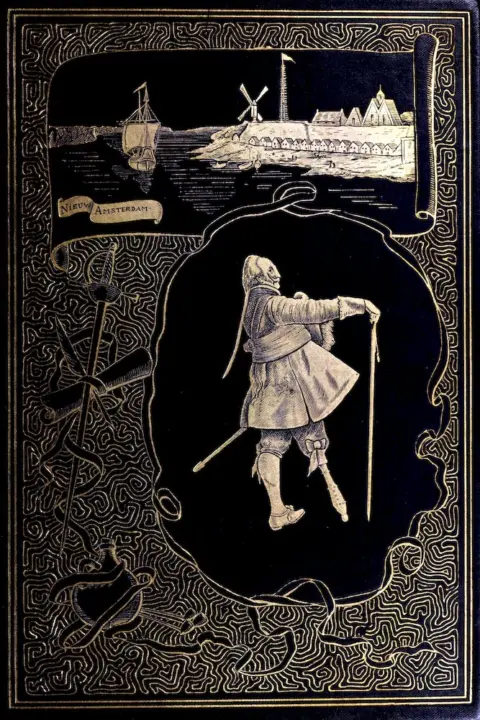
Knickerbocker’s history of New York, vol. 2 (of 2)
Washington Irving
THE CLASSIC COLLECTION · 1807
Salmagundi; or The Whim-whams and Opinions of Launcelot Langstaff, Esq. & Others, commonly referred to as Salmagundi, was a 19th-century satirical periodical created and written by American writer Washington Irving, his oldest brother William, and James Kirke Paulding. The collaborators produced twenty issues at irregular intervals between January 24, 1807 and January 15, 1808. (This summary is from Wikipedia.)
Introduction adapted from the source catalogue; source summaries may be automatically generated.
Free to read · English · 122,790 words · No account needed
MAKE TIME FOR A GOOD BOOK
On by default. Untick to stop anonymous reading totals. Each page counts after 10 seconds in view. How this works.
Anonymous counting is on unless you have switched it off.
As I find you have taken the quill, To put our gay town and its fair under drill, I offer my hopes for success to your cause, And send you unvarnish’d my mite of applause. Ah, Launce, this poor town has been wofully fash’d; Has long been be-Frenchman’d, be-cockney’d, be-trash’d, And our ladies bedevil’d, bewilder’d astray, From the rules of their grandames have wandered away. No longer that modest demeanor we meet, Which whilom the eyes of our fathers did greet; No longer be-mobbled, be-ruffled, be-quilled, Be-powder’d, be-hooded, be-patch’d, and be-frill’d. No longer our fair ones their grograms display, And stiff in brocade, strut “like castles” away. O, how fondly my soul forms departed have traced, When our ladies in stays, and in bodice well laced, When bishop’d, and cushion’d, and hoop’d to the chin, Well calash’d without, and well bolster’d within; All cased in their buckrams, from crown down to tail, Like O’Brallaghan’s mistress, were shaped like a pail. Well—peace to those fashions—the joy of our eyes— Tempura mutantur, new follies will rise; Yet, “like joys that are past,” they still crowd on the mind, In moments of thought, as the soul looks behind. Sweet days of our boyhood, gone by, my dear Launce, Like the shadows of night, or the forms in a trance; Yet oft we retrace those bright visions again, Nos mutamur, ’tis true—but those visions remain. I recall with delight, how my bosom would creep, When some delicate foot from its chamber would peep; And when I a neat stocking’d ankle could spy, By the sages of old I was rapt to the sky! All then was retiring, was modest, discreet; The beauties, all shrouded, were left to conceit— To the visions which fancy would form in her eye, Of graces that snug in soft ambush would lie; And the heart, like the poets, in thought would pursue The elysium of bliss which was veiled from its view. We are old-fashion’d fellows, our nieces will say: Old-fashioned, indeed, coz—and swear it they may— For I freely confess that it yields me no pride, To see them all blaze what their mothers would hide: To see them, all shivering, some cold winter’s day, So lavish their beauties and graces display, And give to each fopling that offers his hand, Like Moses from Pisgah—a peep at the land. But a truce with complaining—the object in view Is to offer my help in the work you pursue; And as your effusions and labors sublime, May need, now and then, a few touches of rhyme, I humbly solicit, as cousin and friend, A quiddity, quirk, or remonstrance to send: Or should you a laureate want in your plan, By the muff of my grandmother, I am your man! You must know I have got a poetical mill, Which with odd lines, and couplets, and triplets I fill; And a poem I grind, as from rags white and blue The paper-mill yields you a sheet fair and new. I can grind down an ode, or an epic that’s long, Into sonnet, acrostic, conundrum, or song: As to dull hudibrastic, so boasted of late, The doggrel discharge of some muddle-brain’d pate, I can grind it by wholesale—and give it its point, With billingsgate dished up in rhymes out of joint. I have read all the poets, and got them by heart; Can slit them, and twist them, and take them apart; Can cook up an ode out of patches and shreds, To muddle my readers and bother their heads. Old Homer, and Virgil, and Ovid I scan, Anacreon, and Sappho, who changed to a swan; Iambics and sapphics I grind at my will, And with duties of love every noddle can fill. O, ’twould do your heart good, Launce, to see my mill grind Old stuff into verses and poems refin’d:— Dan Spenser, Dan Chaucer, those poets of old, Though covered with dust, are yet true sterling gold; I can grind off their tarnish, and bring them to view, New-modell’d, new-mill’d, and improved in their hue. But I promise no more—only give me the place, And I’ll warrant I’ll fill it with credit and grace; By the living! I’ll figure and cut you a dash— As bold as Will Wizard, or ’Sbidlikensflash! PINDAR COCKLOFT.
Your reading position is saved on this browser. Take it to another device with a library code. Reading pages adapt to text, rather than matching a printed edition.
Washington Irving
Washington Irving
Washington Irving
Washington Irving
BEHIND THE BOOK
This eBook is for the use of anyone anywhere in the United States and most other parts of the world at no cost and with almost no restrictions whatsoever. You may copy it, give it away or re-use it under the terms of the Project Gutenberg License included with this eBook or online at www.gutenberg.org. If you are not located in the United States, you will have to check the laws of the country where you are located before using this eBook. Read the source licence.
The original source file, including credits and licence, is retained by this library. Request an original-format copy at no charge. Please include the book title and Project Gutenberg identifier #77926.
KEEP YOUR CURIOSITY GOING

Charles G. (Charles Griffith) Ross
Hannah Webster Foster

Emily Lawless
Edwin Hamlin Carr

Charles De Lano Hine
Andrew Ure