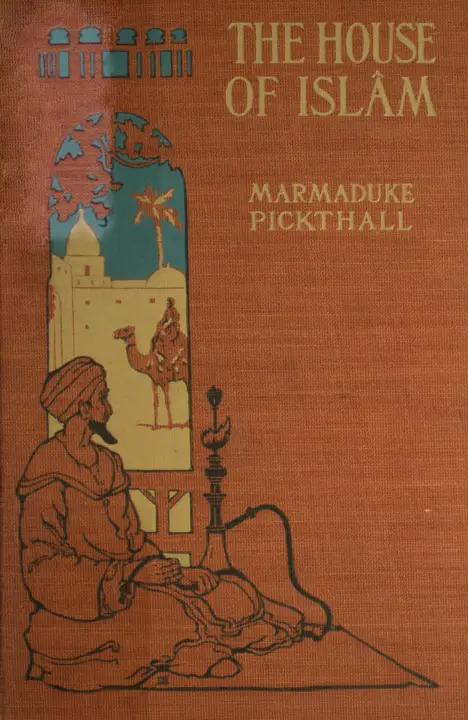
The House of Islâm
Marmaduke William Pickthall
THE CLASSIC COLLECTION · 1925
"Saïd the fisherman" by Marmaduke William Pickthall is a novel written in the early 20th century. It appears to be a picaresque tale set in the eastern Mediterranean, following a poor but ambitious fisherman whose superstition, pride, and quick wits drive him from his coastal town into a string of risky encounters. Through Saïd’s brushes with Ottoman soldiers, crafty villagers, a mendicant, and a Christian missionary’s household, the story weighs luck against fate and pokes at human folly with sly humor. Expect vivid local color, moral ambiguity, and an anti-hero propelled as much by vanity as by need. The opening of the novel shows Saïd losing the day’s earnings to galloping officers and then discovering his hidden savings stolen after his wife is lured out by a voice mimicking his friend Abdullah’s—who then “advises” him to flee and opportunistically claims Saïd’s home and gear. Saïd and his wife, Hasneh, set out; soldiers confiscate his donkey, he’s struck and humiliated, and on the road he learns from a beggar about a generous Frankish preacher, robs a camel-driver for ransom, and abandons the ailing Hasneh in a village, promising vaguely to send for her. Seeking the missionary’s help, he is chased off by a servant, sneaks back to steal a fine robe and fez, and escapes after the servant falls into a pit; dressed in his new finery, he bluffs his way into deference at a roadside khan. The section closes with Saïd basking in mistaken status as talk of soldiers and war stirs around him, setting the tone for a journey of gambles, imposture, and shifting fortune.
Introduction adapted from the source catalogue; source summaries may be automatically generated.
Free to read · English · 115,357 words · No account needed
MAKE TIME FOR A GOOD BOOK
On by default. Untick to stop anonymous reading totals. Each page counts after 10 seconds in view. How this works.
Anonymous counting is on unless you have switched it off.
Abd = A servant, a slave, much used with an epithet of the Deity in the formation of proper names, as Abdullah, the servant of God; Abdul Cader, the servant of the Powerful, and so forth.
Abu = Father of. A man assumes his son’s name with this prefix as an honourable title, letting his own name be almost forgotten.
Afrìt = A devil, a jinni (pl. afærìt).
Ayûb = Job.
Bara = Para. }
Basha = Pasha.} The Arabs have no letter “P” and cannot
pronounce it.
Bedelíeh askerieh = Tax in lieu of military service, levied on
unbelievers.
Cabil = Cain.
Caimmacàm = A local governor, inferior to the provincial governor (Wâly or Mutesarrif) and appointed by him.
Damashe-ush-Shâm (or simply Es-Shâm) = Damascus. Shâm in this name is generally taken to mean “Left” in contrast with “Yemen” meaning “Right.” But it has more likely to do with Shem (Ar. Shâm); Syria is called Es-Shâm or Birr-ush-Shâm.
Daûd = David.
Dejìl = Antichrist.
Dìn = Religion, faith—e. g., dìn Muhammed = El Islâm.
Durzi = A Druze (pl. Drûz).
Ebn = Son—e. g., ebn Ali = the son of Ali.
Effendi = A title of respect given generally to Mahometans.
El Ajem = Persia.
Eljizar = Algiers or Algeria (often confused with Eljezireh =
Mesopotamia).
El Khalìl = An epithet of the patriarch Abraham appropriate to his
city of Hebron.
Emìr = Prince, an hereditary and purely Arab title of nobility, having nothing to do with the Turkish gamut of dignities which, like the Russian, are purely official. It is given, for instance, to all the kindred of the Prophet, in addition to the epithet Sherìf (= honourable, holy).
Fellah = A husbandman, a peasant (pl. fellahìn).
Fulân = An imaginary person (cp. Span. Don Fulano) as we say Mr.
So-and-so.
Habil = Abel.
Haleb = Aleppo, surnamed the White (Esh-Shahbah).
In sh’Allah = (lit., if God will) I hope.
Isa = Jesus (Mahometan).
Iskendería = Alexandria.
Istanbûl = Constantinople.
Jebel Târic = Gibraltar.
Jinni = A geni, a fallen angel dwelling on earth and sharing with man the chance of salvation (pl. jin or jân).
Kâfir = Infidel, heathen.
Khawaja = A title of respect given exclusively to unbelievers.
Kibleh = The point towards which the face is turned at prayers (for Jews, Jerusalem, for Mahometans, Mecca).
Lûndra = London.
Marûni = A Maronite (pl. Mowarni).
Masr = Egypt.
Ma sh’ Allah = (What does God wish!) the commonest exclamation of
surprise.
Mehkemeh = A court of law presided over by the Cadi.
Miriam = Mary.
Mufti = A religious judge in every city.
Mûsa = Moses.
Muslim = A Mahometan (pl. Muslimûn).
Your reading position is saved on this browser. Take it to another device with a library code. Reading pages adapt to text, rather than matching a printed edition.
Marmaduke William Pickthall
Marmaduke William Pickthall
BEHIND THE BOOK
This eBook is for the use of anyone anywhere in the United States and most other parts of the world at no cost and with almost no restrictions whatsoever. You may copy it, give it away or re-use it under the terms of the Project Gutenberg License included with this eBook or online at www.gutenberg.org. If you are not located in the United States, you will have to check the laws of the country where you are located before using this eBook. Read the source licence.
The original source file, including credits and licence, is retained by this library. Request an original-format copy at no charge. Please include the book title and Project Gutenberg identifier #77078.
KEEP YOUR CURIOSITY GOING
Coulson Kernahan

Maurice Baring
Frances Wright
Cécile Tormay

Frederic Jesup Stimson

W. H. P. (William Henry Pope) Jarvis