THE CLASSIC COLLECTION✦A Dream of Empire; Or, The House of BlennerhassettCLASSIC FREE BOOKS
A Dream of Empire; Or, The House of Blennerhassett
William Henry Venable
THE CLASSIC COLLECTION · 1884
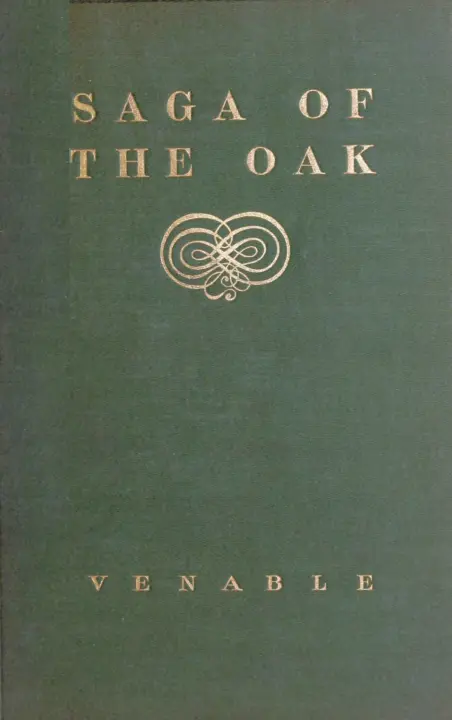
"Saga of the Oak, and Other Poems" by William Henry Venable is a collection of poetry published in the early 20th century. This anthology typically reflects themes of nature, personal introspection, and cultural history, exemplifying the lyrical quality prevalent in poetry of that time, particularly the late 19th to early 20th centuries. The collection showcases the poet’s profound appreciation for natural beauty and his contemplation of life's profound themes through a variety of poetic forms. The poems in this collection range from reflective to celebratory, incorporating various subjects such as love, loss, folklore, and the beauty of the natural world. The titular poem, "Saga of the Oak," metaphorically narrates the story of an oak tree contemplating its existence through the ages, touching on themes of resilience and continuity. Other pieces, like "A Ballad of Old Kentucky" and "Johnny Appleseed," explore historical narratives and American folklore, bringing regional stories to life. Throughout, Venable’s use of vivid imagery and rhythmic language invites readers to engage emotionally and intellectually, providing a rich tapestry of poetic expression that resonates with both contemporary and timeless themes.
Introduction adapted from the source catalogue; source summaries may be automatically generated.
Free to read · English · 14,299 words · No account needed
MAKE TIME FOR A GOOD BOOK
On by default. Untick to stop anonymous reading totals. Each page counts after 10 seconds in view. How this works.
Anonymous counting is on unless you have switched it off.
I saw a beer-plump Saxon--Bacchus’ son-- His red, round face the symbol of slow fun; Unconscious he of all ’twixt sky and earth Except one soul-engrossing cause of mirth: He dragged a painted sled, and, perched thereon, Sat snug a three-years’ maiden, bright as dawn, And happy as the sparrows chirping round, Crumb-hunting near her on the snowy ground. A sudden turn! a laughing cry, and lo! The sled upsets, and Mädchen prints the snow. She laughs; I laugh; loud ha-ha’s Bacchus’ son;-- Then gravely he,--“By yolly! dot vas fun.”
From some sweet home the morning train
Brings to the city,
Five days a week, in sun or rain,
Returning like a song’s refrain,
A school girl pretty.
A violet’s unaffected grace
Is dainty miss’s,
Yet, in her shy, expressive face,
The touch of urban arts I trace,
And artifices.
No one but she and Heaven knows
Of what she’s thinking;
It may be either books or beaux,
Fine scholarship or stylish clothes,
Per cents or prinking.
How happy must the household be
This morn who kissed her;
Not every one can make so free;
Who sees her, inly wishes she
Were his own sister.
How favored is the book she cons,
The slate she uses,
The hat she lightly doffs and dons,
The orient sunshade that she owns,
The desk she chooses.
Is she familiar with the wars
Of Julius Caesar?
Do crucibles, and Leyden jars,
And Browning, and the moons of Mars,
And Euclid, please her?
She studies music, I opine;
O day of knowledge!
And other mysteries divine
Of imitation or design,
Taught in the college.
A charm attends her everywhere,
A sense of beauty;
Care smiles to see her free of care;
The hard heart loves her unaware;
Age pays her duty.
Her innocence is panoply,
Her weakness, power;
The earth her guardian, and the sky;
God’s every star is her ally,
And every flower.
Come hither, my ten years’ maiden;
O’er what do you ponder so much?
“I am reading in Tanglewood Stories,
The tale of the Golden Touch.”
Ah! Hattie, my flax-haired darling,
How buried in study you seem.
“I am reading in Tales from Shakespeare,
Of Puck in Midsummer Night’s Dream.”
And there on the sofa is Mayo;
My laddie, what pleases you so?
“This picture and fable in Æsop,--
See here,--of the Pitcher and Crow.”
Come hither, my dream-eyed baby,
You’re falling asleep on the floor!
“I’m reading in Sing Song, papa,--
I wish you would read me some more.”
Obiit, February 7, 1878.
Your reading position is saved on this browser. Take it to another device with a library code. Reading pages adapt to text, rather than matching a printed edition.
BEHIND THE BOOK
This eBook is for the use of anyone anywhere in the United States and most other parts of the world at no cost and with almost no restrictions whatsoever. You may copy it, give it away or re-use it under the terms of the Project Gutenberg License included with this eBook or online at www.gutenberg.org. If you are not located in the United States, you will have to check the laws of the country where you are located before using this eBook. Read the source licence.
The original source file, including credits and licence, is retained by this library. Request an original-format copy at no charge. Please include the book title and Project Gutenberg identifier #64148.
KEEP YOUR CURIOSITY GOING

Eric Mackay
Edmund Gosse
Sophia Margaretta Hensley
Gilbert Parker
George MacDonald

Elizabeth Bibesco