THE CLASSIC COLLECTION✦A dead man’s diaryCLASSIC FREE BOOKS
A dead man’s diary
Coulson Kernahan
THE CLASSIC COLLECTION · 1913
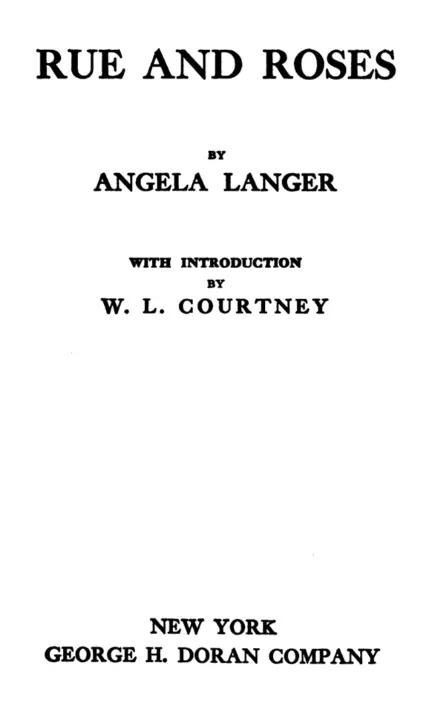
"Rue and Roses" by Angela Langer is a novel written in the early 20th century. The story revolves around Anna, a deeply introspective young woman facing the challenges of her German upbringing, family struggles, and emerging desires for love and a better life. As she navigates her responsibilities as a governess, Anna grapples with loneliness and the societal constraints placed on women, particularly in the context of her unfulfilled dreams and aspirations. The opening of the novel introduces readers to Anna's childhood in a modest, struggling family, highlighted by vivid memories of Christmas and family dynamics that shape her character. As she reminisces about her early experiences, it's evident that Anna's life is marked by a yearning for more — more love, creativity, and autonomy. Her introspective nature drives her to write poetry, serving as both an escape and a reflection of her innermost feelings. The narrative hints at her complex relationship with her family, particularly her father’s failure in business and the burdens of poverty as they move from one home to another. Anna's situation reflects broader themes of female identity and social class, setting a poignant tone for her journey of self-discovery and longing for connection beyond her restrictive environment.
Introduction adapted from the source catalogue; source summaries may be automatically generated.
Free to read · English · 48,764 words · No account needed
MAKE TIME FOR A GOOD BOOK
On by default. Untick to stop anonymous reading totals. Each page counts after 10 seconds in view. How this works.
Anonymous counting is on unless you have switched it off.
I was most anxious to see him next day, but did not meet him, nor the next day, nor the next; on the fourth day, at last.... My first impulse was to run and meet him, but it was arrested by a sweet bewilderment that took hold of me whenever I knew him to be near. It seemed as if he wished to hurry on without taking any notice of me, but then he hesitated, stopped, and lifted his hat. I was struck by the strange coolness of his behaviour, and my heart ached within me.
"How is it," I asked him, "that we see so little of each other?"
He drew a deep breath and looked away from me.
"Because it would be very unwise to see more of each other."
"Why?"
He did not answer at once.
"Because," he said at last, "there are wolves in sheep's clothing."
"I don't understand that."
"Don't you?"
"No."
"I want to caution you."
"What of?"
"Of a wolf that runs about in sheep's clothing and whom you trust."
"Whom do you mean?"
"Myself."
The meaning of his words dawned on me at last, but, filled with a happy, deep-felt trust, I shook my head.
"You are no wolf in sheep's clothing."
He drew a deep breath again, just as he had done before, and looked
hard in front of him.
"You are mistaken. I am a wolf--a heartless, terrible wolf; one that would never hesitate a second to devour a sheep that comes his way without a shepherd and a hound."
I glanced at him, and it seemed to me that his face looked haggard and worn. I grew very quiet and very sad. The whole world looked dark all at once, and the joyous song that, like a glorious promise, had filled my brain and soul ceased with a dissonance.
But then a minute later it rose again, shy and soft, at first no more than a quiver, but gaining force and power until it grew into a thrill of notes so sweet and persuasive that I could and would not check them.
True that there was something crying within me, but the thing that had rejoiced before was rejoicing still.
"Did you get my letter?" I asked him after a while.
"Yes, and many thanks for it."
"May I write to you again?"
He hesitated.
"May I?" I repeated.
"Yes."
It seemed to be wrung from him.
"And you will write back?"
He hesitated again, much longer than before.
"I hardly think so; I mean to say sometimes, perhaps, but never very
much."
"Only sometimes and never very much!"
"Yes; and that only on one condition."
"On what condition?"
Your reading position is saved on this browser. Take it to another device with a library code. Reading pages adapt to text, rather than matching a printed edition.
BEHIND THE BOOK
This eBook is for the use of anyone anywhere in the United States and most other parts of the world at no cost and with almost no restrictions whatsoever. You may copy it, give it away or re-use it under the terms of the Project Gutenberg License included with this eBook or online at www.gutenberg.org. If you are not located in the United States, you will have to check the laws of the country where you are located before using this eBook. Read the source licence.
The original source file, including credits and licence, is retained by this library. Request an original-format copy at no charge. Please include the book title and Project Gutenberg identifier #63947.
KEEP YOUR CURIOSITY GOING
Coulson Kernahan

Maurice Baring
Frances Wright
Cécile Tormay

Frederic Jesup Stimson

W. H. P. (William Henry Pope) Jarvis