THE CLASSIC COLLECTION✦A dead man’s diaryCLASSIC FREE BOOKS
A dead man’s diary
Coulson Kernahan
THE CLASSIC COLLECTION · 1913
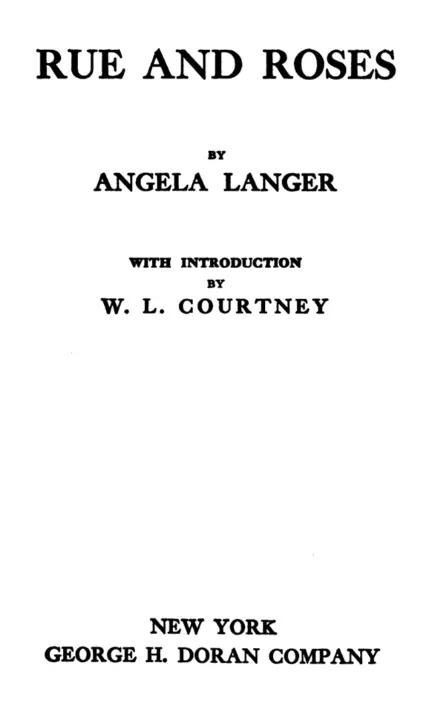
"Rue and Roses" by Angela Langer is a novel written in the early 20th century. The story revolves around Anna, a deeply introspective young woman facing the challenges of her German upbringing, family struggles, and emerging desires for love and a better life. As she navigates her responsibilities as a governess, Anna grapples with loneliness and the societal constraints placed on women, particularly in the context of her unfulfilled dreams and aspirations. The opening of the novel introduces readers to Anna's childhood in a modest, struggling family, highlighted by vivid memories of Christmas and family dynamics that shape her character. As she reminisces about her early experiences, it's evident that Anna's life is marked by a yearning for more — more love, creativity, and autonomy. Her introspective nature drives her to write poetry, serving as both an escape and a reflection of her innermost feelings. The narrative hints at her complex relationship with her family, particularly her father’s failure in business and the burdens of poverty as they move from one home to another. Anna's situation reflects broader themes of female identity and social class, setting a poignant tone for her journey of self-discovery and longing for connection beyond her restrictive environment.
Introduction adapted from the source catalogue; source summaries may be automatically generated.
Free to read · English · 48,764 words · No account needed
MAKE TIME FOR A GOOD BOOK
On by default. Untick to stop anonymous reading totals. Each page counts after 10 seconds in view. How this works.
Anonymous counting is on unless you have switched it off.
After we had done our work we took off our wet overalls, and put on clean pinafores. The cook reached down one of the shining saucepans hanging on the walls, and began to make the coffee, while I went into the dining-room to lay the table. After I had taken in the tray with the hot milk, the steaming coffee, and the cups of white porcelain, the cook and I sat down in the kitchen to take our coffee also. The cook poured out the coffee, and I noticed that her hands trembled a little. She did not speak, and I was silent too, but I could feel that our previous conversation occupied her thoughts. When her cup was empty she put her head into her hands, and looked me straight in the face.
"Then you want to know French?" she asked abruptly.
"Well, it need not be exactly French."
"What else, then?"
"I don't know."
"That's silly. You must know your own mind, to be sure."
"I believe that I should like to learn English," I confessed, much
embarrassed and ashamed.
"I have never heard of a person learning English. Why would you not
rather learn French?"
"No," I said slowly but decisively, "I would much rather learn English."
"I have thought of everything," she continued after a pause; "the mistress must not know about it. She herself has never learnt anything of that sort, and would consider it to be nothing but pride on your part. But it might be managed, nevertheless, if you would learn only in the evening after you have put the children to bed."
"Of course," I cried delightedly; "I would not dream of doing it during the daytime. There is only one thing," I added thoughtfully: "where shall I be able to find a teacher in the evening?"
"A teacher!" cook exclaimed in utter surprise; "do you mean to say that
you want a teacher?"
I lost heart considerably at her question.
"Of course, I am sure it is impossible without a teacher."
"But won't that be too expensive?"
I assumed great indifference at her remark.
"I don't think that it could cost much," I said.
"How much do you think he would charge you?"
"I don't know exactly, but it won't be above a shilling or two."
"But, my dear, you can't afford that."
"Well, let me see. My wages are ten shillings a month, and I do not
need all the money."
"Of course not But you have to think of the future."
"Well, that's just what I am doing."
Your reading position is saved on this browser. Take it to another device with a library code. Reading pages adapt to text, rather than matching a printed edition.
BEHIND THE BOOK
This eBook is for the use of anyone anywhere in the United States and most other parts of the world at no cost and with almost no restrictions whatsoever. You may copy it, give it away or re-use it under the terms of the Project Gutenberg License included with this eBook or online at www.gutenberg.org. If you are not located in the United States, you will have to check the laws of the country where you are located before using this eBook. Read the source licence.
The original source file, including credits and licence, is retained by this library. Request an original-format copy at no charge. Please include the book title and Project Gutenberg identifier #63947.
KEEP YOUR CURIOSITY GOING
Coulson Kernahan

Maurice Baring
Frances Wright
Cécile Tormay

Frederic Jesup Stimson

W. H. P. (William Henry Pope) Jarvis