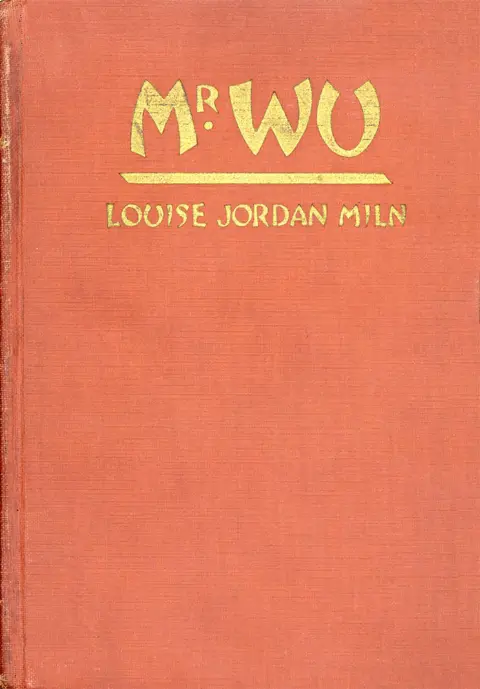
Mr. Wu Based on the Play “Mr. Wu” by H. M. Vernon and Harold Owen
Louise Jordan Miln & Harold Owen & Harry M. Vernon
THE CLASSIC COLLECTION · 1925
"Ruben and Ivy Sên" by Louise Jordan Miln is a novel written in the early 20th century. It centers on a widowed Englishwoman, Ruby Sên, and her two Anglo-Chinese children—Ruben, who looks English, and Ivy, who looks Chinese—as they navigate identity, prejudice, and high society in London. Ruby’s steadfast refusal to remarry, despite Lord Whitmore’s devoted pursuit, frames a family drama about love, loyalty, and belonging. The story especially follows Ivy’s coming-of-age amid social scrutiny and her longing to feel fully English.
The opening of this novel introduces Lord Whitmore’s failed proposal and the divided reactions it sparks: Ivy is angry, Ruben relieved, and the Snows—Ruby’s kinsfolk—recall the costly courage of Ruby’s marriage to the Chinese gentleman Sên King-lo. We see Ivy’s torment over her Chinese features, her plea to Lady Snow to push Ruby into marrying Whitmore so she can claim an English name, and Sir Charles Snow’s quiet watchfulness over the mixed-heritage children. In Dorset, Whitmore comforts Ivy, who begs him to become her stepfather and even to adopt her; meanwhile Ruby, in a rose garden filled with memories of her late husband, gently but decisively refuses Whitmore again. Back in London, Ivy shines at her presentation but is shattered by a slight at the Academy, prompting a raw, painful confrontation with her mother about race, shame, and loyalty; Ivy demands Ruby marry Whitmore, and Ruby refuses. The section ends with Ivy’s calculated, breezy note to a cousin who had mocked her—drawing him into an uneasy visit that reveals both her wit and her wounded pride.
Introduction adapted from the source catalogue; source summaries may be automatically generated.
Free to read · English · 116,528 words · No account needed
MAKE TIME FOR A GOOD BOOK
On by default. Untick to stop anonymous reading totals. Each page counts after 10 seconds in view. How this works.
Anonymous counting is on unless you have switched it off.
While Sên Ruby lives he will be with her at Ashacres. When her spirit has gone to his father’s he will make his last long earthly journey--across the Atlantic, across the Pacific, homing back to Ho-nan to live for Ho-nan, to live for the Sêns. Some boy of his clan shall be his by adoption, that Sên King-lo’s grave and Sên Ruby’s never shall lack descendants to worship at them.
For he will not go back to Ho-nan alone.
He has promised Sên Ruby--she demanded the promise--that her coffin and Sên King-lo’s shall rest in one grave in the old Sên burial garden, beside the grave of Sên Ya Tin, with the temple and pai-fang the old Queen-one of Sênland builded to Sên King-lo, sending their jeweled shafts of love and understanding over the yellow roses, through the quivering bamboos, to lie on their graves.
“BABIES”--peasants, servants.
CASH--a small coin.
CH’IH--a roofless paved courtyard. At great functions it is roofed and
floored.
CHOP--official stamp of a merchant or man of high position. It binds every important Chinese contract and edict.
DRAGON THRONE--the throne of China.
GIRDLE-WEARERS--aristocrats.
GRASS-CHARACTERS--a fine and difficult form of Chinese writing.
HANLIN--a graduate of the Hanlin “college.” One who has passed the highest Peking examinations.
HSIEN-JEN--wiseman, soothsayer, wizard who lives in a hill or mountain.
HSI HUA T’ING--a hall between gardens and walls where ceremonial meals
are served.
I-PANG-LO--a musical instrument.
K’ANG--stove.
KIN--a musical instrument.
K’O-TANG--guest-hall. (In a modest establishment it is the one room of importance, and is put to many social and family uses.)
KO’TOW--prostration of great respect--to kneel and touch the ground with the forehead. (Also written KOT’OW, KOTOW, etc.)
KUEI--the women’s apartments. In good establishments it is a building of many rooms and verandas surrounding a courtyard.
KWAN or KWAN YIN-KO--the goddess of mercy. (There are varied
spellings.)
LAMPS-OF-MERCY--fire-flies.
LANG--roofed passage.
LI--a Chinese measurement of distance, about one-third of a mile.
MEI-JÊN--match-maker, go-between, marriage broker.
PAI-FANG--a memorial arch of great honor, usually in commemoration of some act of great sacrifice.
PAN-KOU--a musical instrument.
RUYIE--an emblem of good luck, often made of jade. It never is large, but usually beautiful, and may be very valuable.
SACRED PRISONER--the Emperor of China.
SHU-CHIA--“Reverence books”--library, reading-room.
“SILKS”--paintings. The greatest Chinese artists have painted on silk.
SON OF HAN--a Chinese. They hold it their proudest title, except the Cantonese who do not so style themselves.
SON OF HEAVEN--the Emperor.
SPIRIT WALL--a devil screen placed outside an entrance to prevent evil spirits from entering.
TA JEN--a great man--a man of importance.
Your reading position is saved on this browser. Take it to another device with a library code. Reading pages adapt to text, rather than matching a printed edition.
Louise Jordan Miln & Harold Owen & Harry M. Vernon
Louise Jordan Miln
Louise Jordan Miln
Louise Jordan Miln
BEHIND THE BOOK
This eBook is for the use of anyone anywhere in the United States and most other parts of the world at no cost and with almost no restrictions whatsoever. You may copy it, give it away or re-use it under the terms of the Project Gutenberg License included with this eBook or online at www.gutenberg.org. If you are not located in the United States, you will have to check the laws of the country where you are located before using this eBook. Read the source licence.
The original source file, including credits and licence, is retained by this library. Request an original-format copy at no charge. Please include the book title and Project Gutenberg identifier #77722.
KEEP YOUR CURIOSITY GOING
Coulson Kernahan

Maurice Baring
Frances Wright
Cécile Tormay

Frederic Jesup Stimson

W. H. P. (William Henry Pope) Jarvis